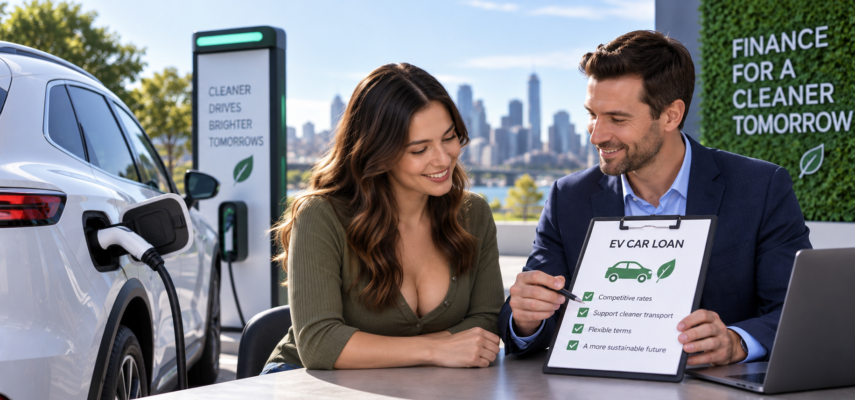

Electric vehicles are moving from a specialist category into the mainstream in several markets, and Australia has shown how quickly that shift can affect adjacent industries. As more drivers consider battery-electric and plug-in hybrid vehicles, lenders are creating financing products tailored to the changing car market.
Vehicle finance is becoming another way for lenders to compete for customers, shape their sustainability positioning and respond to changes in what people are buying.
EV growth is changing finance demand
Australia’s EV market has accelerated sharply in 2026. In August, battery electric vehicles accounted for 24.9% of new vehicle sales, while battery electric and plug-in hybrid vehicles together reached 36% of the market. Australia also surpassed 500,000 battery-electric vehicles on the road in September.
As that customer base expands, finance becomes part of the adoption story. Buyers comparing EV costs aren’t just looking at the purchase price; they’re also weighing loan rates, fees, charging costs and ongoing vehicle expenses. This gives lenders room to differentiate themselves with products like green car loans, provided the pricing and eligibility rules offer a meaningful alternative to standard vehicle finance.
Almost 200 EV models are also now available in Australia, giving buyers more choice across price points, sizes and features. EV finance is therefore becoming relevant to a broader part of the vehicle market rather than only a narrow premium segment.
Lenders are building EV-specific products
Lenders have started offering loan products specifically designed for eligible electric vehicles. These products can feature different interest rates, fees, or eligibility criteria than conventional car loans.
Let’s look at Gateway Bank, for example. At the time of writing, InfoChoice lists Gateway Bank’s Green Car Loan at 6.44% p.a., with a 6.65% comparison rate. Its standard Car Loan is listed at 7.69% p.a., with a 7.90% comparison rate. Rates can change, but the difference illustrates how a lender can use EV-specific pricing to differentiate a green finance product from its broader vehicle-lending offering.
The distinction is important. Rather than treating every car purchase the same way, lenders can create products tailored to a growing category and use pricing, eligibility, and product features to make the offer more relevant to EV buyers.
Demand for EV finance is becoming more visible
Lending data suggests that interest in EV-specific finance is rising alongside vehicle sales. CommBank reported that, from 1 March 2026, new loan volumes for battery-electric vehicles were 161.5% higher than the weekly average recorded in February. Average daily visits to its EV Car Loan product page also increased by 75% in March compared with February.
A short-term spike does not prove that EV lending will continue growing at the same pace. It does, however, show that shifts in vehicle demand can quickly appear in finance enquiries and lending activity.
For lenders, this creates a reason to watch the EV market as more than an automotive trend. Changes in what consumers buy can influence which finance products receive attention, how lenders position those products and where competition develops.
Green finance is also a positioning decision
Discounted EV finance isn’t simply a sustainability message; it can also function as a product-positioning strategy. When several lenders offer conventional car finance, a dedicated EV loan gives a provider another point of difference. A lower rate for an eligible electric vehicle can make the product easier to distinguish, while the green label signals the type of purchase the lender wants to support.
For brands in financial services, that matters because product design and brand positioning are closely connected. Sustainability claims can feel abstract when they sit only in corporate messaging. A finance product tied to a specific customer action gives that positioning a practical expression.
That does not mean every green loan is automatically a better value. Rates, comparison rates, fees, loan terms and eligibility still need to be assessed on their own merits. The broader point is that EV growth is giving lenders another category around which to build and communicate a differentiated offer.
What the shift means for auto lending
The rise of EVs is adding another layer of segmentation to vehicle finance. Instead of competing solely on standard car-loan pricing, lenders can respond to a changing vehicle mix by offering products tailored to specific technologies or purchase types.
Australia’s recent sales figures show how quickly that opportunity can expand. The pattern should not be treated as identical across countries, since EV adoption, incentives, vehicle prices, and lending conditions vary by market.
However, the underlying relationship is relevant more broadly: when a fast-growing vehicle category shifts what consumers buy, finance providers have an incentive to adjust how they package and position their lending products.
For the auto-lending market, rising EV sales therefore mean more than financing a different kind of car. They are creating space for new product categories, new pricing strategies and new ways for lenders to compete. As EV adoption continues to grow, lenders participating in this segment will need to keep testing whether their products align with market economics and expectations.