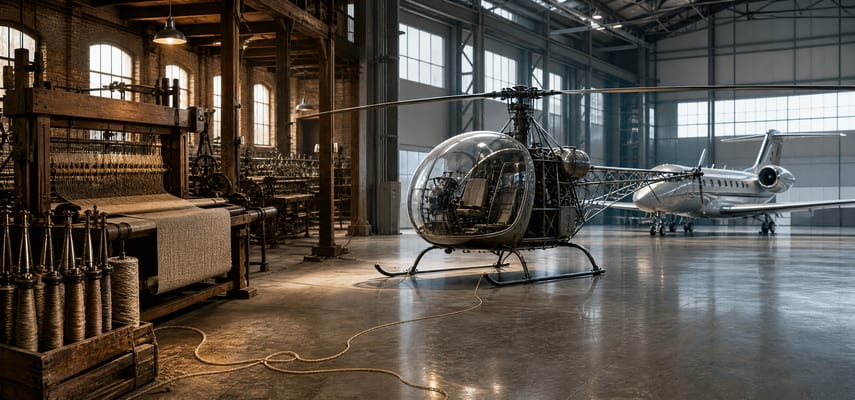
History of Textron
Textron is the story of an American maker that began in textiles and, through calculated bets and a hunger for diversification, remade itself into an aerospace, defense and light-industrial group. Its trajectory — from a small yarn concern to an owner of helicopters, business jets and defense systems — tracks broader shifts in 20th‑ and 21st‑century American industry: the rise of the conglomerate, deindustrialization, military contracting, and a cautious embrace of electrification and advanced air vehicles. The company’s history is as much about opportunistic acquisitions as it is about the limits of diversification and the discipline of later refocusing.
Founding and early years: from yarns to ambition (1923–1940s)
Textron’s roots lie in a Boston textile firm founded in 1923. Its founder, Royal Little, built a modest business producing specialty fabrics and yarns for apparel and industrial uses. Like many New England manufacturing entrepreneurs of the era, Little was disciplined about margins and operations; he also proved unusually willing to experiment with acquisitions outside the firm’s original business.
During the interwar and wartime decades the company navigated the ups and downs of textile markets and the pressures of wartime production. That experience — managing factories, supply chains and labor — provided organizational muscle that Little later leveraged when he began acquiring companies in unrelated fields. The shift away from a single-product company toward a diversified industrial firm did not happen overnight, but the pattern of buying businesses with stable cash flows and experienced managers began to take shape in the 1940s and 1950s.
Royal Little and the birth of the conglomerate idea (1950s–1960s)
Royal Little deserves credit for popularizing a model of acquisition-driven growth that became fashionable in mid‑century corporate America: buy established businesses in industries with differing cycles, consolidate overhead, and let each unit run with a light centralized hand. Little himself later used the phrase “diversified company” to describe his approach, and financial historians often cite his work as a precursor to the conglomerate boom of the 1960s.
That strategy mattered because it turned a regional textile maker into a vehicle for industrial consolidation. Textron’s managers looked for businesses with predictable earnings that could withstand the cyclical swings of textiles. The method insulated the firm from the vulnerability of relying on a single product line, but it also planted the seeds of later managerial challenges: running unrelated businesses through financial engineering rather than common technical competence would test the organization’s capacity as it grew.
Acquisition of Bell and the move into aerospace (1960)
A decisive turning point came in 1960, when Textron acquired Bell Aircraft Corporation, whose businesses included Bell Helicopter. The purchase shifted Textron’s center of gravity toward aerospace and defense. Bell Aircraft, already associated with important fixed-wing and rotorcraft developments, gave Textron entry to technology‑heavy manufacturing and government contracts.
Why this mattered: aerospace and defense offered higher margins and longer contract horizons than commodity textiles. It also exposed Textron to the strategic imperative of investing in engineering and program management rather than just financial oversight. The Bell deal anchored Textron’s identity for decades: by owning a major helicopter manufacturer, Textron joined a smaller, more specialized club of industrial firms that mixed commercial products with defense work.
Diversification into engines, industrial products and defense (1960s–1980s)
After Bell, Textron continued to amass businesses across a range of segments. It built a portfolio that included aircraft components, light vehicles, materials handling and industrial products. Over time the company organized these holdings into operating groups rather than trying to integrate them into a single line of business — a pragmatic choice that reflected both the company’s steady‑acquisition pattern and the managerial limits of running widely disparate operations.
Two features of this period are worth noting. First, defense contracts began to represent a stable and often counter‑cyclical revenue stream, especially during the Cold War, which made the Bell acquisition increasingly strategic. Second, the company’s approach to acquisitions — buying strong, if unrelated, businesses and leaving day‑to‑day control largely in place — kept overhead low but required executives at headquarters to become adept at capital allocation and portfolio management.
Reorganization and market pressures (1990s–2000s)
By the 1990s, the conglomerate model that had served Textron well faced new scrutiny. Globalization, defense drawdowns after the Cold War, and investor demands for clearer strategic narratives pushed many diversified companies to re-examine the coherence of their portfolios. Textron, too, undertook restructurings: it streamlined certain operations, divested non-core businesses, and sought higher returns from its aerospace and industrial units.
Management during this period focused on integrating technology capabilities, improving procurement and consolidating manufacturing where sensible. For a company that had grown by acquisition, the challenge was to turn a loose federation of business units into a set of higher‑performing enterprises without losing the nimbleness that had driven earlier growth.
Leadership change and a renewed strategic focus (2009–2026)
A significant leadership transition occurred in December 2009, when Scott C. Donnelly became chief executive officer. Donnelly had come to Textron with experience at other industrial firms and steered the company through the aftermath of the global financial crisis. Under his leadership Textron sharpened its priorities around aviation, defense and industrial businesses. Lisa M. Atherton succeeded Donnelly as president and CEO on January 4, 2026, while Donnelly became executive chairman of the board.
That refocusing was not just rhetorical. Management invested selectively in aerospace capabilities, pushed for higher operational discipline and repositioned the firm to capture market opportunities in business aviation, military rotorcraft, and light vehicles. Donnelly’s era also saw Textron become more active in targeted acquisitions that complemented its aerospace footprint.
The Beechcraft and Cessna move: creating Textron Aviation (2014)
One of the most consequential recent moves came with Textron’s acquisition of Beechcraft, a well‑known general aviation manufacturer with a heritage of business and military planes. The deal, completed in 2014, brought Beechcraft’s models and customer base together with Cessna — an established light and business aircraft brand that Textron already owned — to form Textron Aviation.
Why this mattered: the consolidation created a single operating group with a broad spectrum of products, from single‑engine pistons through turboprops to business jets. That scale allowed Textron to rationalize manufacturing, consolidate sales and support networks, and present a fuller product portfolio to operators and corporate buyers. Importantly, it also preserved two of general aviation’s most storied names under one corporate roof, a move with clear brand and aftermarket implications.
Looking toward electric flight: Pipistrel and other initiatives (2022)
Textron’s acquisition of Pipistrel in 2022 signaled a distinct interest in new propulsion technologies and small electric aircraft. Pipistrel, a Slovenian manufacturer known for light aircraft and electric prototypes, offered Textron a foothold in the nascent electric and light‑sport segments.
The purchase mattered less for immediate revenue than for capability: it gave Textron access to electric‑propulsion engineering, battery integration experience and a portfolio of small aircraft designs. For a century‑old manufacturer, investing in these technologies represented an acknowledgement that powertrain architectures in aviation were shifting, and that incumbents needed engagement with innovators to avoid falling behind.
Textron’s brands and business units: what the company owns
Over its history Textron assembled a set of recognizable operating names. While the composition of the portfolio has changed with acquisitions, divestitures and internal realignments, several brands have been central to the company’s identity:
- Bell — rotorcraft and vertical‑lift research, long associated with military and civil helicopters and tiltrotor aircraft.
- Textron Aviation — the aircraft business that includes the Cessna and Beechcraft product lines and, following a 2026 segment realignment, Pipistrel. Its products include piston aircraft, turboprops, business jets and military aircraft.
- Textron Systems — the defense group whose offerings include electronic systems, unmanned aircraft, advanced marine craft, aircraft engines, weapons, training services, and manned and unmanned specialty vehicles.
- Industrial businesses — Kautex and Textron Specialized Vehicles, which make automotive systems and components, golf cars, utility vehicles, turf-care vehicles and aviation ground-support equipment.
Effective January 4, 2026, Textron eliminated Textron eAviation as a separate reporting segment and moved Pipistrel primarily into Textron Aviation, while placing certain military aviation activities within Textron Systems. Textron’s other reporting segments were Bell, Industrial and Finance. In April 2026 the company announced plans to separate its Industrial segment, and in July it said that it had initiated a sale process; the separation had not yet been completed.
Recent years: adapting to market shifts and technological change (2019–2026)
In the past half‑decade Textron has balanced near‑term business pressures with long‑range bets. The pandemic years hit general aviation and business travel, prompting careful management of production lines and inventories. Simultaneously, Textron continued to pursue advanced aerodynamic concepts and propulsion technologies.
Bell’s long‑term work on novel vertical‑lift concepts and on hybrid/electric demonstrators placed the company amid a competitive field of established aerospace firms and startups chasing next‑generation air mobility. For Textron as a whole, that research underscores a strategic tension: how much to invest in speculative, high‑capital projects versus taking the safer route of improving current product lines and aftermarket services.
On the defense side, Textron Systems remained active in electronic systems, unmanned aircraft, advanced marine craft, and manned and unmanned specialty vehicles for military and government customers. Those programs support ongoing engineering and production work.
Why Textron’s story matters
Textron illustrates several broader themes in American industry. First, it shows the evolution and eventual retrenchment of the conglomerate idea: diversification can protect against cyclical risk, but running unrelated businesses requires genuine industrial competence, not just financial skill. Second, the company demonstrates how defense work can reshape a manufacturer’s identity — Bell’s rotorcraft business gave Textron a new technological center of gravity. Third, Textron’s recent acquisitions and investments highlight how legacy manufacturers must engage with electrification and advanced air vehicles to remain relevant.
Beyond strategic lessons, Textron’s history is also about organizational adaptation. The firm moved from a founder’s shop to a multiunit corporation, navigated leadership transitions, absorbed marquee aviation brands, and learned to integrate small, innovative firms. Those shifts reflect the tradeoffs executives face when marrying short‑term performance with long‑term technology bets.
Challenges and limits
Textron’s path has not been uniformly upward. Diversification sometimes produced complexity more than value, and aerospace is a field of long lead times and high capital needs. The company’s heavy engagement with defense markets invites political risks tied to defense budgets and procurement cycles. In aviation, competition is intense and certification processes are slow and costly; integrating brands like Beechcraft and Cessna required substantial aftermarket and support commitments.
Moreover, moving into electric and hybrid flight involves deep technical hurdles: batteries, certification frameworks and infrastructure remain constraints. Textron’s strategy of acquiring firms with relevant technology — such as Pipistrel — is one way to mitigate that gap, but the transition to new propulsion models is evolutionary and expensive.
What comes next
Looking forward, Textron’s immediate prospects depend on execution in three areas: managing the operational performance of its aircraft businesses; winning and sustaining defense contracts that reward long‑term investment; and judiciously advancing next‑generation technologies without overcommitting capital. Success will require combining the company’s traditional strengths in manufacturing and program execution with more agile approaches to technology development.
For observers of corporate history, Textron will remain an instructive case: a company that started in textiles, embraced diversification, anchored itself in aerospace, and now must navigate a future in which propulsion and air‑vehicle architecture may evolve as substantially as the firm’s own purpose did over the last century.
Conclusion
Textron’s history is a study in reinvention. From a 1923 yarn business in New England to an owner of helicopters, business aircraft and defense systems, its story traces the rise of the conglomerate, the pull of aerospace technologies, and the modern imperative to adapt to electrified and autonomous flight. The company’s successes and challenges show how acquisition discipline, engineering depth and strategic patience combine to shape the destiny of an industrial corporation across generations.