










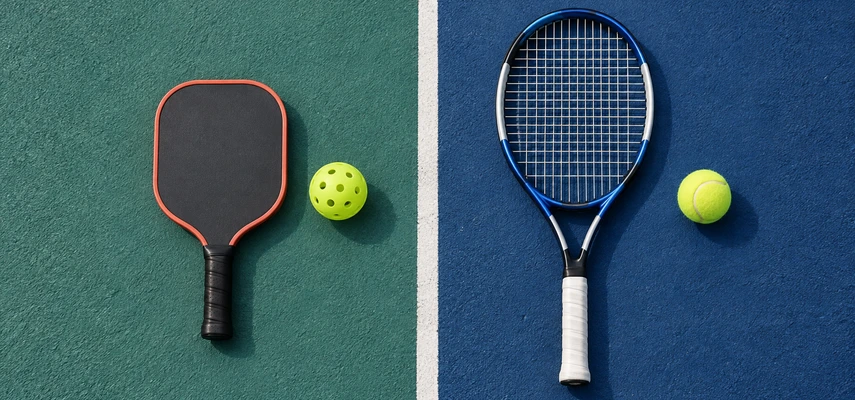

A tennis player walks onto a pickleball court and sees familiar things: a net, painted lines, someone waiting to return a serve. Then the first return comes back, they charge forward to volley it, and the rally ends with an explanation rather than a winner.
The ball needed to bounce first. Welcome to the family resemblance—and the family differences.
Pickleball and tennis reward timing, placement, anticipation, and the ability to send one more ball back. But equipment, court geometry, and a few decisive rules change how those skills fit together. Understanding those differences is more useful than declaring one sport a smaller version of the other. Each offers its own satisfying problems to solve.
The court changes the conversation
A regulation pickleball court measures 20 feet wide by 44 feet long for both singles and doubles. Tennis uses a 78-foot length, with a width of 27 feet for singles and 36 feet for doubles. Those figures describe the playing rectangles, not the additional space players need around them. The dimensions appear in the 2026 pickleball rulebook and the 2026 Rules of Tennis.
The difference is more than a maintenance department’s paving bill. A tennis player can be pulled across a substantial baseline and then drawn forward with a short ball. Doubles partners have extra width to protect. In pickleball doubles, four players share a smaller rectangle, making gaps between people and the space near their feet especially important.
A shorter distance can also mean less reaction time during a fast exchange. Smaller doesn’t automatically mean slower in every moment. Two people trading controlled shots can seem wonderfully unhurried until one ball rises high enough to invite an attack.
The courts divide useful space differently, too. Tennis service boxes matter when the point starts, but they aren’t permanent restrictions on volleying. Pickleball’s kitchen remains relevant throughout the rally.
For the basic shape of a rally before comparing sports, start with the introduction to pickleball.
A paddle isn’t a strung racket
Tennis uses a strung racket and a felt-covered ball. Pickleball uses a solid-faced paddle and a hollow plastic ball with holes. Place them side by side and the differences become obvious before anyone swings.
The tennis racket’s string bed deforms during contact; the frame, strings, tension, and ball contribute to the response. A pickleball paddle’s face and core create a different impact system. Modern paddles vary considerably, so solid-faced doesn’t mean that every paddle feels rigid, dead, or identical.
The balls behave differently in flight and after a bounce. You shouldn’t transfer a tennis swing and assume the same contact point, rebound, and travel will follow. Wind and temperature can affect outdoor play in both sports, and a perforated plastic ball isn’t a miniature tennis ball with an unusual haircut.
For a beginner, the takeaway is practical: allow time to recalibrate. Try easy exchanges before seeking maximum pace. Notice how far the ball travels from a modest swing and how it arrives after bouncing. USA Pickleball’s equipment overview introduces the paddle-and-ball combination without requiring a materials-engineering degree.
Serving starts two different kinds of point
In tennis, the overhead serve can be a major attacking weapon. A server ordinarily has two attempts to put a legal serve into the diagonal service box. A service let, such as a serve touching the net and otherwise landing correctly under standard rules, is replayed. Alternative formats can modify procedures, so check an event’s rules.
Pickleball starts diagonally as well, but normally gives the server one attempt. A legal serve that touches the net and lands correctly beyond the non-volley zone remains playable. There isn’t a routine second serve waiting to rescue a miss.
Pickleball permits a volley serve, struck before the ball bounces, with specific swing and contact restrictions. It also permits a drop serve, struck after a legally released ball bounces; the same three volley-serve swing restrictions don’t apply. Neither is simply tennis serving with a smaller racket. The official pickleball rules summary describes the methods.
The distinction matters even if you’re experienced at another racket sport. Tennis skill can help you coordinate the action, but it doesn’t override legal serving requirements. Learn the actual motion with a qualified instructor rather than trying to negotiate with the rulebook after contact.
Why the server can’t just follow the ball in
Pickleball’s two-bounce rule requires the receiving side to let the serve bounce, then the serving side to let the return bounce. Only afterward can players volley, subject to the kitchen rules.
In tennis, a receiver must let the serve bounce, but the server may volley the return. That makes serve-and-volley a legitimate point construction. In pickleball, charging the net after serving can leave a deep return behind you while you’re still obliged to wait for its bounce.
Think of the opening as a different traffic pattern. The sports may share an intersection, but they don’t share all the right-of-way rules. Good anticipation includes remembering which game you’re playing.
The kitchen makes soft shots useful
Pickleball’s non-volley zone extends seven feet from the net on each side. You can enter it and play a ball after a bounce. What you can’t do is volley while touching the zone, including its lines, or allow volleying momentum to carry you into prohibited contact.
Tennis has no equivalent seven-foot buffer. A net player can move close and volley, which changes the angles available to both attacker and defender. That doesn’t mean tennis lacks soft touch. Drop shots, angled volleys, and defensive slices are familiar parts of the game. The difference is the rule-shaped environment in which touch operates.
In pickleball, a well-placed dink descends into the kitchen and can force an opponent to hit upward from low contact. A drop can seek a similar landing area from farther back. These shots often aim to limit the reply or buy time to improve position rather than end the rally immediately.
A useful comparison is to doors. Power tries to push through an opening; placement can make the other person open it for you. Both sports use that idea, but the kitchen gives pickleball a distinctive way to keep the door inconveniently low.
Scoring follows different architecture
Tennis ordinarily builds a match from points, games, and sets. The familiar point sequence is love, 15, 30, 40, with standard advantage scoring requiring a two-point margin from deuce. Tie-breaks use numerical counting, and approved formats include alternatives such as no-ad scoring and shorter sets. Knowing one television tournament’s format doesn’t cover every match.
Traditional pickleball uses side-out scoring: only the serving side can add points. Games commonly finish at 11 with a two-point margin. A receiving side can win a rally without adding a point, because that success changes service rather than its score.
In doubles, the score call normally has three numbers: serving score, receiving score, and whether the current server is the team’s first or second server in that service sequence. That third number isn’t a third team’s score, however crowded the court might feel initially.
Rally-scoring pickleball formats also exist. Under those, the side winning a rally scores, with service and event procedures that should be checked separately. USA Pickleball’s side-out guide introduces the traditional system.
What transfers—and what needs adjusting
Experience tracking a moving ball, recovering after contact, and recognizing open space can help in either direction. A tennis player may arrive with reliable footwork and an understanding of spin. A pickleball player may bring compact volley control, patience during exchanges, and a habit of reading opponents’ preparation.
Those are starting advantages, not automatic competence. Different equipment changes spacing; different rules change the next sensible position. An ingrained tennis backswing may be more preparation than a close pickleball exchange permits. A comfortable pickleball block may not supply the depth needed from a tennis baseline.
Watch the incoming ball before deciding the stroke. If a familiar movement keeps producing an unfamiliar result, shorten the task: rally cooperatively, choose a large target, and change one thing at a time. Coaching can distinguish a useful adjustment from a compensation that creates another problem.
Which one is easier to start?
Pickleball can offer a welcoming entry through a compact court, borrowed equipment, and cooperative doubles. Tennis can also be adapted for beginners using slower balls, smaller playing areas, and suitable instruction. The ITF’s Play and Stay program emphasizes making serving, rallying, and scoring accessible to newcomers.
Ease depends on the learner, the session, and what success means. Keeping five gentle exchanges going is a different goal from returning a competitive serve. A friendly pickleball group may be easier to join than an advanced tennis league; the comparison reverses if the tennis session is designed for newcomers and the pickleball court isn’t.
Neither sport guarantees low physical demand. Singles coverage, doubles reactions, repeated stopping, and lateral changes of direction can all be challenging. Choose appropriate footwear, check the surface, warm up, and increase playing time gradually. USA Pickleball’s safety guidance also recommends protective eyewear. Existing injuries or health concerns deserve individualized professional advice.
Choose the experience you want
If you’re deciding where to begin, consider the people and opportunities near you. Is there an introductory lesson? Can you borrow equipment? Are beginners welcomed into a clearly explained rotation? Will the group play at a pace you can manage?
You don’t need to choose a permanent sporting identity. Try a well-run session of each. Notice whether you enjoy the longer geometry of tennis, the close negotiation of pickleball, or both.
The useful comparison isn’t which sport wins an argument online. It’s what happens when you understand the rules well enough to stop thinking about every one of them. A ball arrives, you see an opening, and you send something thoughtful back. The pleasure is related. The path to it is delightfully different.











