










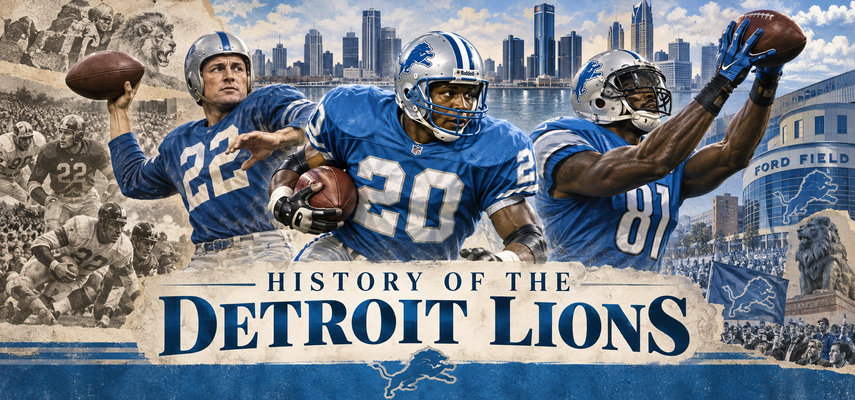

The Detroit Lions connect an early small-city NFL beginning with a long Motor City history of championships, exceptional players and difficult rebuilding. Dutch Clark helped establish the team after its move from Portsmouth, while Bobby Layne and a deep supporting cast shaped the championship years of the 1950s. Barry Sanders and Calvin Johnson later supplied extraordinary individual excellence without another league title. More recent contenders restored expectations after decades of disappointment. This history follows the continuing franchise through the completed 2025 season, distinguishing its four earlier NFL championships from later postseason progress and the still-unfinished competition of the 2026 campaign.
Franchise at a glance
| Field | Details |
|---|---|
| Founded | 1930; Portsmouth Spartans admitted to the NFL |
| First season | 1930, National Football League |
| Original city and name | Portsmouth, Ohio — Portsmouth Spartans |
| Current city and name | Detroit Lions; Detroit, Michigan |
| Previous cities and names | Portsmouth Spartans, 1930–1933; moved to Detroit in 1934 |
| League and conference/division | NFL — National Football Conference North |
| Home venue | Ford Field; opened in 2002 |
| League championships | 4 pre-Super Bowl NFL titles: 1935, 1952, 1953, 1957 |
| Other recognized championships | No Super Bowl victory or NFC championship through the completed 2025 season |
| Historical coverage | 2025 NFL season, including postseason completed in February 2026; later developments through October 16, 2026 |
Origins and early years
The Portsmouth Spartans entered the NFL in 1930, bringing an established local football effort into the professional league. Their competitive rise included the 1932 indoor playoff against Chicago, a game arranged to decide the championship standings. Financial limitations nevertheless made the team’s small-city position difficult to sustain. Radio executive George Richards bought the franchise and moved it to Detroit in 1934.
The Lions name connected the football team to a city already identified with the baseball Tigers, while preserving the Spartans’ franchise record. Earlier Detroit NFL clubs were separate organizations rather than predecessors whose results should be added to the Lions. Dutch Clark gave the relocated team an exceptional player and leader, and a Thanksgiving game in its first Detroit season helped create a lasting place in the sporting calendar. The team won the NFL championship in 1935, immediately giving the new market a substantial football achievement. The later record therefore begins in Portsmouth but includes a distinct Detroit identity built through early success, broadcasting and a recurring public tradition.
Defining eras
1930–1949: Portsmouth’s contenders become Detroit’s Lions
The Spartans developed into a serious contender before the move, with their 1932 loss to Chicago becoming an important game in the league’s structural development. Detroit inherited that competitive foundation and added a larger market. Richards used his broadcasting connections to help bring national attention to the Thanksgiving fixture, making the team’s public presence more substantial than its local gate alone.
The 1935 Lions defeated the New York Giants 26–7 for the franchise’s first NFL championship. Clark’s all-around ability helped define a team that could run, pass and kick effectively within the era’s demands. Later seasons did not sustain the same level of success. Coaching and personnel changes, followed by wartime disruption, made the 1940s uneven. The organization nevertheless remained established in Detroit, moving into the baseball Tigers’ ballpark in 1938. By the end of the decade it had a durable local home and identity, but the next championship team would require a different generation of players and leadership.
1950–1957: The championship years
Buddy Parker’s teams developed around quarterback Bobby Layne, versatile back Doak Walker and an exceptional collection of linemen and defenders. Players such as Lou Creekmur, Jack Christiansen, Yale Lary and Joe Schmidt gave Detroit strength beyond its famous quarterback. The Lions won consecutive NFL championships against Cleveland in 1952 and 1953, then lost the next title-game meeting to the Browns. The rivalry supplied some of the decade’s defining professional football contests.
The 1957 championship came through another route. Parker left before the season, George Wilson became head coach and Tobin Rote took over after Layne was injured. Detroit recovered from a large deficit against San Francisco in the conference playoff, then defeated Cleveland 59–14 for its third title of the decade. The victory demonstrated the depth of the roster and the importance of Rote’s contribution. It should not be presented as another championship directed on the field by Layne. Four overall NFL titles now anchored the franchise’s record, but another league championship would prove elusive.
1958–1988: Strong individuals and limited postseason success
Detroit traded Layne to Pittsburgh in 1958, beginning a long period in which exceptional individual players did not consistently produce championship-level teams. The defense remained capable of major performances, including the 1962 Thanksgiving victory over Green Bay. Schmidt, Lem Barney, Dick Lane and others helped sustain a reputation for talented defenders. The team nevertheless struggled to convert that talent into postseason success.
The Lions reached the playoffs after the 1970 season but lost a low-scoring game at Dallas. A move from Tiger Stadium to the Pontiac Silverdome in 1975 changed the home environment without immediately changing the competitive direction. Billy Sims later supplied a major running threat, and the 1983 team won its division before losing narrowly at San Francisco. That opportunity did not develop into a lasting contender. Detroit’s history increasingly became a contrast between memorable players and a team unable to return to its earlier championship level. The next great individual arrival would sharpen that contrast while producing another important postseason breakthrough.
1989–1998: Sanders and the closest modern breakthrough
Barry Sanders arrived in 1989 and immediately gave Detroit a running back whose balance and improvisation could transform broken plays into major gains. Wayne Fontes built an offense around that threat, and the 1991 team finished 12–4 despite major adversity within the roster. The Lions defeated Dallas 38–6 in the divisional round for their first playoff victory since the 1957 championship.
Washington then won the NFC Championship Game, stopping Detroit short of its first Super Bowl. Other playoff appearances followed during the decade without another victory. Sanders remained the central attraction, surpassing 2,000 rushing yards in 1997 and sharing AP NFL MVP honors with Brett Favre. His retirement before the 1999 season abruptly ended a career spent entirely in Detroit. The era supplied the franchise’s strongest modern postseason run to that point, but its significance also rests on the enduring gap between Sanders’s exceptional individual production and the team’s inability to build a complete championship roster around him.
1999–2020: Collapse and the Stafford–Johnson years
The period after Sanders brought repeated rebuilding projects and declining results. Detroit moved into Ford Field in 2002, returning its home games downtown. The new venue did not immediately repair the football operation. The 2008 team finished 0–16, marking the lowest competitive point of an extended difficult period and making another reconstruction unavoidable.
Matthew Stafford arrived as the first overall draft choice in 2009 and eventually formed a remarkable passing partnership with Calvin Johnson. Jim Schwartz’s 2011 team reached the playoffs, and Jim Caldwell later guided two more postseason appearances. None produced a playoff victory. Johnson retired after the 2015 season with an exceptional individual record, while Stafford continued through 2020. The subsequent Matt Patricia era failed to sustain contention. By the end of that period, the organization again needed a clearer direction. Detroit had produced another generation of nationally prominent offensive players, but the wider team still had not recreated the postseason success achieved in 1991.
2021–2025: Campbell restores expectations
The Lions appointed Dan Campbell and general manager Brad Holmes in 2021, while trading Stafford to the Rams in a deal that brought Jared Goff and draft resources to Detroit. The first season was difficult, but subsequent improvement gave the rebuilding process credibility. A strong offensive line, Goff’s recovery and younger contributors such as Amon-Ra St. Brown and Aidan Hutchinson helped create a more balanced team.
The 2023 Lions won the NFC North and defeated the Rams and Tampa Bay in the playoffs. San Francisco then overcame a large deficit to win the NFC Championship Game 34–31. Detroit followed with a 15–2 regular season in 2024 but lost its divisional playoff to Washington. The 2025 team slipped to 9–8 and missed the postseason. Those results did not erase the revival, but they showed why renewed contention should not be described as a championship already secured. The organization had restored expectations whose fulfillment remained an open competitive task.
Recent history
The latest completed season is 2025, when Detroit finished 9–8 and missed the playoffs after consecutive NFC North titles. The closing win at Chicago left the team with a winning record but did not extend its season. Its most recent playoff appearance remained the 2024 campaign, which ended against Washington in the divisional round.
As of October 16, 2026, Dan Campbell remained head coach, Brad Holmes continued leading personnel and the next season was underway. Its final result and postseason outcome were still undecided. Ford Field remained the home venue. The completed franchise record still contained four pre-Super Bowl NFL titles, with no NFC championship or Super Bowl appearance. The recent revival had made those absences feel more immediate, while the 2025 setback reinforced the difference between building a credible contender and sustaining championship-level performance over several seasons.
Greatest players and influential figures
Dutch Clark
Clark supplied exceptional all-around play during the Portsmouth years and the early Detroit period. His running, passing, kicking and leadership helped establish the relocated team and its 1935 championship. His contribution belongs to the franchise’s foundational identity, before specialization changed the way later professional football positions were played.
Bobby Layne
Layne gave the 1950s Lions their defining quarterback personality and led the 1952 and 1953 championship teams. His competitive leadership remains central to the franchise’s strongest era. Injury kept him from directing the 1957 postseason title run, so Tobin Rote’s contribution to that championship must remain distinct.
Doak Walker
Walker supplied versatility as a runner, receiver and kicker during Detroit’s early-1950s championship period. His partnership with Layne gave the offense several ways to create points. His entire NFL playing career belonged to the Lions, and the team later retired his No. 37 in recognition of that contribution.
Joe Schmidt
Schmidt became the defensive organizer whose range and intelligence helped define Detroit’s strongest teams. His playing career included the 1953 and 1957 NFL championships, and he later served as head coach. Those are separate forms of contribution within a long association that the franchise recognized by retiring his No. 56.
Barry Sanders
Sanders transformed the Lions’ offense through exceptional balance, acceleration and improvisation. His career included the 1991 conference-final run and the 1997 season in which he surpassed 2,000 rushing yards and shared AP MVP honors. His entire professional playing career belonged to Detroit, despite the absence of a league championship.
Calvin Johnson
Johnson supplied an exceptional receiving threat whose size, speed and production shaped the Stafford-era offense. His 2012 receiving-yardage record became a defining individual achievement. The early retirement and lack of a playoff victory belong to the broader account of a Detroit career whose excellence exceeded the team’s competitive results.
Buddy Parker
Parker coached the Lions to consecutive NFL championships in 1952 and 1953 and helped assemble the franchise’s strongest sustained contender. His teams combined offensive personalities with substantial defensive talent. He left before the 1957 season, so that later championship belongs to George Wilson’s coaching tenure rather than his own.
Dan Campbell
Campbell helped turn a prolonged rebuilding period into renewed division and postseason contention. His 2023 team won two playoff games and reached the NFC Championship Game, followed by another division title in 2024. Those completed achievements remain substantial without being described as an NFC or Super Bowl championship.
Championships and postseason milestones
All four Lions league titles were won before the Super Bowl era. The 1991 and 2023 teams later reached the NFC Championship Game but lost, so neither added a conference title. The championship table identifies the earlier opponents and scores; postseason progress in the modern era remains a separate part of the record.
On smaller screens, scroll horizontally to see all columns.
| Season/year | Competition | Opponent | Result | Defining figure(s) |
|---|---|---|---|---|
| 1935 | NFL Championship | New York Giants | Won 26–7 | Dutch Clark; Potsy Clark |
| 1952 | NFL Championship | Cleveland Browns | Won 17–7 | Bobby Layne; Doak Walker; Buddy Parker |
| 1953 | NFL Championship | Cleveland Browns | Won 17–16 | Bobby Layne; Doak Walker; Buddy Parker |
| 1957 | NFL Championship | Cleveland Browns | Won 59–14 | Tobin Rote; Joe Schmidt; George Wilson |
Rivalries, venues and team identity
Rivalries
Green Bay supplies an enduring divisional rivalry shaped by regional proximity and repeated competitive turning points. Chicago connects the franchise’s Portsmouth history to its modern schedule, including the pivotal 1932 game. Cleveland occupies a different place: the championship meetings of the 1950s made the Browns Detroit’s defining opponent during its greatest era.
Home venues and traditions
The Lions moved from the University of Detroit stadium to the Tigers’ ballpark in 1938, then to the Pontiac Silverdome in 1975. Ford Field brought the team back downtown in 2002. Thanksgiving football, Honolulu blue and silver and the memories of exceptional running backs connect supporters across those venues. The Thanksgiving tradition began with the first Detroit season, with a wartime-era interruption rather than an entirely unbroken annual sequence.
Retired numbers and team honors
Detroit recognizes retired numbers including Dutch Clark’s 7, Bobby Layne’s 22, Doak Walker’s 37 and Joe Schmidt’s 56. No. 20 is associated with the honored legacies of Lem Barney, Billy Sims and Barry Sanders. The Pride of the Lions recognizes a wider group of contributors. Such team honors remain separate from Pro Football Hall of Fame election and from the titles won during a player’s career.
Legacy
Detroit’s history is defined by the distance between a genuine early championship tradition and the long effort to recover it. The Portsmouth beginning, the 1950s teams and later exceptional players belong to one continuous franchise, but they flourished under very different conditions. The modern revival restored meaningful expectations after years of frustration. Its significance remains strongest when described through completed achievements rather than anticipated titles. Four earlier NFL championships, extraordinary individual careers and an enduring public tradition give the Lions a historical identity that extends beyond either the drought or the latest contender.
Where to eat in Detroit
Planning a visit? Explore our best restaurants in Detroit guide.












