










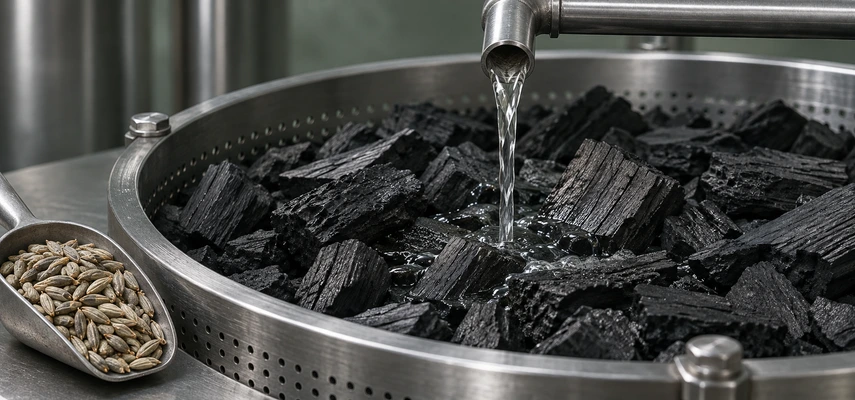

Rye and Tennessee whiskey make an instructive pair because their names answer different questions. American rye starts with a grain-based production identity. Tennessee whiskey adds a geographic identity and, normally, a particular treatment before maturation. Treating them as two flavors on opposite ends of a scale misses what the producer actually does.
The practical goal is to follow the production chain without letting a label do all the explaining. A rye can be fruity as well as spicy. A charcoal-mellowed whiskey still has a mash bill, fermentation history and cask history. Those factors remain active even when one famous process receives most of the attention.
Rye and Tennessee whiskey begin with different rules
For the American rye type, the federal whisky standard requires at least 51% rye in the fermented mash, distillation no higher than 80% ABV and storage in charred new oak barrels at no more than 62.5% ABV on entry. Bottling meets the whisky minimum of 40% ABV. Straight rye adds at least two years of maturation and excludes coloring, flavoring and blending materials.
The distinction between rye and straight rye matters. Do not automatically transfer every restriction attached to straight whiskey onto every non-straight named-grain whiskey: the federal table distinguishes their permitted materials. Equally, a product with rye in its recipe is not necessarily rye whiskey. A corn-majority bourbon can include substantial rye while remaining bourbon.
For Tennessee whiskey, the Tennessee Distillers Guild’s overview sets out Tennessee manufacture, a corn-majority mash, strength limits and new charred oak, along with maple-charcoal filtering before aging. This is not a category defined by a rye-majority recipe. Keep the two starting identities separate before discussing examples that share a location or treatment.
Tennessee’s charcoal rule needs its qualification
The state framework normally requires filtration through maple charcoal before aging, often called the Lincoln County Process. A narrow statutory exception exists. The state Attorney General’s 2015 opinion discusses that exception and its constitutional implications. An Attorney General’s opinion should not be misreported as a court judgment repealing the whole whiskey definition.
For study, remember the usual production pattern and the fact that it has a specific exception. Avoid saying every Tennessee whiskey, without qualification, must receive precisely the same charcoal treatment. The process can also vary among producers. A familiar commercial implementation is an example of the method, not a universal specification for bed depth or contact time.
Nor is charcoal treatment a magical barrier between bourbon and everything else. Federal bourbon identity and Tennessee’s additional framework concern overlapping requirements. The useful analysis asks whether a particular product meets the applicable conditions. A producer’s preferred category language does not justify inventing a general federal prohibition on charcoal contact for bourbon.
Grain choice creates a starting tendency
Rye can contribute a character associated with pepper, baking spice, herbs or grain, but those associations are tendencies rather than mandatory descriptors. A recipe just above the minimum and one using much more rye offer different starting materials. The remaining cereals matter too, as do their preparation and the conditions that follow.
By contrast, corn supplies the majority grain in the standard Tennessee whiskey framework. That does not mean the final spirit must be sugary. Grain starch is converted and fermented; the sweetness suggested by vanilla or caramel aromas is not the same measurement as dissolved sugar. Tasting vocabulary and compositional claims need different evidence.
Imagine two hypothetical recipes that differ only in rye proportion. That comparison helps isolate one variable in thought, but real bottles rarely offer such tidy control. Different yeast, fermentation conditions, still operation and cask histories may accompany the recipe change. Use a mash bill to develop a plausible hypothesis, then assess whether the actual sample supports it.
Preparation still has to supply usable sugars
The basic cereal problem remains unchanged: ordinary distilling yeast needs usable sugars rather than intact grain starch. Milling, suitable hydration and cooking make the starch accessible, while enzymes break it into smaller carbohydrates. Malted barley can contribute enzymes, and commercial enzyme preparations can also play a role in suitable production systems.
A producer must adapt preparation to the cereals being used. The objective is effective conversion and a manageable medium, rather than copying the temperature schedule of a different recipe. Grain handling can affect viscosity, heat transfer and process reliability. Those technical considerations matter even when the finished label concentrates on a romantic account of the main grain.
Do not confuse conversion with fermentation. Enzymes make suitable carbohydrates available; yeast then transforms usable sugars into alcohol and other products. A failure to distinguish the stages produces explanations in which yeast somehow cooks corn or a malt enzyme makes ethanol. Keeping each agent’s job clear makes the whole production sequence easier to remember.
Fermentation can complicate the grain stereotype
Yeast contributes more than alcohol. Strain and environment influence the formation of aroma-active compounds, including compounds associated with fruit. Fermentation length, temperature, nutrition and microbial activity can alter the resulting medium. The raw material sets possibilities, but it does not write the entire aroma profile before fermentation begins.
This is why a fruity rye need not be an exception requiring an unusual flavor addition. Its grain recipe and fermentation can contribute different parts of the sensory picture. Likewise, a corn-based Tennessee whiskey can have grain, fruit, spice and other notes together. The presence of one association does not cancel the rest of the production history.
Sour-mash practice concerns the use of acidic material from earlier production in preparing a subsequent mash. It can help manage conditions and consistency; it does not define rye or Tennessee whiskey by itself. Sour mash is also not a requirement for a sour taste in the glass. Keep process terminology separate from an assumed palate description.
Distillation controls what moves onward
Columns and secondary distillation apparatus can select and concentrate the fermented medium’s volatile components. Repeated phase contact and operating choices influence retained character. The equipment must be understood as a working system: a column does not inevitably erase grain character, and a lower collection strength does not independently guarantee a more complex result.
The producer’s target might call for a relatively robust distillate that can stand up to fresh oak, or a different balance of fruit and grain character. Feed composition, separation and copper contact all contribute. Discuss these mechanisms together rather than explaining the eventual whiskey solely through the percentage of rye or the word Tennessee on the label.
Charcoal mellowing changes the spirit before wood aging
In the usual Lincoln County Process, fresh distillate passes through a charcoal bed before entering its maturation barrel. Contact can selectively reduce compounds and change aroma balance. It is a treatment of an already distilled spirit, not a substitute for fermentation, distillation or the subsequent time spent in oak.
University of Tennessee researchers examined changes in odorants during this process. Their reported reductions were selective, and their work does not justify a claim that every implementation removes all undesirable aromas or always produces a universally smoother whiskey. Bed properties, contact and the starting distillate affect what a treatment can achieve.
Charcoal mellowing is also different from simply tasting char from a barrel. Fresh oak maturation introduces extraction and development over time; filtration through a separate charcoal bed changes the liquid before that stage. Both involve heated wood in some form, but they are different operations with different environments and purposes.
A Tennessee-made rye shows the naming trap
As a concrete example, Brown-Forman describes Jack Daniel’s Single Barrel Tennessee Rye with a 70% rye, 18% corn and 12% malted barley grain bill. The company also describes its charcoal-mellowing tradition. This is evidence about an actual producer’s product, rather than a reason to redefine the corn-majority Tennessee whiskey category.
A rye made in Tennessee can identify both its grain type and its place of production. That geographical description should not be confused with meeting every condition of the separate corn-based Tennessee whiskey framework. Read the complete designation and recipe. A state name on a rye label does not change rye into corn.
Maturation and selection still decide much of the result
Charred new oak brings a potentially assertive environment to both styles. Wood-derived aromas, extraction, evaporation and chemical development interact with the new spirit. Climate, warehouse position, barrel characteristics and time can create variation among casks. A peppery starting spirit can therefore emerge with prominent vanilla, fruit or oak as well as spice.
Selection aims to achieve a suitable relationship among those elements. More oak can add structure or overwhelm the spirit; more time can help development or push a cask beyond its best balance for the intended release. Age, dark color and high strength are useful observations, but none of them independently establishes higher quality.
What to remember
Start with the category, then follow grain preparation, fermentation, distillation, any charcoal treatment and maturation. For quality, use the actual whiskey’s balance, persistence, complexity and integration. Explain a specific mechanism when connecting a production choice with flavor, and qualify the outcome when other variables remain in play. The most useful comparison is a chain of decisions, not a contest between a spicy label and a smooth one.
Written practice: original TFE exercises
These suggested marks and indicative points are independent teaching guidance, not official WSET marking schemes.
Exercise 1: 5 suggested marks
Explain why changing charcoal-bed contact can change the character of fresh whiskey distillate. Mapping: LO2 explain: post-distillation operations.
Indicative marking points:
- Fresh distillate contains multiple aroma-active compounds.
- Charcoal contact can remove selected compounds.
- Changing contact can alter the extent of those reductions.
- Different reductions change the aroma balance.
- Assessment is needed because the effect depends on the starting spirit and treatment.
Model answer: Fresh distillate contains multiple aroma-active compounds. Charcoal contact can selectively remove some of them, and a change in contact can alter the extent of those reductions. The aroma balance may therefore change. The producer must assess the result because the starting spirit and treatment conditions influence the outcome.
Why it works: It connects a process adjustment with selective compositional change and the resulting need for sensory verification.
Common mistake: Saying charcoal always removes every bad flavor assumes an absolute result the mechanism does not support.
Exercise 2: 5 suggested marks
Explain how new-oak maturation could make a rye whiskey less obviously dominated by its starting grain character. Mapping: LO2 explain: maturation and style.
Indicative marking points:
- New oak supplies extractable wood-derived compounds.
- Those compounds can contribute prominent aromas.
- Their contribution changes the relationship with existing grain-related character.
- Development and evaporation can further change composition over time.
- The resulting balance may give grain less relative prominence without changing the original mash bill.
Model answer: New oak supplies extractable compounds that can contribute prominent wood-derived aromas. Those aromas change the balance with the spirit’s existing grain-related character, while development and evaporation can further alter composition over time. Grain may become less prominent in the final mixture of sensations even though the original mash bill has not changed.
Why it works: The explanation separates a fixed production input from changing composition and perception during maturation.
Common mistake: Claiming the rye percentage falls during aging confuses the original grain recipe with the matured liquid.
Knowledge check: 10 original practice questions
Independent TFE questions, not official WSET examination items. Choose one answer per question; explanations follow separately.
1. What can charcoal contact do?
2. Which is required for straight rye beyond the ordinary rye framework?
3. What is the best basis for comparing quality?
4. Why is grain sweetness not a sufficient sugar claim?
5. Why should the charcoal rule be qualified?
6. Can a rye show fruit character?
7. What does a Tennessee place description on a rye identify?
8. What is the usual main grain requirement for Tennessee whiskey?
9. When does the usual Lincoln County Process occur?
10. What is the defining minimum grain proportion for American rye whiskey?
Answers and explanations
- C — Selectively reduce some compounds. Selective changes depend on the starting spirit and treatment conditions. Mapping: LO2.
- A — At least two years of maturation. Straight rye carries a minimum maturation period and additional materials restrictions. Mapping: LO2.
- D — Evidence of balance, persistence, complexity and integration. Category and measurements provide context; sensory evidence supports the quality conclusion. Mapping: LO2.
- C — Aroma associations and dissolved sugar are different evidence. Sweet-associated aromas do not establish a measured concentration of sugar. Mapping: LO2.
- D — A narrow statutory exception exists. The normal rule should be learned without erasing its specific exception. Mapping: LO2.
- B — Yes, fermentation and other stages contribute. The grain tendency does not exclude aromas developed elsewhere in the process. Mapping: LO2.
- B — Origin alongside a grain type. Read the complete designation; geographical origin does not change the defining grain. Mapping: LO2.
- A — At least 51% corn. The usual Tennessee whiskey framework is corn-based, despite the existence of Tennessee-made rye products. Mapping: LO2.
- B — After distillation and before barrel aging. The treatment works on fresh distillate before its maturation stage. Mapping: LO2.
- D — 51% rye. The rye type has a rye-majority threshold; corn-majority whiskey may contain rye without becoming rye whiskey. Mapping: LO2.
Continue exploring this series
3. Alcoholic Fermentation Explained: Yeast, Nutrients, and Flavor Compounds
7. Column and Hybrid Stills Explained: Plates, Reflux, and Continuous Distillation
9. Oak Maturation Explained: Barrels, Oxygen, Evaporation, and Flavor Development
10. Spirits Finishing Explained: Blending, Filtration, Sweetening, Coloring, and Packaging
11. How Grains Become Whisky: Malting, Mashing, Enzymes, and Starch Conversion
14. Bourbon Explained: Mash Bills, Distillation, New Oak, and Quality
29. Spirits Quality Explained: How Production Decisions Affect Balance and Complexity
16. How Fruit Spirits Are Made: Grapes, Wine, Pomace, and Fermentation
50. WSET Level 3 Spirits Exam: Complete Revision Guide and Practice Examinations












