










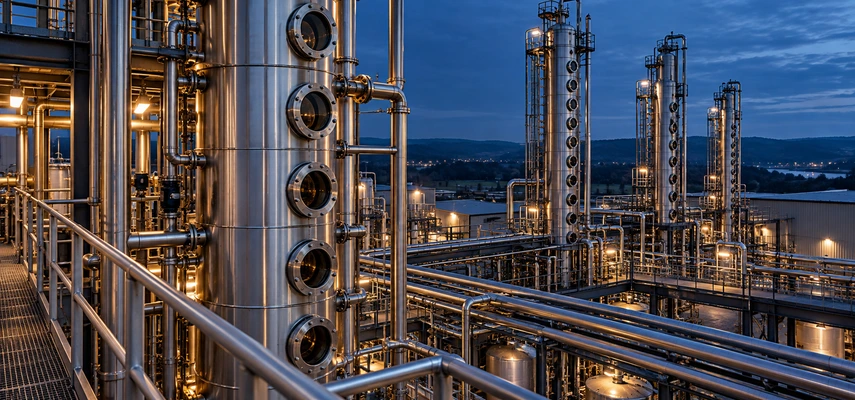

Look at a tall column beside a squat pot still and it’s tempting to describe the difference as plumbing with extra floors. But column and hybrid stills are about how material moves and repeatedly separates. In a working column, rising vapor meets descending liquid across a series of contact opportunities. The exchange, rather than the height alone, does the important work.
This lesson follows that exchange from a simple two-component mixture to a fermented feed, then considers continuous systems and hybrid arrangements. Keep one question in mind: what does the equipment let the distiller control? “Column-distilled” is a production description, not a synonym for neutral or a judgment of quality.
Column and hybrid stills manage phase contact
Distillation separates components through differences in their behavior between liquid and vapor phases. A column provides repeated contact between those phases. As the streams interact under suitable conditions, their compositions change. Ethanol can become enriched in the rising vapor while the descending liquid becomes relatively depleted in it through the appropriate part of the system.
This is countercurrent movement: the principal vapor and liquid streams move in opposite directions. A column isn’t simply a pipe carrying everything upward. The downward liquid is an active participant. Remove it from the explanation and you lose the exchange that allows repeated separation rather than a single journey to a condenser.
A simple model considers ethanol and water as a two-fraction liquid. It is useful for understanding enrichment, but a real fermented medium also contains congeners and other material. Begin with the model, then restore that complexity. Otherwise, an explanation that works for two components may be stretched into false certainty about every aroma compound in a spirit.
Heat drives vapor and cooling makes liquid return
Columns need a supply of energy to generate vapor. Depending on the arrangement, this can involve steam input or heat transferred through a reboiler. A reboiler vaporizes part of a liquid stream to supply rising vapor. The actual equipment and operating configuration determine how heat enters, so don’t prescribe one heat source for every column.
Condensers remove heat from vapor. Some condensed liquid may be returned as reflux, providing a liquid stream that participates in further separation. Other condensate can be collected as product. Distinguish a condenser’s phase-change function from the decision about where its liquid goes; condensing everything doesn’t mean collecting everything as finished spirit.
Heat input and cooling therefore belong in the same process explanation. They establish and control flows rather than merely warming one end and chilling the other. A change in either can influence internal conditions and the product. Stable operation requires the parts of the system to work together.
Plates create repeated contact opportunities
Rectification plates, or trays, hold liquid while permitting vapor passage in a suitable design. Contact helps the phases approach their local equilibrium relationship, allowing transfer of components. The purpose isn’t to use metal shelves as a physical sieve for molecules. Separation results from phase behavior and contact, rather than sorting molecules by visible size.
Different plate designs manage vapor and liquid differently. The number of installed plates isn’t necessarily the same as the number of ideal equilibrium stages achieved in operation. Efficiency, flow and control matter. You don’t need advanced design calculations to recognize why “ten plates” alone cannot guarantee a particular strength or aroma profile.
Kothe’s still description illustrates adjustable liquid levels on plates as one means of control. Treat that as an equipment example. It doesn’t mean every column has identical controls, or that changing a setting has one fixed sensory effect independent of feed and collection. The mechanism is useful because it connects hardware with operating choices.
Packed columns provide another contact surface
Packing replaces discrete trays with material that provides surface for liquid and vapor contact. Liquid distributes over the packing while vapor moves through the available spaces. Effective distribution matters: if streams bypass useful contact, the installed height may not deliver the expected separation. Packing is an internal arrangement, not a different biological process.
A packed column and a plated column can pursue related separation objectives with different engineering characteristics. The appropriate choice depends on the application and operating needs. Avoid a blanket rule that one makes better beverages. Material, geometry, loading and cleaning requirements are practical considerations, while the desired product determines which separation is useful.
For an examination description, name what the contact material does. “Packing gives a surface over which liquid and vapor interact” is more informative than “packing purifies the spirit.” The latter hides the mechanism and assumes purity is the target. Some spirits need a substantial retained contribution from their fermentation rather than the most neutral possible base.
Stripping removes ethanol from the descending liquid
In a common tall-column model, fermented feed enters between regions with different principal jobs. Below the feed, the stripping section helps transfer ethanol from descending liquid into rising vapor. The liquid moving toward the bottom becomes relatively depleted in ethanol. This describes a transfer process rather than a claim that every useful compound goes in one direction.
Above the feed, the rectifying section further enriches the rising vapor in the more volatile component under the working conditions. Returning reflux supplies descending liquid for contact. Stripping and rectifying sections are therefore related parts of a working separation, not merely two names for the bottom and top exterior panels.
Purdue’s chemical-engineering treatment explains this countercurrent arrangement and reflux supply. Its purpose is fuel-alcohol education, so transfer the separation principles without importing fuel specifications into beverage quality. A spirits producer’s preferred balance of retained compounds may differ from the objective in that publication.
Continuous operation balances moving streams
A continuous system can receive feed while withdrawing products and residues during sustained operation. At a stable operating condition, the system maintains an overall working balance rather than processing one closed batch from beginning to end. Internal flows and energy transfer continue; “stable” doesn’t mean molecules have stopped moving or reacting.
Dynamic equilibrium describes ongoing exchange with balanced behavior under the relevant conditions. In practical continuous operation, the distiller manages a dynamic steady state of flows and compositions. Don’t confuse it with every location containing an identical mixture. Different regions can maintain different compositions while the system operates consistently over time.
Feed composition, flow rate, heat and reflux must suit the operation. A change in one can disturb the balance and require adjustment. Starting, stopping and changing production also create transitions that differ from stable running. “Continuous” describes an operating pattern, not permission to ignore process control once the equipment is switched on.
One column is only one possible arrangement
A single column can combine useful functions, but equipment also comes in double-column and multiple-column systems. Separate vessels can divide tasks, allowing different stages or separations to be managed in dedicated sections. The reason for additional equipment is functional organization and control, rather than a universal desire to make the tallest possible structure.
A double-column arrangement might divide stripping and rectification between connected columns. More elaborate systems can provide additional separation tasks suited to the product. Learn the actual flow path before explaining the result. Counting vessels alone tells you less than identifying which stream enters, what happens inside and where each output goes.
Nor do all single columns operate identically. Design, contact surfaces, feed, reflux and withdrawals influence their capabilities. A short characterful-spirit column and a highly rectifying neutral-alcohol system should not be collapsed into one generic diagram. The shared scientific principle is repeated separation; the engineering and product objectives can be quite different.
Columns can retain substantial spirit character
Equipment manufacturer Forsyths lists column applications across rum, grain whisky, Bourbon, brandy, vodka and other products. That breadth is a useful corrective to “all columns make neutral alcohol.” Different systems and operating choices retain or reduce different contributions from the starting material.
A producer can seek substantial raw-material or fermentation character while using column equipment. Another can seek extensive rectification and a less distinctive base. Neither objective determines quality by itself. Evaluate whether the resulting aroma, texture and balance suit the intended spirit, then explain which separation choices plausibly contributed to that result.
Hybrid systems combine routes and choices
Hybrid stills combine pot and column elements, often with valves and piping that permit different process paths. A pot supplies a batch while a connected column can provide additional rectification. Some arrangements allow stages to be used or bypassed. A hybrid label doesn’t mean every route or operating mode is available in every installation.
Forsyths describes hybrid equipment as a way to offer flexible production paths, while also noting cross-product contamination risks. That illustrates a real tradeoff: versatility can help a producer make different spirits, but cleaning and carryover management become important. Having several routes creates useful options and additional responsibilities.
Advantages and tradeoffs depend on the intended product
Continuous systems can support sustained throughput and a consistent separation when the feed and operating balance remain stable. Their advantages depend on suitable scale, control and reliable utilities. Start-up transitions, energy demand, cleaning and changes between products create tradeoffs. A flexible hybrid can serve several recipes, while dedicated equipment may simplify a narrower task. Neither choice supplies quality by itself; the producer needs a system that can repeat the desired result.
What to remember
Trace heat input, rising vapor, descending liquid, reflux and collection. Explain plates or packing through contact, and distinguish stripping from rectification. Describe continuous operation as a maintained balance of moving streams. Then judge a hybrid through its actual flow paths and controls. The equipment’s name begins an explanation; its operation and intended product complete it.
Written practice: original TFE exercises
These suggested marks and indicative points are independent teaching guidance, not official WSET marking schemes.
Exercise 1: 5 suggested marks
Explain the different roles of stripping and rectifying sections in a working tall-column model. Mapping: LO1 explain: stripping and rectifying sections.
Indicative marking points:
- Rising vapor contacts descending liquid.
- Below the feed, ethanol transfers out of descending liquid.
- That liquid becomes relatively depleted in ethanol.
- Above the feed, reflux supplies returning liquid for further separation.
- Rising vapor can become more enriched before product collection.
Model answer: Rising vapor meets descending liquid. In the stripping section below the feed, this contact transfers ethanol from the descending liquid into the vapor, leaving a more depleted liquid stream. In the rectifying section, returning reflux permits further contact and separation, enriching the rising vapor before collection.
Why it works: It explains the transfers and stream consequences rather than merely labeling two physical locations.
Common mistake: Calling both sections alcohol storage spaces overlooks their active role in transfer between phases.
Exercise 2: 5 suggested marks
Explain why continuous operation still requires active control of feed, heat and reflux. Mapping: LO1 explain: continuous operation.
Indicative marking points:
- Feed adds material during running.
- Withdrawals remove product and residues.
- Heat input supports vapor generation.
- Reflux supports internal liquid contact and separation.
- Changes to these streams can disturb composition and the working balance.
Model answer: A continuous system receives feed while removing products and residues. Heat sustains vapor generation and reflux supports internal liquid contact. These streams together establish the working balance. Changes in feed, energy or reflux can alter internal composition and separation, so continuous running still requires control.
Why it works: It connects each control to a process function and shows why a moving steady system is not self-correcting by definition.
Common mistake: Assuming continuous equipment needs no adjustment confuses sustained operation with an absence of changing conditions.
Knowledge check: 10 original practice questions
Independent TFE questions, not official WSET examination items. Choose one answer per question; explanations follow separately.
1. What is a hybrid still arrangement?
2. What is a principal job of a stripping section?
3. Why does plate count alone not guarantee a flavor?
4. What does a rectifying section do in the model?
5. What does reflux supply?
6. What is countercurrent contact in a column?
7. What do plates or packing principally provide?
8. What distinguishes continuous operation?
9. What is a tradeoff of flexible multi-product equipment?
10. Which statement about column character is correct?
Answers and explanations
- A — A system combining pot and column elements. Hybrid equipment combines distillation elements and may provide different routes through valves and connected sections. Mapping: LO1.
- A — Transfer ethanol from descending liquid toward rising vapor. Stripping depletes ethanol from the liquid stream through contact with the rising vapor. Mapping: LO1.
- A — Effective contact, feed and operation also matter. Installed stages describe part of the equipment, while actual separation depends on the complete operating system. Mapping: LO1.
- B — Further enriches rising vapor in the relevant volatile component. Repeated contact with returning liquid supports further separation in the rectifying region. Mapping: LO1.
- D — Returning condensed liquid for further contact. Reflux participates inside the separation system and should be distinguished from collected product. Mapping: LO1.
- A — Rising vapor meeting descending liquid. Opposite principal flows support repeated phase contact and transfer of components under working conditions. Mapping: LO1.
- C — Opportunities for vapor-liquid contact. Their separation role depends on phase contact and equilibrium behavior, rather than mechanically filtering molecules by size. Mapping: LO1.
- A — Feed and withdrawals occur during sustained balanced operation. Continuous operation maintains moving streams and outputs, with controls needed to preserve appropriate conditions. Mapping: LO1.
- C — Cleaning and carryover require management. Multiple products and process paths create useful versatility alongside a risk of unwanted cross-product carryover. Mapping: LO1.
- C — Columns can make characterful or relatively neutral products. Equipment design and operation vary with different beverage applications and retained-character objectives. Mapping: LO1.
Continue exploring this series
5. Distillation Science Explained: Volatility, Congeners, Reflux, and Rectification
6. Pot Still Distillation Explained: Design, Heating, Cuts, and Flavor
8. How Distillers Manage Flavor: Sulfur, Esterification, Pressure, and Distillation Choices
13. Grain and Blended Scotch Whisky Explained: Production Choices, Laws, and Style
19. Armagnac Explained: Grapes, Column Distillation, and Regional Styles
22. Caribbean Rum Explained: Distillation, Regional Traditions, and Quality
26. Vodka Explained: Neutral Spirits, Raw Materials, and Production Choices
30. How to Explain Spirits Production: Advanced Cause-and-Effect Case Studies
50. WSET Level 3 Spirits Exam: Complete Revision Guide and Practice Examinations












