










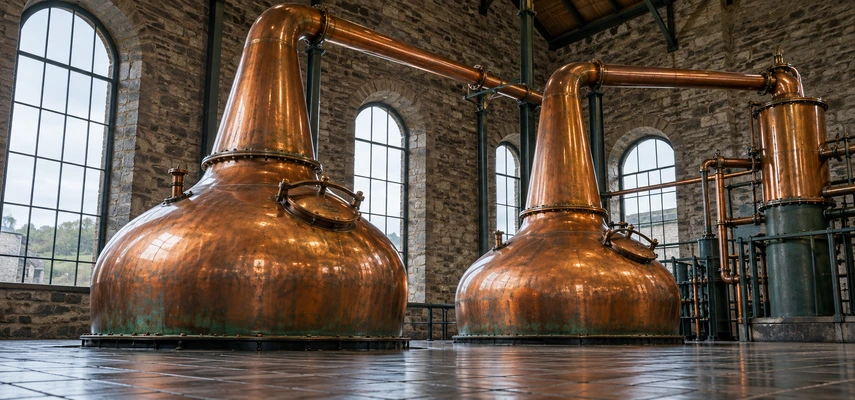

A pot still doesn’t deliver one unchanging liquid from start to finish. Its charge changes as distillation proceeds, and the collected stream changes with it. Pot still distillation is therefore a moving selection problem: the distiller manages a batch, follows its development and decides which portion belongs in the intended spirit.
The copper shape is only part of that explanation. Heat input, filling level, reflux, condensation and collection strategy work together. Two similar vessels can be run differently, while different designs can support different approaches. To explain style, follow the operation rather than treating the silhouette as a flavor label.
Pot still distillation works in batches
A batch begins with a charge: material placed in the still for a run. Heat generates vapor, which passes toward condensation and collection. Material is removed from the system as distillate, so the composition remaining in the pot changes. At the end, the still must be prepared for another charge rather than receiving an uninterrupted feed in the same way as a continuous system.
This changing composition is central to collection decisions. Ethanol and congeners don’t leave as isolated pure substances in a queue. Their proportions vary through the run, influenced by mixture behavior and the equipment. A thermometer or strength measurement provides information, but neither reduces the whole sensory decision to one universal number.
Batch operation also creates practical rhythms: charging, heating, collecting, discharging and cleaning. These stages affect throughput and energy use. A producer may value the control and flexibility offered by batches while recognizing the time needed between them. “Traditional” describes history and practice; it doesn’t cancel the operational work.
Follow the main pieces of equipment
The pot contains the heated charge. Above it, the head and neck provide a vapor path, with shape and surface conditions influencing heat loss and reflux. The lyne arm carries vapor onward toward the condenser. The condenser removes heat so vapor becomes liquid, which can then be directed into appropriate receivers.
Real designs vary in size, geometry and arrangement. Equipment maker Forsyths describes its copper pot-still work, including related condensation and sampling equipment. A useful diagram should identify functions before asking you to memorize decorative outlines. Otherwise, an elegant drawing can conceal that you haven’t explained where vapor travels or liquid returns.
Copper is more than a convenient color. Contact with copper can influence sulfur-containing compounds and other aspects of the distillation environment. But the location, condition and extent of contact matter. Don’t claim that any copper vessel eliminates every sulfur compound, or that the largest visible copper surface automatically produces the best spirit.
Heating choices affect how the charge behaves
Heat can be supplied indirectly using steam, or through direct heating arrangements. In an indirect system, steam transfers energy through an appropriate surface. Direct-fired equipment applies heat to the vessel from a burner or flame arrangement. The heat source and transfer surfaces affect control, local conditions and the management of material inside the still.
Glenfarclas identifies direct-fired double distillation in its own production account. That verifies one producer’s choice. It does not prove that every Scottish distillery uses direct fire, or that steam necessarily produces a less characterful spirit. A named example helps illustrate variation without turning it into a league table.
Heat input also influences the rate at which vapor is generated. Changes can alter vapor movement, contact and reflux behavior, interacting with the still’s design and charge. Faster heating isn’t a separate shortcut to greater flavor. The consequences depend on the system, and a distiller balances throughput with the conditions needed for the desired collection.
Still shape influences opportunities for reflux
Vapor can lose heat against cooler surfaces, condense and return as reflux. A neck’s geometry and the route toward the condenser influence opportunities for those interactions. Bulges, constrictions and lyne-arm arrangement can matter, but their effect depends on operation. Shape should be connected to a mechanism before a sensory consequence is proposed.
For example, an arrangement supporting more effective reflux can provide further separation before vapor reaches the final condenser. That may alter ethanol enrichment and the congener balance collected. It doesn’t establish one fixed aroma for every tall still. The starting material and the way the still is run remain part of the explanation.
Compare this with the weak answer “tall stills make good whisky.” It doesn’t define the process change or the intended style, and it jumps straight to quality. A stronger answer describes heat loss, returning condensate and further separation, then explains a qualified effect on the collected mixture. The mechanism is doing the useful work.
Scottish double distillation divides the process
In a familiar Scotch malt arrangement, a first distillation takes fermented wash and produces low wines. This intermediate liquid has a higher alcoholic strength than the wash but is not the finished selected spirit. A second distillation processes low wines, commonly with recycled fractions according to the distillery’s system, and permits collection of the desired heart portion.
The Scotch Whisky technical file describes this production framework. Keep its categories straight: wash comes from fermentation; low wines come from the first distillation; selected new-make spirit follows the spirit run. None is the same as matured whisky, which requires later production stages and compliance with the category’s rules.
Double distillation isn’t a universal requirement for all pot-distilled spirits, or even an explanation of every malt whisky process. Some producers use different numbers or combinations of distillations. Learn this Scottish example as a worked system, then examine other arrangements on their own terms. Counting runs alone cannot reveal the complete collection strategy.
Heads, heart and tails are mixed portions
Heads describe an earlier portion of the run, heart the portion selected for the desired product, and tails a later portion. Terminology and handling vary, including the use of foreshots and feints in Scotch contexts. These are changing mixtures, not pure chemicals separated into three perfectly discrete containers.
The cut is the decision to change what is being collected or where it goes. Producers use suitable measurements, process knowledge and assessment to manage it. A cut point chosen for one raw material, apparatus and style should not be presented as a universal instruction for every still. Numerical precision without context can make an explanation less accurate.
The heart also isn’t “everything good,” with every other fraction defined as worthless. Compounds desirable in one style can be unwelcome in another proportion or context. Some excluded portions may be recycled under the production system. Explain exclusion from the current product separately from disposal; they are different statements about the material’s destination.
Inclusions and exclusions shape character
An inclusion is material or character retained in the selected spirit; an exclusion is kept out of that collection. Distillers influence these through operating and collection choices. The objective is an appropriate balance, not indiscriminate removal. A characterful spirit may need compounds that a neutral-spirit producer deliberately reduces.
Imagine two hypothetical collection strategies applied to comparable feedstocks. One excludes more of a later portion; the other retains a greater contribution from it. Their congener balances can differ, potentially affecting weight, aroma or other sensory qualities. To judge success, assess the resulting spirits in relation to the intended style rather than assuming a narrower collection is always better.
The same principle applies near an earlier cut. Including more early material doesn’t simply add “fruit” in a predictable quantity. Several compounds and sensory interactions may change together. Good explanations name the operational difference, describe altered composition and qualify the consequence. Avoid assigning an entire fraction one friendly tasting word.
Distillation works with the fermentation it receives
A still does not begin with a blank canvas. Fermentation has already established a mixture of alcohol and other compounds. Original research following wash, low wines and new make found that differences between experimental samples could remain recognizable across stages even as composition and descriptors changed. The study used laboratory simulations, which limits how directly its findings can be generalized.
The practical lesson is to consider upstream and downstream decisions together. A distiller can select and modify aspects of a fermentation’s character, but shouldn’t assume that equipment makes raw-material and yeast choices irrelevant. Likewise, a promising fermentation still needs suitable distillation and collection. Quality emerges through the chain rather than being installed with one piece of copper.
Advantages and challenges belong in the same answer
Batch operation can support flexible handling and collection decisions. Different charges and settings offer opportunities to pursue distinct profiles. At the same time, repeated preparation, heating and cleaning affect capacity and consistency. Changes in feed composition or operation may alter results, so control and recording are important parts of managing the process.
Energy demand, equipment maintenance and copper condition are additional considerations. These are production tradeoffs rather than reasons to declare pot stills obsolete or inherently superior. A producer chooses equipment suited to raw material, intended product, scale and available expertise. Examination answers improve when they acknowledge that a practical advantage often arrives with a corresponding cost or challenge.
What to remember
Trace the batch through pot, neck, lyne arm, condenser and receivers. Connect heating and design to vapor behavior, reflux and collection. In the Scottish double-distillation example, distinguish wash, low wines and selected new make. Explain inclusions and exclusions as decisions about a mixed stream, then assess whether their consequences suit the intended spirit.
Written practice: original TFE exercises
These suggested marks and indicative points are independent teaching guidance, not official WSET marking schemes.
Exercise 1: 5 suggested marks
Explain how a design that supports effective reflux can influence the collected spirit, while identifying a limitation of predicting flavor from shape alone. Mapping: LO1 explain: still design.
Indicative marking points:
- Vapor can lose heat to suitable surfaces.
- Some vapor condenses.
- Returning liquid provides reflux.
- Further phase contact supports separation and changes collected composition.
- Feed and operation mean shape alone cannot guarantee a fixed flavor or quality.
Model answer: Where the working design encourages heat loss and condensation, some liquid returns as reflux. Contact with rising vapor allows further separation, which can change ethanol and congener proportions reaching collection. The result also depends on feed composition and operation, so the outline of the still alone cannot guarantee a particular flavor or quality.
Why it works: The explanation traces a physical mechanism and then names the variables that limit a simple shape-to-flavor prediction.
Common mistake: Claiming that every tall still makes the best spirit skips the mechanism and replaces sensory assessment with an equipment stereotype.
Exercise 2: 5 suggested marks
Explain why changing a heart collection strategy can change spirit style without necessarily improving quality. Mapping: LO1 explain: inclusions/exclusions.
Indicative marking points:
- A batch stream changes composition over time.
- Changing the selected portion changes retained material.
- Retained congener proportions can therefore differ.
- These differences can alter sensory character.
- Suitability and balance determine quality rather than collection width alone.
Model answer: The composition of a batch distillate changes through the run. Altering which portion is retained changes the balance of accompanying compounds, potentially changing aroma or weight. That is a stylistic change. Whether it improves quality depends on the resulting balance and the intended spirit; a narrower collection is not automatically superior.
Why it works: It links a collection decision to composition, then separates a style consequence from an unsupported quality guarantee.
Common mistake: Describing every excluded fraction as worthless ignores both context-dependent sensory contributions and possible recycling.
Knowledge check: 10 original practice questions
Independent TFE questions, not official WSET examination items. Choose one answer per question; explanations follow separately.
1. Which claim about fractions is correct?
2. What does the condenser do?
3. What is one challenge of batch operation?
4. What are low wines in the Scottish double-distillation example?
5. How should still height be used in an explanation?
6. Why consider fermentation when explaining new make?
7. What is a cut decision?
8. Which statement about direct heating is accurate?
9. What changes during a batch pot-still run?
10. What is the lyne arm principally part of?
Answers and explanations
- C — Heads, heart and tails are portions with changing mixed compositions. Cuts distinguish collected portions, not a sequence of chemically pure substances leaving one at a time. Mapping: LO1.
- D — Removes heat so vapor becomes liquid. Condensation changes the phase of material that has entered the vapor stream during distillation. Mapping: LO1.
- B — Repeated preparation and cleaning affect throughput. Batch flexibility comes with preparation, heating, discharge and cleaning stages that affect productive capacity. Mapping: LO1.
- D — An intermediate product of the first distillation. Low wines follow the wash distillation and are subsequently processed in the spirit distillation. Mapping: LO1.
- A — Connect it with actual reflux and operating conditions. Geometry can affect vapor and returning liquid behavior, but the practical consequence depends on the working system. Mapping: LO1.
- C — Distillation receives an already differentiated chemical mixture. Upstream compounds and differences can influence the starting point and outcomes of later separation and collection. Mapping: LO1.
- B — A change in the portion being collected or its destination. Cut strategy selects from the changing stream and shapes the mixture retained for the intended product. Mapping: LO1.
- D — It is one heat-supply arrangement used by some producers. Heating choices have operational consequences, but one producer example does not establish universal use or superiority. Mapping: LO1.
- B — The composition remaining in the pot. As material leaves the batch, remaining liquid and collected distillate change composition over time. Mapping: LO1.
- D — The vapor route toward the condenser. The lyne arm connects the still head or neck route with the downstream condensation arrangement. Mapping: LO1.
Continue exploring this series
5. Distillation Science Explained: Volatility, Congeners, Reflux, and Rectification
7. Column and Hybrid Stills Explained: Plates, Reflux, and Continuous Distillation
8. How Distillers Manage Flavor: Sulfur, Esterification, Pressure, and Distillation Choices
12. Single Malt Scotch Whisky Explained: Production, Distillation, and Quality
17. Cognac Explained: Grapes, Double Distillation, Oak, and Quality
22. Caribbean Rum Explained: Distillation, Regional Traditions, and Quality
30. How to Explain Spirits Production: Advanced Cause-and-Effect Case Studies
50. WSET Level 3 Spirits Exam: Complete Revision Guide and Practice Examinations











