











Cognac starts with a wine you might never choose for dinner. That is part of the point. Its grapes and winemaking serve a later process: two distillations in copper, followed by oak maturation and selection. The finished Cognac can carry fruit, flowers, spice, wood and developed aromas that no single stage could create on its own.
The useful study question is how those stages fit together. A fine raw material needs appropriate fermentation; a promising wine needs careful separation; an expressive new spirit needs a suitable maturation environment. This lesson follows those connections. The next examines crus and age classifications, which describe important aspects of identity without replacing the production explanation.
Cognac has a protected production framework
Cognac is a protected wine spirit from its delimited French area. Its requirements extend beyond simply distilling white wine. The official specification published in June 2026 covers grapes, winemaking, Charentais distillation and maturation. Cognac delivered to consumers has a minimum strength of 40% ABV, and the ordinary matured spirit requires at least two years in oak.
One detail deserves care when using older references: the current maximum distillate strength is 73.7% ABV. Older material can give 72.4%, or round a typical working strength to about 70%. A legal ceiling, an older limit and a producer’s normal operating strength are different facts. Do not exchange them merely because all concern alcohol concentration.
This framework leaves room for style. It does not prescribe one fixed aroma intensity, one cask sequence or one blending recipe for every house. Start with the conditions that establish identity, then examine the choices available within them. That approach gives a more accurate account than treating the appellation as a single flavor.
Ugni Blanc supplies a purposeful starting wine
Ugni Blanc dominates the vineyard. Its suitability includes the ability to give relatively low-alcohol, acidic wine for distillation. Folle Blanche and Colombard are also relevant names in the production discussion, alongside other permitted varieties under the detailed rules. Their historical or stylistic significance does not mean every Cognac contains the same combination.
High acidity helps the wine’s natural conservation before distillation. Relatively low alcohol also affects the relationship between wine feed and recovered spirit: more wine is processed for a given quantity of alcohol than with a stronger feed. This helps explain why a thin, sharp table-wine impression is not a useful verdict on suitability for Cognac.
Raw-material condition remains crucial. The producer wants sound fruit and a wine with an appropriate balance, not damage disguised by a picturesque variety name. Harvest and transport need to preserve useful material. Neither the reputation of the vineyard nor an expensive eventual bottle gives the distiller permission to ignore the condition of the current crop.
Pressing and fermentation prepare the feed
Grapes are pressed and the juice fermented into wine. Controlled handling limits unwanted extraction or deterioration and establishes a suitable medium for yeast. The aim differs from making a richly extracted red table wine: grape skins are not deliberately retained throughout a conventional red-style fermentation to build the eventual Cognac’s color.
Yeast makes ethanol and other fermentation products from usable sugars. Those other products contribute to the material available for distillation and later development. Fermentation therefore matters even when Ugni Blanc itself is discussed as relatively restrained in aroma. A neutral-sounding grape description does not mean the wine contains only alcohol and water.
The BNIC production overview describes the prohibition on adding sugar and sulphites during fermentation. Maintaining suitable wine condition is particularly important in this framework. Distillation must be completed by March 31 following the harvest, so preservation and seasonal processing capacity form part of the production plan rather than an afterthought.
The first chauffe turns wine into brouillis
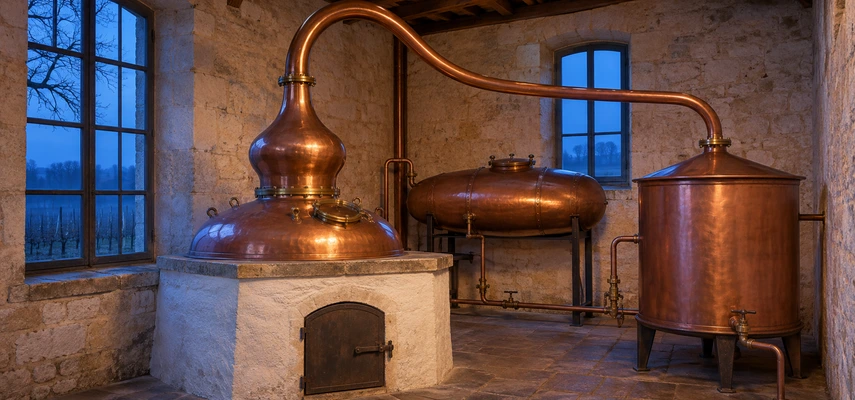
The Charentais process is batch double distillation. In the first chauffe, wine is heated in the copper apparatus, vapor travels toward a condenser and the condensed liquid is collected as brouillis. It contains more alcohol than the wine, but it is still a mixture requiring further separation. The first run does not produce finished bottled Cognac.
Keep the physical mechanism clear. The boiling mixture supplies vapor containing ethanol, water and other volatile components; they do not leave as isolated chemicals in a perfectly ordered queue. Their behavior changes with mixture composition and operating conditions. Distillation can concentrate and select material, but it is not a set of separate pure boiling points taking turns.
Copper contact can influence sulfur-related compounds, while apparatus design and operating conditions influence condensation and vapor behavior. Heating also brings practical demands, especially when solids are present. The producer needs a stable, appropriate run, not simply the largest possible flame. Equipment and operation work together to shape the feed for the next stage.
The bonne chauffe selects the heart
Brouillis is distilled again in the second chauffe, also called the bonne chauffe or repasse. The distiller separates fractions and selects a heart for the intended spirit. Heads and later fractions can be managed through appropriate recycling arrangements rather than imagined as a permanent loss of everything not immediately collected for maturation.
Cut decisions influence composition because the output changes during a batch run. A different collection window can alter the balance of aroma-active compounds and heavier character. The useful outcome depends on the wine and intended maturation. A narrow heart is not automatically better, and a broad one is not automatically more complex in a desirable way.
Du Peyrat describes its own approach to retaining character through cuts and recycling. It is a helpful producer example, not a universal recipe. The explanation to learn is that selecting and returning fractions changes the material passing through the system, creating opportunities for different house styles within the same double-distillation framework.
Lees give the distiller another choice
Lees include fine yeast-related sediment remaining after fermentation. Distilling wine with some fine lees differs from distilling a clarified wine. Their presence changes the material heated in the still and can influence the resulting composition, including contributions associated with fuller or more fruit-driven character. That is a potential stylistic tool, not an automatic superiority claim.
Solids also create handling demands. Their condition and behavior during heating matter, and careless operation can produce unwanted burnt character. More lees is therefore not a complete objective. A producer needs an amount and operating approach appropriate to the feed and desired spirit, while another may deliberately seek the different balance available from clearer wine.
This is a useful exam connection: material selection affects what enters the still; the still’s operation affects which part of that material reaches the heart; the heart’s composition affects its subsequent maturation possibilities. Do not jump from the word lees directly to a guarantee of quality without explaining those intermediate relationships.
Oak should develop the spirit without burying it
Fresh oak offers extractable material that can supply color, structure and aromas such as vanilla or toast-related notes. Previously used casks provide a different extractive starting point. A cellar master can move spirit between suitable vessels as its needs change, balancing wood contribution with the retention and development of spirit character.
Barrel size, grain, seasoning and heat treatment influence the environment. Familiar names such as Limousin and Tronçais are useful context for discussing oak sources and characteristics, but a forest name is not a complete barrel specification. Construction and individual history still matter. Avoid explaining an entire mature Cognac solely through one wood label.
The Du Peyrat maturation account illustrates decisions about new and previously used casks. Its choices belong to its own production system. For the broader principle, compare extraction, oxygen-related development and evaporation, then ask how the producer manages their combined effect on a particular eau-de-vie over time.
The cellar changes more than color
Temperature and humidity influence the barrel environment and evaporation. The remaining volume and alcohol-water balance can change, with the direction and extent depending on conditions. There is no need to assume every cellar produces one universal annual loss or identical strength change. The individual vessel and its setting form a working relationship.
Longer development can bring dried-fruit, nutty, spice or other mature associations, often discussed under rancio Charentais. That term describes a sensory family rather than one isolated molecule or an aroma guaranteed at a precise birthday. Time creates opportunity, but the barrel and spirit must remain in an appropriate balance.
Eventually a producer may preserve a developed stock in an inert container to limit further wood influence. Such storage does not add more years of oak maturation. The distinction matters whenever comparing a spirit’s calendar history with an age claim. A long-lived bottle or glass vessel is not a substitute for additional qualifying time in wood.
Blending connects the stocks to a house style
Selection can combine spirits with different origins, ages and sensory contributions. The objective may include consistency, complexity or a particular relationship among fruit, floral character, oak and maturity. An unchanging recipe is not always the best way to maintain a consistent result when the available stocks themselves vary.
Reduction with water and suitable final preparation influence presentation too. Assess the bottled strength and balance rather than assuming that the strongest or oldest available stock must be the best finished release. Age classification supplies information, while quality remains a conclusion supported by the actual spirit’s performance.
What to remember
Follow Cognac from suitable white grapes to acidic base wine, then through brouillis, bonne chauffe, heart selection and oak. Explain lees, cut choices and cask management as connected variables. Judge balance, persistence, complexity and integration using evidence from the sample. The protected framework establishes Cognac’s identity; careful decisions within it give an individual Cognac its character.
Written practice: original TFE exercises
These suggested marks and indicative points are independent teaching guidance, not official WSET marking schemes.
Exercise 1: 5 suggested marks
Explain how choosing to distil wine with fine lees can influence production and style. Mapping: LO2 explain: distillation choices.
Indicative marking points:
- Lees change the material entering the still.
- They contribute yeast-related components.
- Heating and separation act on that changed feed.
- Retained composition and sensory balance can therefore differ.
- Appropriate handling is needed because solids can create heating problems.
Model answer: Fine lees introduce yeast-related components into the still feed. Heating and separation act on that changed mixture, so the retained composition and sensory balance can differ from a clarified-wine route. The producer must manage the solids appropriately because poor handling during heating can create unwanted burnt character.
Why it works: The response connects a feed choice to composition, separation and a practical control requirement.
Common mistake: Saying more lees always means better Cognac ignores both the target style and handling demands.
Exercise 2: 5 suggested marks
Explain why a cellar master might move an eau-de-vie from a new cask into a previously used cask. Mapping: LO2 explain: post-distillation operations.
Indicative marking points:
- New oak supplies extractable wood compounds.
- Their accumulation changes aroma and structure.
- Further strong extraction may threaten the desired balance.
- A previously used cask offers a different extractive environment.
- Development can continue while further wood influence is managed.
Model answer: New oak supplies extractable compounds that alter aroma and structure. Once that contribution approaches the desired level, continued strong extraction could overwhelm the spirit. Moving it into a previously used cask changes the extractive environment, allowing further development while managing additional wood influence.
Why it works: It identifies the initial contribution, the possible imbalance and the mechanism behind the vessel change.
Common mistake: Treating used casks as chemically inert overlooks the difference between reduced extraction and no interaction at all.
Knowledge check: 10 original practice questions
Independent TFE questions, not official WSET examination items. Choose one answer per question; explanations follow separately.
1. What happens in the bonne chauffe?
2. Why transfer developing spirit into a previously used cask?
3. What are fine lees in this discussion?
4. Which variety dominates Cognac production?
5. What should support a quality conclusion?
6. What does rancio Charentais describe here?
7. What is the current official maximum distillate strength checked for this article?
8. Which statement about cut choices is sound?
9. Why is relatively high acidity useful in the base wine?
10. What is brouillis?
Answers and explanations
- C — Brouillis is distilled again and fractions selected. The second run performs further concentration and selection. Mapping: LO2.
- B — To change further wood extraction while development continues. Vessel history affects the extractive environment; transfer can help manage wood balance. Mapping: LO2.
- C — Fine yeast-related sediment after fermentation. Their presence changes the material distilled and can influence style. Mapping: LO2.
- D — Ugni Blanc. Ugni Blanc is the dominant white grape, while other permitted varieties also matter to the subject. Mapping: LO2.
- B — Observed balance, persistence, complexity and integration. Production and age provide context, while the actual sample supports the judgment. Mapping: LO2.
- D — A family of developed sensory associations. Mature associations arise through interacting development rather than one fixed calendar trigger. Mapping: LO2.
- D — 73.7% ABV. The June 2026 specification confirms 73.7%; a legal maximum is distinct from a typical working strength. Mapping: LO2.
- D — They alter the composition of the collected heart. Batch output changes, so the collection window affects retained character without providing perfect chemical isolation. Mapping: LO2.
- C — It helps natural conservation before distillation. Acidity contributes to preservation but does not remove the need for sound handling. Mapping: LO2.
- A — The first distillate from the wine. The first chauffe supplies a more concentrated intermediate for the second distillation. Mapping: LO2.
Continue exploring this series
3. Alcoholic Fermentation Explained: Yeast, Nutrients, and Flavor Compounds
5. Distillation Science Explained: Volatility, Congeners, Reflux, and Rectification
6. Pot Still Distillation Explained: Design, Heating, Cuts, and Flavor
8. How Distillers Manage Flavor: Sulfur, Esterification, Pressure, and Distillation Choices
9. Oak Maturation Explained: Barrels, Oxygen, Evaporation, and Flavor Development
10. Spirits Finishing Explained: Blending, Filtration, Sweetening, Coloring, and Packaging
16. How Fruit Spirits Are Made: Grapes, Wine, Pomace, and Fermentation
18. Cognac Classifications Explained: Crus, Age Statements, and Blending
19. Armagnac Explained: Grapes, Column Distillation, and Regional Styles
20. Cognac vs. Armagnac: How Production Decisions Shape Two Great Brandies
50. WSET Level 3 Spirits Exam: Complete Revision Guide and Practice Examinations












