











A label reading “Cognac Fine Champagne VSOP” gives you three different pieces of information. Cognac identifies the protected spirit. Fine Champagne says something specific about the origins of its components. VSOP supplies a minimum maturation classification. None of those words tells you exactly how this particular bottle will smell.
Cognac classifications become easier when you stop trying to make one term answer every question. Origin, time and composition belong on separate lines of your mental worksheet. Once those lines are clear, you can connect them to production and tasting. The label becomes useful evidence rather than a complicated way to say expensive.
Cognac classifications distinguish origin from maturation
The official specification published in June 2026 defines Cognac’s production framework and supplementary geographical names. Its age terms operate alongside that framework. A Cognac can identify a particular cru and also carry an age designation; the two terms are not competing categories from which the producer must choose one.
Start with a simple example: Borderies XO. Borderies is the geographical information, while XO is the maturation information. Swapping XO for VSOP changes the minimum age claim, not the location of Borderies. Changing Borderies to Grande Champagne changes the origin claim, not the meaning of XO. This small exercise clears away a surprising amount of confusion.
The producer’s name adds another layer. A house can select and blend stocks to create a recognizable style within the legal categories. That style can cross several releases, but an individual bottling still has its own composition and target. House reputation provides context; it does not turn the rest of the label into decoration.
Learn the six crus as a geographical set
The six crus are Grande Champagne, Petite Champagne, Borderies, Fins Bois, Bons Bois and Bois Ordinaires, the last also associated with the term Bois à terroirs. Learn their names together before attaching broad sensory associations. Fine Champagne is not a seventh cru. It is a specific combination drawn from two of the six.
Grande Champagne and Petite Champagne refer to areas within the Cognac region. Their names do not turn the spirit into sparkling wine from the separate Champagne wine region. In this context, the word belongs to Cognac geography. If a tasting question mentions Champagne, establish which product and which geographical use are intended before making a production claim.
The appellation’s descriptions connect Grande Champagne with floral finesse and capacity for extended development, and Petite Champagne with related characteristics. Borderies has associations with rounded character and violet-like floral notes. Fins Bois is often described through supple, fruit-driven character, while the wider Bois areas also offer fruit-oriented styles. These are broad regional descriptions, not mandatory aromas in every glass.
Geography offers tendencies, not a finished recipe
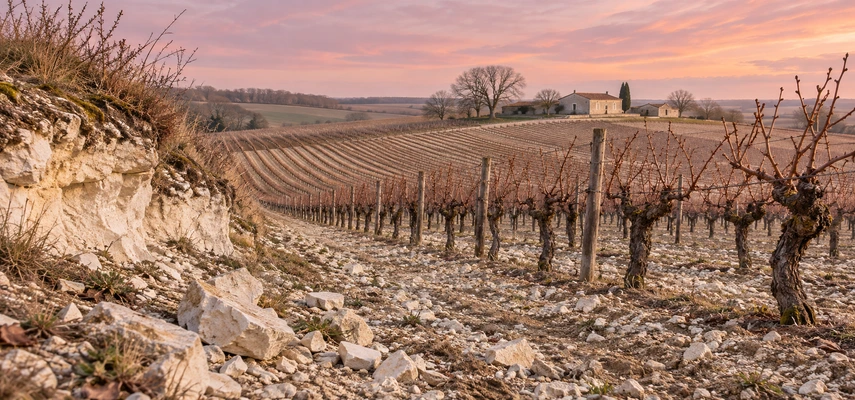
Soils, climate, grape growing and local production traditions help establish the regional context. They influence the material available to the producer, but they do not bypass fermentation, distillation or maturation. A chalk-rich origin does not mean pieces of chalk are distilled into the spirit, and a violet descriptor does not mean flowers were added.
Imagine two stocks from the same cru. One is distilled with fine lees, the other from clearer wine; their cuts and cask histories differ too. Sharing an origin does not force them into an identical sensory profile. The cellar master assesses the actual stocks, using origin as useful background rather than a substitute for tasting.
This also prevents an unhelpful geographical league table. A region associated with long maturation can provide valuable material for one objective, while a more immediately expressive stock can serve another. Suitability depends on the intended release. Ranking every bottle solely by the presumed prestige of its cru misses both production skill and the consumer’s actual experience.
Fine Champagne has a precise composition
Fine Champagne combines eaux-de-vie from Grande Champagne and Petite Champagne, with at least 50% from Grande Champagne. The BNIC’s current origin guide states this distinction explicitly. No Borderies or Fins Bois component belongs in that specified combination, however appealing it might be in a different Cognac blend.
Try three hypothetical recipes. A 60% Grande Champagne and 40% Petite Champagne combination meets the geographical proportions. A 40% Grande Champagne and 60% Petite Champagne combination does not meet the minimum Grande Champagne share. A 60% Grande Champagne, 30% Petite Champagne and 10% Borderies mixture also falls outside Fine Champagne because the permitted origin set is exclusive.
Notice how little sensory prediction those arithmetic examples require. They test a composition rule. The first recipe can qualify geographically without proving that its components make the best possible blend. Legal eligibility and sensory achievement are different checks, and a good production answer gives each the evidence it needs.
The main age terms describe minimums
For the principal classifications, remember VS at least two years, VSOP at least four, XO at least ten and XXO at least fourteen. Napoléon has a six-year minimum. The relevant age is that of the youngest component, under the controlled maturation system. These figures are minimum guarantees rather than a complete inventory of every stock in the blend.
An XO may therefore contain components considerably older than ten. It need not contain a ten-year-old component exactly, and its label does not give a mathematical average. Likewise, VSOP does not require the producer to discard every stock on its fourth birthday. The category leaves room for selection above the threshold.
Hors d’âge is another important term: in Cognac it sits with a minimum of ten years, alongside the XO threshold. Its ordinary-language impression should not be translated into a claim that age is unregulated or literally beyond counting. Learn the controlled use rather than inventing a legal meaning from the poetry of the words.
Youngest-component age survives the arithmetic
Suppose a hypothetical blend contains four-, eight- and twelve-year-old eaux-de-vie. The presence of the oldest stock does not make the entire blend twelve years old. Its youngest component establishes the relevant minimum-age position. Adding more twelve-year-old stock does not remove the four-year-old material already present.
Now suppose the producer replaces that four-year-old component with an appropriate six-year-old stock. The age position changes, but the sensory result must be checked separately. The new stock may bring a different fruit profile, wood influence or texture. Meeting an age threshold is a compositional fact; preserving a successful house style requires another set of decisions.
This is why averaging ages is such a poor shortcut. It creates a tidy number while concealing the youngest material. In study exercises, list the component ages, identify the youngest and then apply the term’s minimum. Deal with aroma or quality only after the classification question has been answered correctly.
Bottle time does not become more oak age
Cognac’s age reflects qualifying maturation, not years sitting in a drinks cabinet. A VSOP bottled long ago does not quietly become XO while its owner waits. The bottle can have a long history without the spirit acquiring additional time in oak. The same distinction matters when developed stocks are held in glass rather than left extracting from wood.
That does not require a claim that every chemical feature of a stored bottle is perfectly immutable. Storage conditions and closure behavior can matter to condition. The narrower point is that calendar time after bottling does not advance the controlled maturation classification. Condition and qualifying age are different questions.
Vintage information also answers a different question from an age category. A vintage identifies a harvest year under the applicable traceability requirements; it does not independently disclose the bottling date or total time in oak. You need the relevant history before calculating maturation. A date is useful only when you know what event it dates.
Blending turns separate histories into a style
A cellar master works with stocks that differ in origin, distillation, cask history and development. BNIC’s production account describes selection and blending as central creative stages. The purpose can include consistency and complexity, but it is the interaction among the actual stocks that matters, rather than simply the number of vessels emptied into a vat.
For example, a stock with vivid fruit can bring lift, while a more developed stock may add depth or persistence. Too much of either could upset the target relationship. Trial proportions help establish whether they complement each other or compete. Blending offers control, but the blender still needs appropriate material and sensory judgment.
Consistency can require a changing formula. If this year’s fruit-driven stock is more pronounced, repeating last year’s percentages may change the finished impression. Selecting alternatives or adjusting proportions can better preserve the intended style. A consistent result is an achievement of active assessment, not evidence that the ingredients never vary.
Read a label, then taste the Cognac
Return to Fine Champagne VSOP. You can now state its specified origin relationship and minimum youngest-component age. You cannot infer its exact average age, the number of components, a compulsory oak intensity or a guaranteed quality score. Those questions need additional evidence from the producer or the sample.
In tasting, connect fruit, flowers, wood, developed character, alcohol and texture into an assessment of balance and integration. Consider persistence and complexity without awarding points merely for age terminology. An expressive younger release and a mature XO have different opportunities; either can succeed or disappoint relative to its purpose.
What to remember
Separate three tasks: locate the origin, establish the minimum age and assess the finished blend. Know all six crus, the exclusive Grande-and-Petite Champagne rule for Fine Champagne and the youngest-component basis of age terms. Then use production history and sensory evidence to explain style. The letters become much less mysterious once each is allowed to do its own job.
Written practice: original TFE exercises
These suggested marks and indicative points are independent teaching guidance, not official WSET marking schemes.
Exercise 1: 5 suggested marks
State the minimum ages associated with VS, VSOP, Napoléon, XO and XXO Cognac. Mapping: LO2 state/describe: Cognac classification.
Indicative marking points:
- VS: two years.
- VSOP: four years.
- Napoléon: six years.
- XO: ten years.
- XXO: fourteen years.
Model answer: The minimum ages are two years for VS, four for VSOP, six for Napoléon, ten for XO and fourteen for XXO. These are minimum maturation classifications based on the youngest component, rather than the average age of a blend.
Why it works: It supplies one distinct factual age for each requested term, with the correct interpretive basis.
Common mistake: Using the former six-year XO threshold gives an outdated current classification.
Exercise 2: 5 suggested marks
Explain why a blender may change component proportions to preserve an established Cognac style. Mapping: LO1 explain: blending for consistency.
Indicative marking points:
- Available stocks can vary.
- A changed component can alter the mixture aroma or texture.
- Repeating the old proportions may therefore change the finished balance.
- Alternative selections or proportions can move the mixture toward the target.
- Trial blending and assessment confirm whether consistency is restored.
Model answer: Stocks can vary, so a changed component may alter aroma or texture even when the old proportions are repeated. The blender can adjust selections or proportions to move the mixture back toward the target balance. Trial blending and sensory assessment are needed to establish whether the intended consistency has been restored.
Why it works: The answer follows component variation through mixture effects into a justified control response.
Common mistake: Assuming an unchanged recipe guarantees an unchanged sensory result overlooks variation in the ingredients.
Knowledge check: 10 original practice questions
Independent TFE questions, not official WSET examination items. Choose one answer per question; explanations follow separately.
1. Which age governs a blend containing four-, eight- and twelve-year-old stocks?
2. Why can a consistent blend need adjusted proportions?
3. What is the VSOP minimum?
4. What is the current XO minimum?
5. What is the XXO minimum?
6. Which hypothetical origin recipe can meet Fine Champagne proportions?
7. Does ten years in bottle turn VSOP into XO?
8. What can a cru name alone not establish?
9. Which is not a seventh Cognac cru?
10. What is the minimum Grande Champagne share in Fine Champagne?
Answers and explanations
- B — The four-year-old youngest component. The oldest or average age cannot replace the youngest-component basis. Mapping: LO2.
- D — Available stocks can vary in sensory character. Assessment and recipe adjustment can preserve a target result when components change. Mapping: LO1.
- C — Four years. The minimum applies through the controlled youngest-component age basis. Mapping: LO2.
- B — Ten years. XO has a ten-year minimum; the older six-year figure should not be used as the current rule. Mapping: LO2.
- A — Fourteen years. XXO has its own fourteen-year minimum rather than simply repeating XO. Mapping: LO2.
- B — 60% Grande Champagne and 40% Petite Champagne. Only the first stays within the specified two-origin combination and meets the minimum. Mapping: LO2.
- A — No, bottle time adds no qualifying oak maturation. Calendar history after bottling does not advance the controlled maturation classification. Mapping: LO2.
- C — The complete sensory quality of a specific bottle. Origin supplies context while distillation, maturation, selection and execution still matter. Mapping: LO2.
- D — Fine Champagne. Fine Champagne is a specified Grande and Petite Champagne combination rather than another cru. Mapping: LO2.
- B — 50%. The blend must draw exclusively from Grande and Petite Champagne and meet the Grande Champagne minimum. Mapping: LO2.
Continue exploring this series
9. Oak Maturation Explained: Barrels, Oxygen, Evaporation, and Flavor Development
10. Spirits Finishing Explained: Blending, Filtration, Sweetening, Coloring, and Packaging
17. Cognac Explained: Grapes, Double Distillation, Oak, and Quality
19. Armagnac Explained: Grapes, Column Distillation, and Regional Styles
20. Cognac vs. Armagnac: How Production Decisions Shape Two Great Brandies
29. Spirits Quality Explained: How Production Decisions Affect Balance and Complexity
30. How to Explain Spirits Production: Advanced Cause-and-Effect Case Studies
50. WSET Level 3 Spirits Exam: Complete Revision Guide and Practice Examinations











