










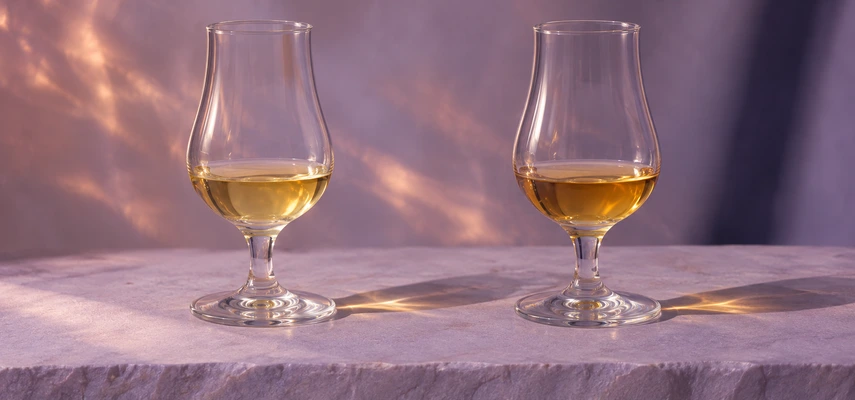

Cognac vs. Armagnac is often presented as a choice between elegance and rustic power. That is memorable, but it explains very little. An elegant Armagnac and a forceful Cognac are not production errors. Both names cover spirits shaped by grapes, fermentation, distillation, maturation and selection, with plenty of variation inside their protected frameworks.
A useful comparison asks what changed, how that change acts and what consequence might follow. Then it asks what else could influence the result. This lesson puts that method to work. By the end, you should be able to discuss two actual samples without relying on the notion that one region has exclusive rights to finesse.
Cognac vs. Armagnac starts with a shared foundation
Both are protected French wine spirits. Their production begins with grapes, then wine, rather than the starch conversion required for a cereal mash. Relatively low-alcohol, acidic base wines are important to both traditions. The wines are prepared for distillation and subsequent development, so their suitability is judged for that purpose rather than as finished table wines.
Both also depend on sound handling. Good acidity does not make wine indestructible, and a still does not guarantee that unwanted volatile character disappears. Fermentation supplies alcohol and additional compounds that the distiller must manage. Similarities at this stage explain why the two subjects belong together before their equipment and maturation routes begin to diverge.
Their separate rules remain essential. The June 2026 Cognac specification and April 2025 Armagnac specification define different origins and conditions. Shared raw material does not make the appellations interchangeable, any more than two grain spirits become the same category because both begin with cereal.
Compare grapes without turning them into destiny
Ugni Blanc is central to Cognac and also important in Armagnac. Armagnac’s principal grape discussion additionally gives Baco a distinctive place, alongside Folle Blanche and Colombard. The useful contrast concerns the starting materials available and commonly selected, rather than a claim that every bottle from either region uses an identical recipe.
A grape can influence acidity, potential alcohol, aroma precursors and practical growing performance. Those properties affect the wine supplied to the still. They are several steps removed from a mature spirit’s final balance, however. A ripe-fruit association in an aged Armagnac cannot be assigned exclusively to Baco without knowing the wine, separation and maturation history.
For a stronger explanation, say that the chosen grape and its condition influence the feed composition, which creates possibilities for fermentation and distillation. That is a causal connection. Saying Baco tastes of Armagnac and Ugni Blanc tastes of Cognac is a circular label exercise that leaves the actual transformations unexplained.
Fermentation can strengthen or blur the difference
The two regions both transform grape sugars through yeast fermentation. Strain, temperature, nutrition and microbial conditions influence the compounds produced alongside ethanol. Similar grape names do not ensure identical fermentation results, while different grapes can still lead to spirits with overlapping aroma families. The organism and its working environment matter.
Lees management adds another variable. Fine yeast-related material can change what is heated and separated, influencing the resulting composition. Cognac producers can take different approaches to distilling with or without fine lees; Armagnac has its own feed requirements. The word lees should trigger a question about the actual material and method, rather than a universal conclusion about quality.
Imagine two wines with the same measured alcohol concentration. One carries more suitable fine lees and differs in aroma-related composition. Similar starting strength has not made them equivalent distillation feeds. This is why a production answer improves when it describes what the wine contains, rather than reducing the entire fermentation to an alcohol percentage.
Cognac separates through two batch distillations
In the Charentais route, the first chauffe produces brouillis from wine. The second, or bonne chauffe, provides further concentration and fraction selection. The batch changes as the run proceeds, so the distiller makes cuts through time and manages returned fractions. BNIC describes that sequence as part of the protected production process.
The resulting heart reflects more than the number two. Feed, copper contact, heating, reflux opportunities, cut positions and recycling all contribute. Two runs do not automatically remove every heavy compound or produce one compulsory light style. A distiller can work toward different balances while using the same broad equipment category.
That observation matters when comparing with Armagnac. If you call Cognac delicate solely because it is distilled twice, you have skipped the selection decisions that make the process useful. Describe what the repeated separation allows the producer to control. Then connect those controls to a qualified result in the particular spirit.
Traditional Armagnac uses continuous contact
The common alambic armagnacais balances descending wine with rising vapor through a compact working column. Repeated phase contact enriches the vapor, while the liquid loses alcohol as it moves downward. Condensation recovers the selected vapor as liquid eau-de-vie. The BNIA account explains how cooling and preheating also connect within the system.
Its relatively limited rectification can retain substantial wine-derived character. This is different from running a large multi-column arrangement for highly neutral alcohol. Equipment belongs to a working process: column shape by itself cannot establish the final composition. Armagnac is a particularly useful example when challenging the assumption that continuous means bland.
Some Armagnac also follows a permitted batch double-distillation route. A comparison should therefore identify the predominant traditional contrast without saying all Armagnac is continuous. This qualification changes the logic of a blind-tasting answer: a production tendency can support a hypothesis, but it cannot make an alternative legal route impossible.
Strength is one clue among several
The current Cognac maximum distillate strength is 73.7% ABV. The principal continuous Armagnac apparatus has a 52–72.4% ABV daily-receiver range, while its accessory batch route has a different lower bound. These figures define legal conditions at particular production stages; they are not a requirement that every producer operates at a maximum.
Traditional Armagnac can emerge at relatively low strength with substantial retained character. That supports a plausible explanation for some fuller examples. It does not establish that the lower number alone causes every sensation of richness. Feed composition, actual separation and the later maturation remain part of the answer.
Keep bottling strength separate too. Water adjustment changes the final alcohol-water environment and can affect aroma release and texture. Comparing a stronger bottled sample with a weaker one without acknowledging that difference can confuse production character with presentation. The still’s collection strength and the consumer’s glass strength are different facts.
Oak can make the styles converge or diverge
Both matured traditions use oak, with choices about vessel history, wood characteristics, size, heating and cellar conditions. An active cask can add prominent wood influence; a more exhausted vessel offers another extractive environment. Those decisions can bring two otherwise different new spirits toward overlapping vanilla, spice or developed-fruit associations.
Conversely, different cask strategies can push two similar distillates apart. Imagine one spirit spending a controlled period in fresh oak before transfer, while another receives prolonged contact with more active wood. Their eventual difference cannot be attributed solely to whether the original apparatus had a pot or a column. The barrel has made a contribution that needs its own explanation.
Temperature, humidity, evaporation and oxygen-related development add further variation. Time permits change, but extraction and desirable integration do not advance in perfect lockstep. An older spirit can become unbalanced, while a younger one can deliver an excellent version of its intended style. Age is part of the history rather than a universal quality score.
Classification tells you what the history means
Cognac’s familiar VS, VSOP, XO and XXO terms set minimum youngest-component ages. Armagnac also uses age designations and frequently presents vintages. A vintage identifies a harvest year, not necessarily one cask or the entire time spent in wood. Bottling date and maturation history supply additional information needed for an accurate interpretation.
BNIA’s vintage discussion also makes clear that blending is widely practised. Do not contrast blended Cognac with supposedly unblended Armagnac as if that were the category definition. Both can involve deliberate selection, and an individual vintage can still include appropriate material from more than one vessel.
Blanche Armagnac provides another useful exception to an overly simple comparison. Its inert-container rest creates a colorless route rather than a wood-aged amber style. Compare it with an appropriate purpose in mind. Penalizing it for lacking mature oak character would be like judging a fresh fruit on whether it tastes convincingly dried.
Build a comparison around the two actual samples
Suppose sample A shows lifted fruit, restrained wood and a relatively delicate palate, while B shows fuller texture, dried fruit and stronger oak. Those are observations, not immediate proofs of Cognac and Armagnac identities. They suggest production and maturation questions that you can investigate or discuss conditionally.
For B, retained congeners from a particular feed and separation could help explain weight, while maturation could explain dried-fruit and oak influence. For A, a different distillate and cask strategy could preserve lift. Several combinations might produce those patterns. A good explanation identifies plausible mechanisms without claiming more certainty than the evidence supports.
Quality is then assessed through balance, persistence, complexity and integration. A more intense sample can be less harmonious; a delicate one can be short and simple or exceptionally detailed. Distinguish the style description from the quality conclusion, and support each with the relevant sensory evidence.
What to remember
Begin with shared wine production, then compare grapes, feed, separation, oak and selection. State Cognac’s batch double route and Armagnac’s predominant continuous route accurately, including the permitted alternative. Use legal and age information as context. The strongest comparison explains a chain of decisions and tests it against the glass, rather than making two famous names do all the work.
Written practice: original TFE exercises
These suggested marks and indicative points are independent teaching guidance, not official WSET marking schemes.
Exercise 1: 5 suggested marks
Explain why knowing that a spirit is column distilled is insufficient to predict a neutral flavor. Mapping: LO2 explain: distillation choices.
Indicative marking points:
- Columns can differ in design.
- Their operating conditions can differ.
- These differences change phase contact and separation.
- Different balances of congeners can remain in the distillate.
- Retained character must therefore be assessed for the actual system and feed.
Model answer: Columns differ in design and operation, changing phase contact and separation. They can therefore retain different balances of congeners rather than all producing neutral alcohol. Prediction requires the actual system and feed, followed by assessment of the resulting distillate.
Why it works: The explanation connects equipment and operation to composition without relying on an equipment stereotype.
Common mistake: Equating every column with a neutral-spirit plant ignores its working target.
Exercise 2: 5 suggested marks
Explain how different cask strategies could make two similar new spirits develop different styles. Mapping: LO2 explain: maturation choices.
Indicative marking points:
- Casks can differ in available extractable compounds.
- Their wood contributions can therefore differ.
- Different histories and conditions also affect development.
- Those changes alter the balance with the initial spirit character.
- Selection and time management determine whether the resulting styles meet their targets.
Model answer: Different casks offer different extractable material and development environments. Their contributions can change the balance with the same initial spirit character in different ways. Time management and selection then determine whether those diverging styles meet the intended targets.
Why it works: It holds the new spirit similar while tracing differences in vessel environment into style and control decisions.
Common mistake: Attributing every mature difference to the original still ignores subsequent cask effects.
Knowledge check: 10 original practice questions
Independent TFE questions, not official WSET examination items. Choose one answer per question; explanations follow separately.
1. Does two-stage distillation alone guarantee delicate Cognac?
2. Which variable can make similar distillates develop differently?
3. What is the useful predominant distillation contrast?
4. What do Cognac and Armagnac share at the raw-material stage?
5. What does a vintage year alone fail to establish?
6. How should a fuller sample be explained?
7. Which statement about blending is sound?
8. What distinguishes style from quality?
9. Why is a traditional Armagnac column not equivalent to a neutral-spirit plant?
10. What makes Blanche Armagnac a useful qualification?
Answers and explanations
- C — No, feed, cuts and operation also matter. The number of distillations does not independently determine retained composition. Mapping: LO2.
- C — Cask history and activity. Wood extraction and development contribute separately to the final spirit. Mapping: LO2.
- D — Cognac batch double versus commonly continuous Armagnac. The contrast must retain the qualification that a batch Armagnac route is permitted. Mapping: LO2.
- B — Wine made from grapes. Both are protected wine spirits, though their separate frameworks and choices differ. Mapping: LO2.
- D — Total time spent in oak. Additional maturation and bottling history is needed. Mapping: LO2.
- C — Through plausible feed, separation and maturation mechanisms. Several connected variables can influence perceived weight and character. Mapping: LO2.
- B — It is practised in both traditions. Selection and combination are not exclusive to one appellation. Mapping: LO2.
- A — Style describes character while quality needs evaluative evidence. Balance, persistence, complexity and integration support the quality conclusion. Mapping: LO2.
- A — Its arrangement and operating target differ. Phase contact can be used for different degrees and patterns of separation. Mapping: LO2.
- D — Its inert rest differs from the wood-aged route. Its intended colorless style should not be assessed as if it were an old oak-aged release. Mapping: LO2.
Continue exploring this series
5. Distillation Science Explained: Volatility, Congeners, Reflux, and Rectification
6. Pot Still Distillation Explained: Design, Heating, Cuts, and Flavor
7. Column and Hybrid Stills Explained: Plates, Reflux, and Continuous Distillation
9. Oak Maturation Explained: Barrels, Oxygen, Evaporation, and Flavor Development
10. Spirits Finishing Explained: Blending, Filtration, Sweetening, Coloring, and Packaging
16. How Fruit Spirits Are Made: Grapes, Wine, Pomace, and Fermentation
17. Cognac Explained: Grapes, Double Distillation, Oak, and Quality
18. Cognac Classifications Explained: Crus, Age Statements, and Blending
19. Armagnac Explained: Grapes, Column Distillation, and Regional Styles
29. Spirits Quality Explained: How Production Decisions Affect Balance and Complexity
30. How to Explain Spirits Production: Advanced Cause-and-Effect Case Studies
47. How to Assess Spirits Quality: Balance, Complexity, and Evidence
48. WSET Level 3 Blind Tasting Practice: Spirit Identification and Quality Assessment
49. How to Answer WSET Level 3 Spirits Written Questions: Structure, Reasoning, and Marks
21. Sugar Cane Spirits Explained: Juice, Syrup, Molasses, and Fermentation
50. WSET Level 3 Spirits Exam: Complete Revision Guide and Practice Examinations












