










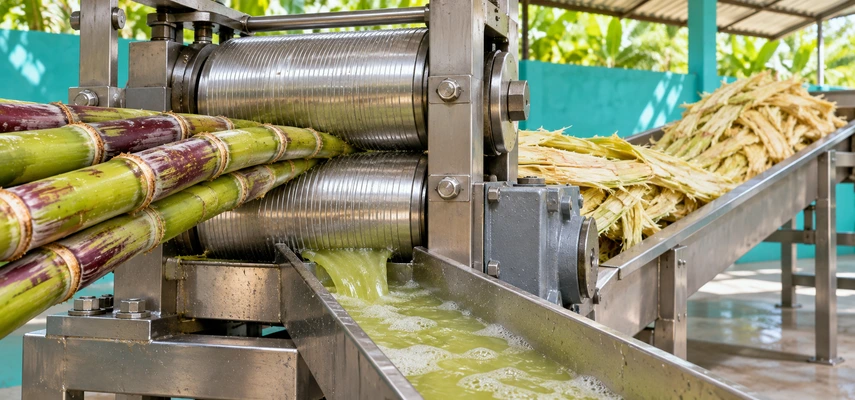

Sugar cane spirits begin with a plant that has already done much of the carbohydrate preparation. The stalk stores sugars, especially sucrose, that can become fermentation feed without a grain-style starch-conversion stage. Yet fresh juice, concentrated syrup and molasses are far from interchangeable. They arrive at the fermenter with different histories, concentrations and practical demands.
The easiest way to understand those differences is to follow the sugar factory as well as the distillery. Crushing releases juice. Removing water concentrates it. Crystallising and separating sugar leaves a different liquid behind. Each operation changes the material available for yeast, and fermentation then creates both alcohol and the beginnings of much of the spirit’s aroma.
Sugar cane spirits start inside the stalk
Cane is a grass whose stalk stores useful sugars in a fibrous structure. Variety, maturity, growing conditions and the condition of the harvested cane affect the starting material. The useful question is not simply how tall the plants look. A producer needs suitable sugar-bearing material delivered in a condition that supports the intended process.
Harvest also starts a logistical race. Cut cane can deteriorate, with unwanted microbial changes and losses of useful sugar. CIRAD’s cane account explains why moving harvested stalks to processing promptly matters. The best fermentation plan cannot fully recover the original condition of material that has been poorly held before crushing.
This connects agriculture with distillery capacity. Harvest, transport, milling and fermentation need to work together. Cutting much more cane than the system can process well may create a quality problem before yeast is deliberately added. Freshness is a managed production condition, not merely an attractive word on a label.
Crushing releases juice and leaves bagasse
Preparation opens the stalk structure, and mills press out the sugar-bearing juice. Water can assist extraction through the fibrous material. The remaining fibre is bagasse, which can be used as fuel in suitable production systems. Juice and bagasse are different outputs: one carries the intended soluble fermentation material, while the other is principally a physical fibre residue.
The producer then needs appropriate handling of the extracted liquid. Its sugar concentration, temperature, suspended matter and condition affect the next stage. Crushing has released sugar; it has not made alcohol. The distinction is the same one encountered with pressed grapes: physical extraction supplies a medium for a later biological process.
For a concrete fresh-juice example, Clément describes rapid crushing after harvest in its Martinique production. That illustrates a deliberate approach to retaining fresh material. It does not establish a universal schedule for every sugar cane spirit, nor make the exact arrangement of one producer’s mill part of the definition of fermentation.
Syrup concentrates the juice
Removing water from juice raises the concentration of dissolved material and produces syrup. The sugar has not been created by that concentration step; it has been brought into a smaller water volume. Heat treatment and storage introduce a different history from promptly fermented fresh juice, with potential consequences for handling and aroma-related material.
Concentration can make storage and transport more practical, but a dense syrup is not automatically a suitable fermentation medium without further preparation. Yeast needs an appropriate environment, including water availability and manageable sugar concentration. The convenience of the stored raw material and the organism’s preferred working conditions are separate design problems.
Do not confuse cane syrup with molasses. Both can be viscous, and their appearances can overlap. The difference is the production route: concentrating juice is not the same operation as removing a portion of its sucrose as crystals. Ask what has been separated, rather than trying to classify every sample by how slowly it pours.
Molasses remains after sugar separation
In sugar production, concentrated material is processed so sucrose crystallises. Separating those crystals leaves a liquid containing remaining sugars and other dissolved material. Further processing can remove additional recoverable sugar and change the residual liquid’s composition. Molasses is therefore a sugar-industry co-product with useful fermentable material, not a synonym for pure liquid sucrose.
The proportions of fermentable sugars, minerals and other components vary with the source and manufacturing history. Two deliveries with similar appearance need not perform identically. A distiller benefits from understanding the actual material, especially when trying to reproduce yield and aroma from one batch to the next.
Brown sugar belongs in this production map too. Some forms retain a proportion of molasses associated with the crystals; commercial products can also combine refined crystals with molasses. The material’s actual composition matters more than an assumption that every brown sugar was made by one identical route. It is not the same physical feed as an unseparated vat of cane juice.
Prepare a liquid that yeast can work in
Molasses and syrup commonly need dilution. Adding suitable water lowers the concentration and changes the environment around the cells. Too much initial dissolved material can create osmotic stress, while inappropriate temperature or acidity creates additional problems. More sugar per litre does not automatically mean more useful alcohol produced per unit of processing time.
Sucrose also has to become usable through the organism’s relevant enzyme activity. That is different from converting grain starch: the starting carbohydrate and required transformations differ. Keep the scale of the problem clear. Cane preparation does not normally need a cereal mash simply because enzymes are involved somewhere in yeast metabolism.
Water, nutrients and process conditions must be considered together. The Lallemand yeast-nutrition guidance emphasizes that sugar availability alone is not complete nutrition. Nitrogen, minerals and vitamins support cell functions, with needs affected by the substrate. A dark, mineral-rich molasses is not automatically balanced in every nutrient the chosen yeast requires.
Yeast makes alcohol and more than alcohol
During fermentation, yeast uses available sugars to produce ethanol, carbon dioxide and other compounds. Some contribute directly to aroma; others provide material for later transformations. Strain selection, temperature, nutrition and fermentation management influence that mix. The raw-material route creates a starting environment, while the organism develops it into a different medium.
For example, two fermentations can reach similar alcohol levels while differing in aroma-related composition. That difference matters to the still. Measuring ethanol alone cannot establish that the feeds will yield identical spirits, because the distiller is separating more than an alcohol-water mixture. Fermentation performance and flavor development belong in the same discussion.
This also explains why a sweet-smelling rum need not retain the original cane sugar through distillation. Volatile aroma compounds can suggest fruit, caramel or sweetness without being a measurement of sugar. Actual sweetening of a finished product is another operation governed by its applicable rules. Keep sensory association and ingredient claims separate.
Short and long fermentations serve different aims
A relatively short, controlled fermentation can prioritize reliable alcohol production and a particular balance of congeners. It can limit the opportunity for extensive additional microbial changes. That is useful for some style targets, especially where the producer wants a relatively restrained fermentation-derived profile to combine with later separation and maturation choices.
An extended fermentation can create more opportunity for microbial activity and changes in acids and other aroma-related material. Hampden describes extended fermentation as central to its high-ester style. This is one purposeful production approach, not evidence that every longer fermentation automatically becomes more complex or better balanced.
Duration is a condition, not a complete microbial description. A long fermentation with one culture and environment differs from a long fermentation with another. Temperature, feed, available nutrients and the organisms present determine what can happen over that time. An exam answer saying longer equals more flavor needs the missing mechanism filled in.
Acids and alcohols help explain ester development
Esters can arise through yeast pathways and through reactions involving alcohols and acids. Some are associated with fruity or floral aromas, though the family is chemically diverse. Changing the available acids, alcohols and reaction conditions can therefore change the aroma possibilities. It is more useful to follow those reactants than to treat funk as a substance added from a bottle.
In some systems, bacterial activity and recycled production material help shape the acidic environment or supply relevant compounds. Heriot-Watt research on dunder found changes in measured esters and higher alcohols in its tested fermentations. That supports the importance of microbial and feed management without proving an identical result for every distillery or recipe.
Dunder is material remaining after an earlier distillation; its subsequent handling and condition matter. It should not be confused automatically with every cultured material or muck preparation used in particular traditions. Nor does it mean that yeast survived the distillation unchanged. Recycled material can contribute through composition and its later microbial history.
The still receives the result of those choices
Fermentation supplies the volatile mixture that distillation will concentrate and select. A highly expressive wash can be treated differently from a more restrained one, and different separation systems can retain different proportions of its compounds. You cannot predict the final spirit from fermentation time alone without considering what the still does next.
The same principle applies to quality. A pronounced ester profile can be exciting, useful in blending or overwhelming in the wrong balance. More analytical ester content is not a universal quality score. Assess whether the spirit achieves its intended character with appropriate integration, rather than rewarding the highest number regardless of what the glass contains.
What to remember
Trace juice extraction, concentration and sugar separation before discussing fermentation. Distinguish bagasse, syrup, molasses and brown sugar, then explain dilution and nutrition as preparation for a working organism. For short or long fermentations, identify the microbial and chemical opportunities involved. The final aroma begins with cane, but the route from stalk to still gives it much of its personality.
Written practice: original TFE exercises
These suggested marks and indicative points are independent teaching guidance, not official WSET marking schemes.
Exercise 1: 5 suggested marks
Explain why fermenting an undiluted concentrated cane syrup may perform poorly despite its abundant sugar. Mapping: LO2 explain: creating a sugary liquid.
Indicative marking points:
- The syrup has a high dissolved concentration.
- This can create osmotic stress for yeast.
- Cell performance can therefore be impaired.
- Sugar abundance does not supply every other required nutrient.
- Appropriate dilution and nutrient management create a more suitable fermentation environment.
Model answer: A concentrated syrup can impose osmotic stress on yeast, impairing cell performance despite abundant sugar. It may also lack a suitable balance of other nutrients. Appropriate dilution and nutrient management therefore help create a working environment in which the yeast can use the available sugar effectively.
Why it works: It links feed concentration with cell conditions and distinguishes substrate quantity from complete nutrition.
Common mistake: Assuming the sweetest feed must ferment best ignores the organism’s working limits.
Exercise 2: 5 suggested marks
Explain how an extended fermentation with appropriate microbial activity could change the eventual ester profile. Mapping: LO2 explain: long fermentation and ester development.
Indicative marking points:
- More time permits additional microbial activity under suitable conditions.
- That activity can change available organic acids.
- Alcohols are also present or produced.
- Acids and alcohols provide material for ester-related pathways or reactions.
- The resulting profile depends on conditions and later separation rather than duration alone.
Model answer: An extended fermentation can permit microbial activity that changes available organic acids, alongside the alcohols already present or being produced. Those materials contribute to ester-related pathways and reactions, changing the aroma possibilities. The result still depends on conditions and later separation, so time alone does not guarantee a particular profile.
Why it works: The answer supplies a mechanism connecting duration, microbes, reactants and a qualified sensory possibility.
Common mistake: Writing longer always means better omits both the chemical mechanism and the intended balance.
Knowledge check: 10 original practice questions
Independent TFE questions, not official WSET examination items. Choose one answer per question; explanations follow separately.
1. What can an extended fermentation provide?
2. What is bagasse?
3. What distinguishes cane syrup from molasses most usefully?
4. Why does sugar availability not establish complete yeast nutrition?
5. What does a high ester measurement alone not prove?
6. Which materials are relevant to ester formation?
7. Can similar final wash alcohol levels conceal different flavor composition?
8. Which statement about brown sugar is safest?
9. What is a sound statement about dunder?
10. Why is dense molasses commonly diluted before fermentation?
Answers and explanations
- A — More opportunity for relevant microbial and chemical changes. Time allows possibilities whose results depend on the organisms and conditions. Mapping: LO2.
- B — Fibrous residue after juice extraction. The physical fibre and extracted sugar-bearing liquid are different mill outputs. Mapping: LO2.
- D — Its concentration route rather than removal of sugar crystals. Syrup concentrates juice; molasses is residual liquid after sugar crystallisation and separation. Mapping: LO2.
- A — Cells need other nutrients for their functions. Nitrogen, minerals and vitamins can matter independently of fermentable sugar. Mapping: LO2.
- D — Superior sensory quality. Balance and intended style matter alongside the analytical amount. Mapping: LO2.
- B — Alcohols and acids. Those reactants and yeast pathways help explain changes in ester composition. Mapping: LO2.
- B — Yes, other fermentation products can differ. Alcohol measurement does not describe the full congener mix supplied to the still. Mapping: LO2.
- A — Its actual composition and manufacturing route matter. Brown sugar can retain molasses or be made by combining crystals with it; it is not one universal liquid feed. Mapping: LO2.
- A — Its composition and subsequent handling affect its contribution. Recycled material has its own production and storage history, which must be understood. Mapping: LO2.
- B — To create suitable concentration and water conditions. Dilution can reduce osmotic stress and create a manageable fermentation medium. Mapping: LO2.
Continue exploring this series
2. Carbohydrates Explained: How Sugar, Starch, and Fructans Become Fermentable
3. Alcoholic Fermentation Explained: Yeast, Nutrients, and Flavor Compounds
5. Distillation Science Explained: Volatility, Congeners, Reflux, and Rectification
8. How Distillers Manage Flavor: Sulfur, Esterification, Pressure, and Distillation Choices
22. Caribbean Rum Explained: Distillation, Regional Traditions, and Quality
32. Shōchū Explained: Honkaku Shōchū, Awamori, and Japanese Distillation
33. Baijiu Explained: Qu, Solid-State Fermentation, and China’s Major Styles
20. Cognac vs. Armagnac: How Production Decisions Shape Two Great Brandies
50. WSET Level 3 Spirits Exam: Complete Revision Guide and Practice Examinations












