











Baijiu can be fruity, floral, earthy, savory or surprisingly restrained, sometimes with several of those qualities in the same glass. Treating it as one strong Chinese drink misses the useful story. This is a family of grain spirits whose different starters, fermentation arrangements and distillation routes produce markedly different compositions.
The four principal styles in this lesson are strong aroma, sauce aroma, light aroma and rice aroma. Their names are helpful organizing terms, but they need a production explanation behind them. For WSET Level 3, baijiu belongs to Learning Outcome 3; the practice questions therefore test prescribed knowledge without adding written-exam tasks for this category.
Baijiu begins with grain, but not always one grain
Sorghum is particularly important, while rice and other cereals appear in different production traditions. Some recipes use a single main grain; others use a combination. Their starch, physical structure and other constituents give the producer different starting materials. The raw material must be prepared so that conversion and fermentation can proceed.
Steeping, steaming, cooling and mixing belong to that preparation. The details vary with the production route. Do not assume every baijiu begins as a clear liquid wort like a particular whisky process. Much traditional production retains grain solids as the physical setting for fermentation, which changes how the later stages need to be understood.
Rice husks may be included as a structural aid in some processes. They can help maintain the physical arrangement of the grain bed rather than supplying the same fermentable contribution as the principal cereal. A materials list therefore needs attention to function, just as a botanical list needs attention to which part is actually extracted.
Qu supplies a community and an enzyme system
Qu is a grain-based starter material associated with microorganisms and their enzymes. Molds, yeasts and bacteria can have different functions in the system. Enzymes release fermentable material from starch; yeast contributes alcoholic fermentation; bacterial activity and other transformations influence the mixture. Calling qu simply yeast leaves out much of its role.
An original study of Xiaoqu communities and volatile compounds found differences among starters from several regions. That supports treating a starter as a variable biological material. The reported correlations do not establish that one named organism alone causes every characteristic aroma in all baijiu.
Qu and Japanese koji help solve a related starch-conversion problem, but they should not be treated as identical production systems. Their materials, cultivation and microbial relationships differ. The useful comparison is functional: a prepared biological source can provide conversion capability. The details of how that source is produced still belong to the individual tradition.
Daqu, Xiaoqu and Fuqu describe different starter traditions
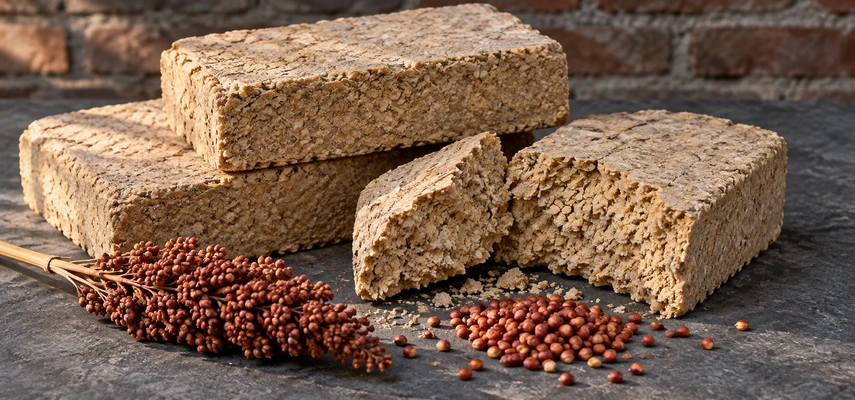
Daqu, or large qu, commonly takes the form of substantial grain bricks and can involve wheat, barley or peas. Xiaoqu, or small qu, is associated with different preparations including rice-derived materials. Fuqu uses bran-based cultivation. These terms organize differences in starter production rather than measuring a finished spirit’s quality by the physical size of a cake.
Temperature during starter cultivation helps shape the selected community and its activity. This is a different stage from the later fermentation of the spirit’s main grain material. Distinguish growing and conditioning the starter from applying it in production; otherwise a remembered temperature can easily end up attached to the wrong vessel or operation.
Starter choice is also not a perfect one-to-one code for the four aroma styles. For example, light-aroma production includes more than one starter tradition. Learn the characteristic associations while leaving room for the documented variations. A useful classification helps organize the family without pretending every distiller follows a single national recipe.
Solid-state fermentation still needs moisture
In solid-state production, the fermenting material remains a moist mass of grain rather than becoming a freely flowing liquid wash. Solid does not mean dry: microorganisms and enzymes need an appropriate environment, and the moisture and physical arrangement of the material matter. Fermentation can involve pits or vessels whose construction influences that environment.
Sugar release and alcoholic fermentation can occur alongside other microbial transformations. The fermented grain therefore carries ethanol and a range of other compounds. The starter, surrounding environment, grain treatment and fermentation history all help shape that composition. Naming the pit alone is not a complete account of the biology inside it.
Some traditions reuse fermented grain and maintain continuing production cycles. Such continuity is not the same as saying every batch is an unchanged material that has been fermenting for centuries. Distinguish the age and history of a fermentation pit from the time spent fermenting the grain currently occupying it.
Strong aroma is closely associated with earthen pits
Strong-aroma baijiu is particularly associated with Sichuan and with fermentation in mud-lined earthen pits. The pit environment contributes to the production ecology, while sorghum can be used alone or with other grains. The resulting style is often full and intensely aromatic, with fruit and spice among its characteristic associations.
Ming River describes its own sorghum-based process: fermentation in earthen pits, followed by batch distillation, storage and blending. That gives a concrete example without making its particular timings or recipe compulsory for all strong-aroma baijiu. A producer account is most reliable when describing what that producer actually does.
For revision, connect the starter, moist grain and earthen-pit environment as parts of the process. Then distinguish them from the sensory description. Pineapple-like or anise-like notes do not establish that pineapple or anise was added, just as fruit aromas in whisky do not independently establish a fruit ingredient.
Sauce aroma uses repeated processing and a different setting
Sauce-aroma baijiu is strongly associated with Guizhou. Sorghum, high-temperature starter traditions, heap stages and fermentation in brick- or stone-lined pits form important parts of its production picture. Repeated fermentation and distillation cycles create separately collected components that can later be stored and blended.
The producer-founded Drink Baijiu guide to sauce aroma describes those repeated stages and the separate handling of distillates. Counting a whole production cycle is different from counting only the collections used in the final blend, so do not casually equate every number appearing in different summaries.
Savory, nutty, roasted and fermented-food associations help distinguish this style from a simple expectation of neutral grain alcohol. The name sauce aroma is a sensory analogy. It is not an instruction that soy sauce is added to the still or bottle. Ingredient claims need production evidence beyond resemblance in smell.
Light aroma includes contrasting northern traditions
Light-aroma baijiu is associated with northern China and often uses sorghum. The familiar Fenjiu tradition and erguotou provide different examples within the wider style. Derek Sandhaus’s account describes contrasting starter choices and fermentation in stone vessels or stone-lined settings, with shorter cycles than some southern traditions.
The style can be floral, fruity and comparatively restrained in body, but light aroma does not mean legally low alcohol. It describes a sensory family. A spirit can be relatively delicate in its aromatic composition while still being bottled at a substantial alcoholic strength. Keep aroma classification separate from the number on the strength statement.
The existence of different light-aroma routes is another reason not to memorize only one starter association. A question may test whether you understand the variation, rather than whether you can repeat a simplified chart. Use the subcategory and process named in the question to choose the relevant comparison.
Rice aroma can use a more liquid route
Rice-aroma baijiu is associated with southeastern China, particularly Guangxi and Guangdong. Rice and small qu form the central raw-material and starter picture. Its preparation can lead to a semi-solid or more liquid fermented mash rather than the same grain-bed arrangement used for a typical strong-aroma process.
The Drink Baijiu rice-aroma production account describes alternative distillation routes, including separating liquid for distillation. This is an important exception to a careless statement that all baijiu must be distilled as a solid grain bed. A broad family can share a starter tradition without requiring identical equipment at every producer.
Rice, floral and honey-like associations can occur in a relatively restrained profile. They are descriptors, not proof of residual sugar or added honey. Compare texture, aromatic intensity and the relationships of the observed characteristics while keeping the production claim separate from the sensory analogy.
Traditional stills pass steam through the grain
For solid-state distillation, steam passes through the fermented grain bed, heating it and carrying volatile components onward. The vapor is condensed into liquid distillate. In a direct interview, Ming River co-founder Derek Sandhaus compares the traditional arrangement to a large steamer, a helpful image for the physical process.
The bed must allow effective steam passage. Its loading and structure affect contact, so this is not simply a liquid pot still filled with a random quantity of grain. Collection still matters because the composition changes during the run. A solid charge does not eliminate the need to select the appropriate retained distillate.
The equipment guide distinguishes the older tianguo arrangement, which condenses vapor against a cooled upper surface, from a still connected to a separate condenser. The shared task is recovering vapor-derived spirit; the difference lies in how cooling and collection are arranged. Do not assume every traditional still has the familiar curved copper neck of a Scotch pot still.
Storage and blending organize the final spirit
Baijiu can develop during storage in suitable vessels, traditionally including clay jars and also tanks in contemporary production. Development need not produce an oak-derived brown color. A clear spirit can have a substantial storage history, so appearance alone cannot establish that it was bottled immediately after distillation.
Distillates from different runs, cycles or storage histories provide blending options. One component can contribute aromatic lift, another depth or structure, and another help integrate the composition. The target is the finished relationship, rather than the largest number of ingredients or oldest vessel story. Reduction and preparation must also suit the intended bottled product.
What to remember
Follow grain preparation into qu-driven conversion and fermentation, then identify the actual distillation route. Learn earthen pits for the strong-aroma comparison, repeated processing for sauce aroma, the variations within light aroma and rice aroma’s more liquid possibilities. Storage and blending complete the picture. Baijiu’s diversity becomes manageable when each style has a clear production route behind its name.
Knowledge check: 12 original practice questions
Independent TFE questions, not official WSET examination items. Choose one answer per question; explanations follow separately.
1. What distinguishes an older tianguo arrangement?
2. What does sauce aroma establish by itself?
3. What does qu provide in baijiu production?
4. Which starter term commonly refers to large grain bricks?
5. What does solid-state fermentation mean here?
6. Why store or handle different distillates separately before blending?
7. Which setting is characteristic of strong-aroma production?
8. Which style can involve a semi-solid or liquid fermentation route?
9. How does a traditional solid-state still recover spirit?
10. Does clear baijiu necessarily lack storage development?
11. Does light aroma necessarily mean low bottling strength?
12. Which starter term is associated with small-qu traditions?
Answers and explanations
- C — An upper cooled condensing surface. The configuration differs from a vapor pipe leading to a separate condenser. Mapping: LO3.
- B — A sensory style name rather than added soy sauce. A sensory analogy cannot independently prove the presence of a flavor ingredient. Mapping: LO3.
- C — Microorganisms and an enzyme system. Qu contributes biological conversion and fermentation capabilities beyond a simple yeast label. Mapping: LO3.
- C — Daqu. Daqu describes a starter tradition rather than an assessment of bottled quality. Mapping: LO3.
- B — A moist fermenting grain mass rather than a freely flowing wash. Solid-state material still needs an environment that supports microbial and enzyme activity. Mapping: LO3.
- D — To control their distinct contributions to the final composition. Separate components provide options for composing a consistent and coherent finished spirit. Mapping: LO3.
- D — Mud-lined earthen fermentation pits. The earthen-pit environment is a central production association for the style. Mapping: LO3.
- C — Rice aroma. Rice-aroma production helps show why not every baijiu uses the same solid-grain distillation route. Mapping: LO3.
- C — Steam passes through grain and the resulting vapor is condensed. Heating and vapor recovery perform the distillation step in a grain-bed arrangement. Mapping: LO3.
- C — No. Development can occur without the extraction of visible oak color. Mapping: LO3.
- B — No. Aroma classification and alcoholic strength describe different properties. Mapping: LO3.
- D — Xiaoqu. Xiaoqu is a starter term and should not be confused with equipment or aging. Mapping: LO3.
Continue exploring this series
3. Alcoholic Fermentation Explained: Yeast, Nutrients, and Flavor Compounds
4. Fermentation Methods Explained: Liquid, Solid-State, Sequential, and Parallel Fermentation
5. Distillation Science Explained: Volatility, Congeners, Reflux, and Rectification
6. Pot Still Distillation Explained: Design, Heating, Cuts, and Flavor
9. Oak Maturation Explained: Barrels, Oxygen, Evaporation, and Flavor Development
10. Spirits Finishing Explained: Blending, Filtration, Sweetening, Coloring, and Packaging
32. Shōchū Explained: Honkaku Shōchū, Awamori, and Japanese Distillation
34. Soju Explained: Korean Distilled and Diluted Spirits
48. WSET Level 3 Blind Tasting Practice: Spirit Identification and Quality Assessment
50. WSET Level 3 Spirits Exam: Complete Revision Guide and Practice Examinations












