










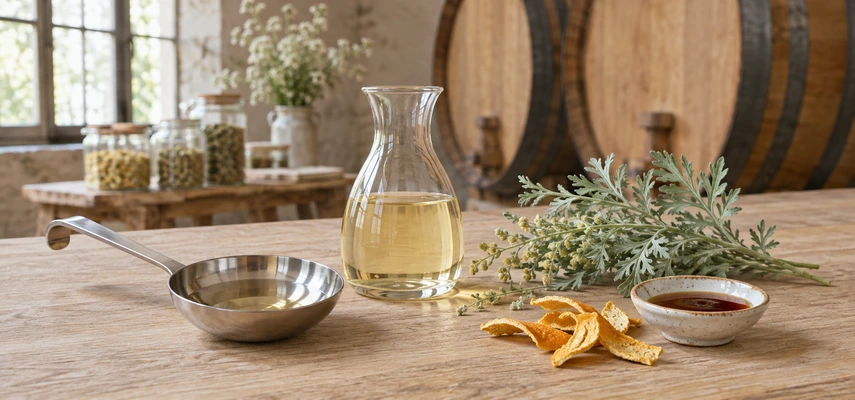

Aromatised wines keep wine in the finished drink. That makes them different from spirits distilled from wine and from liqueurs built around an independently produced alcohol base. Vermouth adds botanical character to that wine foundation, with sweetness, alcohol and sometimes maturation choices helping define the final style.
The most useful way to learn the category is to follow the blend. What kind of base wine is wanted? How are the botanicals prepared? Where does sweetness come from? What happens before bottling, and what changes after opening? Those questions connect production with the familiar dry, white and red styles without assuming that color reveals the whole recipe.
Aromatised wines begin with a suitable base wine
Grapes provide juice containing fermentable sugar, and yeast develops ethanol during fermentation. For many aromatised-wine styles, the producer seeks a relatively restrained base that can support the botanical formulation. That does not make the wine irrelevant. Its acidity, alcohol, aroma and condition remain part of the final liquid.
Dolin describes Ugni Blanc wine as the base for its vermouths. This is a named example of selection for the intended blend. It is not proof that every vermouth must use Ugni Blanc, nor that any neutral-tasting wine will work equally well with every botanical formula.
Fermentation choices affect the working wine
The producer needs a suitable wine before aromatisation can be successful. Grape condition, juice handling and fermentation management influence the material available. An overly dominant aroma or an unwanted fault can interfere with a delicate botanical profile; adding herbs is not a dependable way to repair every problem in a defective wine.
Think of the base as the foundation of a blended dish rather than a blank container. A lively acidity may help balance a sweetened formulation, while an unsuitable oxidized note can distract from it. The useful comparison identifies the wine’s contribution to the intended whole rather than praising neutrality as the only possible virtue.
Fortifying alcohol is a separate ingredient choice
Adding suitable alcohol can increase strength and change the balance of a wine-based formulation. A relatively neutral contribution can preserve emphasis on wine and botanicals, while a more characterful permitted spirit can add its own influence. The applicable framework controls what may be used, so recipe imagination does not override identity requirements.
Do not confuse alcohol used as an extraction solvent with the entire wine base. A concentrated botanical preparation may introduce alcohol as one part of the blend, while wine remains the main structural ingredient. The quantity and purpose of each addition matter when interpreting the production account or the legal description.
Sources of sweetness can enter through different routes
Sugar or suitable syrups can sweeten the blend, and grape-derived materials provide other possibilities. A mistelle is made by adding alcohol to grape must so that its sugars are retained rather than fully fermented away. It therefore supplies a different combination of sweetness and grape character from a completely dry base wine.
These materials should be distinguished before comparing the final palate. Residual sugar in a wine, sweet must and a separate sugar syrup can all contribute sweetness, but they have different production histories. The producer chooses the combination that fits the intended formula and the relevant requirements rather than assuming one sweet material is universally interchangeable with another.
Prepare botanicals for their intended contribution
Wormwood, citrus peel, roots, spices and flowers can each provide a different part of the aromatic or bitter structure. Material preparation affects extraction: dried peel, fresh leaves and a prepared flavor component do not necessarily need identical conditions. A long ingredient list alone cannot reveal the balance of the finished wine.
For vermouth, Artemisia species have a particular identity role under the EU framework. The relationship is more specific than a general herbal impression. Other botanicals can complement that contribution, but a wine flavored with any random herb does not automatically meet the requirements of the vermouth name.
Maceration and separate extracts give the blender options
Maceration holds material in a liquid so selected constituents dissolve into it; percolation instead passes liquid through a prepared bed. M. J. Horn’s extraction comparison helps clarify these physical differences. Alcohol concentration, time and material preparation influence what an extraction delivers to the blend.
Some ingredients may be treated separately because their desired extraction conditions differ. One component can supply citrus aroma, another bitterness and another a supporting floral note. Blending those components allows adjustment, but it does not eliminate the need for judgment. More extraction or more ingredients can produce confusion as readily as a successful layered profile.
Blending coordinates wine, flavor and structure
The blender combines the selected wine with botanical preparations, sweetening and any appropriate alcohol or color contribution. Each component affects more than one sensory dimension. A sweetening adjustment can change perceived bitterness, while a strength adjustment can affect texture and the expression of aromatic material.
Imagine a base wine with sharper acidity than the previous batch. Keeping every other quantity fixed might produce a noticeably different finished drink. Controlled adjustments can help preserve the house style, provided the final product remains compliant. Consistency therefore depends on evaluating ingredients and the finished blend, not only repeating a written recipe mechanically.
Resting and maturation are different from making the base
A completed blend may rest to integrate its components before filtration and bottling. Maturation can also occur earlier in the production sequence, using particular vessels and conditions to shape selected wines. Neither operation should be confused with the initial fermentation, whose job was to develop alcohol from the grape sugars.
Noilly Prat’s Original Dry account describes alcohol addition, twelve-month aging of selected base wines and sweet-wine components, then a three-week herb-and-spice maceration stage. Its range overview limits the outdoor-aging account to particular expressions. This is a useful house method, not a compulsory production clock for every vermouth.
Color does not uniquely identify the base wine
Rosso or red vermouth need not begin with a red base wine. Color can come from the permitted final formulation, including caramel, rather than red-grape skin extraction alone. A pale sweet vermouth is also possible, so the neat equation pale equals dry and red equals sweet does not describe every product accurately.
Martini’s vermouth guide discusses red and pale sweet styles. Use those examples to separate appearance from sweetness and flavor profile. The syllabus excludes the specified sweetness-level section from examination; this article therefore teaches sensory and production relationships without turning the excluded numerical bands into practice questions.
Dry, white and red styles offer useful comparisons
A dry expression can emphasize a relatively restrained sweetness impression with herbal, citrus or bitter notes. A white or bianco style may be pale while offering a more rounded sweet impression. A red style can combine deeper color with a different sweet-bitter and aromatic balance, depending on the recipe.
Dolin’s red expression provides another producer-specific comparison alongside its dry bottling. Learn the actual profiles by observing examples rather than assigning a compulsory vanilla, spice or fruit note to every style name. Production establishes possibilities, while tasting records what a particular sample actually expresses.
EU: wine proportion and Artemisia define important boundaries
The March 2026 consolidated EU aromatised-wine regulation specifies at least 75% relevant grapevine products in aromatised wine, with an actual alcoholic-strength range starting at 14.5% and ending below 22%. It separately defines aromatised wine-based drinks and wine-product cocktails. The similar names do not make the categories interchangeable.
For vermouth, the characteristic taste comes from appropriate Artemisia substances. Current wording says alcohol may have been added, so an old blanket statement that every EU vermouth must receive added alcohol is inaccurate. Keep the legal distinction separate from the fact that fortification remains an important and widely encountered production route.
Other bitter aromatised wines have their own flavor anchors
The same EU framework recognizes bitter aromatised wine, including quinquina wine associated with quinine flavoring and Americano associated with wormwood and gentian. These are useful flavor-identity connections, rather than permission to call every bitter herbal wine vermouth. The exact name should follow the relevant composition and requirements.
A shared bitter impression does not reveal whether the dominant contribution came from wormwood, gentian, quinine-related material or another ingredient. In a blind comparison, describe bitterness and the accompanying aromas first. Use the verified production information afterward to explain the category relationship instead of treating one taste as a complete ingredient analysis.
USA: aperitif wine is the relevant framework
The US wine standard, 27 CFR 4.21(g), describes aperitif wine as grape wine with added brandy or alcohol and natural aromatic flavoring materials, at no less than 15% ABV. Vermouth is a type within that aperitif-wine framework. Do not substitute the EU lower limit for the US condition.
Jurisdiction matters because similar commercial names can sit within differently worded rules. For revision, pair the country or framework with the condition being learned. That is more reliable than memorizing a detached strength number and later attaching it to whichever bottle happens to be in front of you.
Storage after opening protects the wine-based character
An opened vermouth is not an indefinitely stable bottle of full-strength spirit. Air exposure can dull fresh aromas and change the balance of the wine and botanical profile. Close the bottle promptly, refrigerate it and follow the producer’s guidance. Smaller bottles can be practical when turnover is low, because repeated long storage undermines a useful tasting comparison.
Compare a fresh sample with a tired opened bottle only if that is the intended exercise. Otherwise, differences caused by storage can be mistaken for house style or production choices. Recording opening dates and conditions helps distinguish a formulation’s intended profile from the changes introduced on the bar shelf.
What to remember
Aromatised wines combine a wine foundation with botanical, sweetness and sometimes added-alcohol decisions. Separate base-wine production from extraction, blending, resting and storage. Remember vermouth’s Artemisia relationship, distinguish EU and US frameworks, and avoid inferring the base from color alone. The opened bottle still deserves the care of a wine-based drink.
Knowledge check: 12 original practice questions
Independent TFE questions, not official WSET examination items. Choose one answer per question; explanations follow separately.
1. Why refrigerate and close an opened vermouth?
2. What does a mistelle contribute?
3. What US minimum is cited for aperitif wine?
4. Which genus has a specific EU vermouth identity role?
5. Which botanical pairing is associated with Americano in the cited framework?
6. Which flavor anchor belongs to quinquina wine?
7. What does red vermouth color prove about its base wine?
8. What does resting a completed blend differ from?
9. What remains a central component of aromatised wine?
10. What minimum grapevine-product proportion applies to EU aromatised wine here?
11. Which statement reflects current EU vermouth wording on added alcohol?
12. Why might botanical ingredients be extracted separately?
Answers and explanations
- C — To help preserve its wine and botanical profile. Air exposure and storage can change the intended profile and confuse style comparisons. Mapping: LO3.
- D — Grape must sugars retained through alcohol addition. Its production relationship differs from a fully fermented dry base wine. Mapping: LO3.
- D — 15% ABV. The US condition must be remembered with its framework rather than borrowing the EU lower limit. Mapping: LO3.
- C — Artemisia. Appropriate Artemisia substances provide the characteristic taste required for that name. Mapping: LO3.
- D — Wormwood and gentian. The named bitter aromatised-wine relationship has its own specified botanical anchors. Mapping: LO3.
- C — Quinine. The legal flavor identity differs from a generic bitter impression or another botanical category. Mapping: LO3.
- A — It does not uniquely prove a red-wine base. Color can come from the final permitted formulation rather than grape skin extraction alone. Mapping: LO3.
- B — Fermenting grape sugars to create the base alcohol. Resting concerns the prepared blend rather than the initial microbial alcohol-production stage. Mapping: LO3.
- D — The wine base. The wine remains in the finished drink rather than being merely a distillation feed. Mapping: LO3.
- D — 75%. The wine proportion helps distinguish the category from related wine-based drink classes. Mapping: LO3.
- C — Alcohol may have been added. Current wording should not be replaced with an older absolute requirement to fortify every example. Mapping: LO3.
- D — Their desired extraction conditions can differ. Separate preparation supports suitable recovery before the components are combined. Mapping: LO3.
Continue exploring this series
4. Fermentation Methods Explained: Liquid, Solid-State, Sequential, and Parallel Fermentation
9. Oak Maturation Explained: Barrels, Oxygen, Evaporation, and Flavor Development
10. Spirits Finishing Explained: Blending, Filtration, Sweetening, Coloring, and Packaging
28. How Botanicals Flavor Spirits: Maceration, Percolation, and Redistillation
43. Genever, Amaro, and Cocktail Bitters Explained: Production, Styles, and Laws
44. Liqueurs and Non-Alcoholic Spirits Explained: Sweetness, Flavoring, and Production
46. The WSET Level 3 Systematic Approach to Tasting Spirits Explained
50. WSET Level 3 Spirits Exam: Complete Revision Guide and Practice Examinations












