











Soju is often introduced through the familiar green bottle on a Korean restaurant table. That is a useful starting point, but it is not the whole category. A relatively restrained diluted soju and a characterful rice distillate can follow different production routes, even when both appear clear. Understanding the difference makes the category much easier to study.
Begin with the distinction between the spirit selected from a fermented material and the formulation of a finished drink from highly rectified alcohol. Both involve distillation somewhere in their production history. The important question is what kind of distillate is used, how much starting-material character it retains, and what happens before it reaches the bottle.
Distilled and diluted describe production routes
Traditional distilled soju begins with a fermented material, often cereal-based, whose character can remain perceptible after distillation. The term diluted soju commonly describes a product made by reducing highly rectified alcohol with water and preparing it for bottling, potentially using permitted sweetening or other additions. Neither term is simply a visual description.
Do not interpret distilled as containing no water adjustment. A grain distillate can be reduced to a chosen bottling strength while remaining part of the distilled-soju tradition. Conversely, the alcohol used for diluted soju had to be produced through fermentation and distillation; it did not appear merely by mixing water with a flavoring.
For WSET Level 3, these production routes and their resulting styles belong to Learning Outcome 3. The practice questions are therefore multiple-choice exercises. There is no need to turn every additional spirit category into an explain-type written examination task simply because its production offers interesting technical comparisons.
Rice is important, but the wider category has other inputs
Rice is central to many traditional distilled expressions. It provides starch that needs conversion before the selected yeast can use the resulting fermentable material. Grain preparation and the enzyme source are therefore essential parts of the story, rather than optional details before the real work of distillation begins.
The neutral alcohol used in diluted soju can originate from a wider range of suitable materials. Korea.net’s overview identifies examples including sweet potatoes, molasses and tapioca in that route. Those materials differ in their initial carbohydrate form and preparation, even if high rectification leaves a comparatively restrained base.
A raw-material declaration is consequently useful information, but it is not a complete sensory forecast. The degree of rectification strongly influences how much of the starting composition remains. Rice used for a characterful distillate and a starch source used for neutral alcohol need not produce the same style simply because both began with carbohydrate.
Nuruk provides conversion and fermentation capability
Nuruk is a fermentation starter associated with Korean brewing traditions. Traditional preparations can contain a community of microorganisms and their enzymes. Enzymatic starch conversion makes sugars available, while alcoholic fermentation creates ethanol and other compounds. As with qu and koji, the term should not be reduced to a vague synonym for pure yeast.
Selected-culture preparations also exist. Hwayo’s own process account describes rice nuruk prepared with cultured microorganisms and steamed rice. That is a specific production arrangement, not proof that every Korean distiller uses an identical starter. The material, organisms and conditions need to be understood together.
This distinction helps avoid two opposite mistakes. One is assuming every traditional starter is an uncontrolled accident; the other is assuming every product called nuruk is the same standardized culture. Producers manage biological inputs through preparation, selection and monitoring. A familiar starter name can cover meaningful differences in the system applied to a particular mash.
Starch conversion and alcoholic fermentation work together
Rice preparation makes the material suitable for the chosen conversion and fermentation system. Steaming changes its physical condition; cooling allows it to enter the next stage under suitable conditions. Enzymes then act on starch while yeast uses fermentable sugars. Keeping those roles distinct makes the process intelligible without needing to memorize every chemical intermediate.
In some production sequences, a starter fermentation is established before more prepared rice and water are added. Hwayo describes such a staged arrangement for its own process. This supplies a concrete example of managing the fermentation input, but does not establish a compulsory timetable or number of additions for every distilled soju.
The resulting fermented liquid or mash contains more than ethanol. Grain treatment, the starter and fermentation conditions influence other components that can matter after distillation. A producer seeking recognizable rice character has to consider the incoming fermented composition as well as the performance of the still.
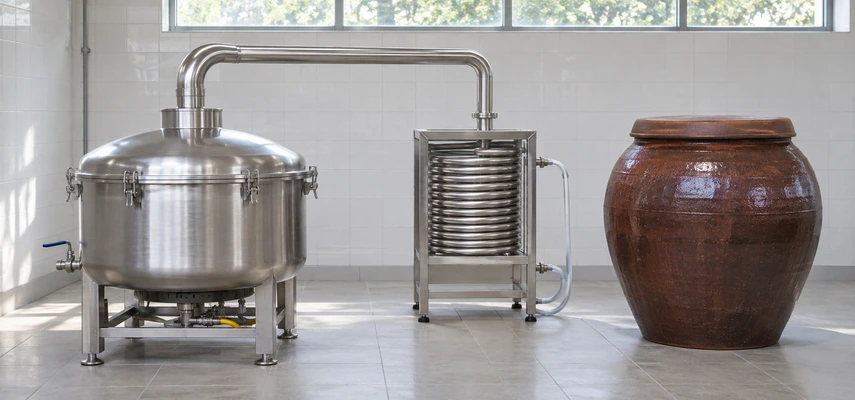
Traditional distillation can retain a material identity
Distillation separates a new mixture from the fermented material. Selection determines the relative contribution of ethanol and other volatile components in the recovered spirit. A less highly rectified route can leave more character from fermentation and raw material than a route intended to produce neutral alcohol, although the actual collection choices still matter.
The Korea Tourism Organization’s account of Andong soju describes a rice, nuruk and water preparation that is fermented and then distilled. That illustrates a well-known distilled tradition. It should not be used to claim that every bottle bearing the wider soju name follows this same small-scale arrangement.
A distinctive distillate also does not automatically earn a higher quality judgment. Its components need to form an appropriate relationship in the finished drink. Pronounced grain character can be attractive, but its intensity alone does not establish integration or complexity. Evaluate the resulting style rather than giving every retained compound a positive score.
Pressure changes the distillation environment
Atmospheric and reduced-pressure approaches create different temperature conditions. Reducing pressure lowers the temperature at which the mixture boils, which can alter the balance of thermal reactions and recovered aroma. That makes pressure a useful style variable, rather than a claim that one method eliminates all undesirable sensations in every spirit.
Hwayo identifies vacuum distillation in its production. Korea.net’s direct visit and interview also describe this low-temperature approach and subsequent storage. Use the example to understand a route to a particular expression; do not infer that reduced pressure is a universal legal requirement for Korean distilled soju.
The wider technical comparison is also described in the NRIB and JSS guide to Japanese distilled spirits. A mechanism can help compare traditions without making their category definitions identical. Similar equipment conditions do not turn a Korean rice distillate into shōchū or erase the different starters and identities involved.
Diluted soju uses a more highly rectified base
In the diluted route, the producer works with alcohol whose composition is deliberately restrained through greater separation. The original material’s aromatic identity is much less prominent than in a characterful grain distillate. Water reduction then changes strength, but final preparation may involve more than calculating how much water reaches a target ABV.
The maker selects the base, water and any appropriate additions for a desired profile. Sweetening can soften the perceived relationship among alcohol, bitterness and other sensations, while different formulations create different balances. A relatively gentle or sweet impression does not independently identify one particular starting crop or filtration treatment.
This route can support consistent production at scale. Consistency is a real technical task, not evidence that a drink has no production decisions behind it. The producer must control the composition and presentation of a prepared product even when the intention is a restrained profile rather than a conspicuously aromatic distillate.
Sweetness and flavor are separate choices
Sweetening and flavoring can interact but are not the same operation. A sweetener changes taste and perceived balance; a fruit flavoring can supply a particular aromatic identity. A product can therefore seem sweet without containing a large amount of fruit-derived sugar, or show fruit aroma that was introduced after the base alcohol was made.
The Jinro product list includes flavored expressions alongside unflavored products. Read each product’s description and market-specific label rather than assuming one recipe applies across the range. The marketing use of fruit soju also does not independently settle its legal classification in every destination market.
Storage is another style decision
Traditional vessels such as onggi can be used to rest or mature distillate. Changes during storage need not involve the visible extraction associated with a new oak cask. A clear product can therefore have a deliberate storage history. The absence of brown color is not evidence that it traveled directly from still to bottle.
Wood-aged expressions supply another possibility. Their vessel influence needs its own description: wood can add and transform contributions rather than merely making the original spirit older. Neither ceramic storage nor wood use automatically proves superiority. The effect must be assessed against the starting distillate and intended finished profile.
Strength does not identify the production route by itself
Specific bottlings demonstrate the range. Hwayo describes products at 17%, 25%, 41% and 53% ABV. Jinro’s listed range includes Chamisul Fresh at 16%, Chamisul Original at 20.1% and Ilpoom at 25%. These are producer-specific examples checked for this lesson, not invented national minimums or a promise that every market always receives the same version.
The examples show why a single strength threshold is a poor substitute for knowing the process. A lower-strength distilled expression can exist, and a familiar brand can offer several types. Read the production and product information together. Bottle color and ABV are clues requiring context, rather than complete definitions.
Compare the finished styles with appropriate evidence
A characterful distilled soju may show cereal, fruit, floral or savory detail arising from its materials and processing. A diluted expression may emphasize a restrained aromatic profile and a particular alcohol-sweetness balance. The categories give a useful starting comparison, while an individual product still needs assessment on its own evidence.
For revision, follow two parallel routes: material and starter through fermentation to a selected distillate, or suitable alcohol through rectification and formulation to a prepared drink. Then identify the effects of storage, reduction and additions. This organization is more reliable than remembering that all soju is either rice spirit or low-strength neutral alcohol.
What to remember
Distilled and diluted soju name different production approaches, not a simple opposition between water and no water. Learn nuruk’s role, distinguish starch conversion from fermentation, and connect rectification with retained character. Pressure, vessels and final preparation create further variation. Use actual production information to interpret the bottle instead of asking its color or strength to explain everything.
Knowledge check: 12 original practice questions
Independent TFE questions, not official WSET examination items. Choose one answer per question; explanations follow separately.
1. What is the general aromatic aim of a highly rectified base?
2. Are sweetness and fruit aroma the same production contribution?
3. What best distinguishes the two production routes discussed?
4. Can distilled soju be reduced with water before bottling?
5. What does reduced pressure permit during distillation?
6. Which statement about nuruk is sound?
7. What is a sound revision method for soju?
8. Which example is explicitly described as a producer-specific pressure choice?
9. Can bottling strength alone reliably identify distilled versus diluted production?
10. Why must rice starch be processed before ordinary yeast can use it?
11. Does clear appearance prove that a soju had no deliberate storage?
12. What is nuruk?
Answers and explanations
- D — A comparatively restrained contribution from starting-material compounds. Greater separation can support a less raw-material-driven profile. Mapping: LO3.
- D — No they can be adjusted through different inputs. Taste balance and aromatic identity require separate explanation. Mapping: LO3.
- B — Characterful fermented-material distillate versus formulation using highly rectified alcohol. Both routes involve alcohol production, but their retained composition and final preparation differ. Mapping: LO3.
- A — Yes. Water adjustment alone does not define the broader production tradition. Mapping: LO3.
- C — Boiling at a lower temperature. The changed temperature environment can influence the recovered composition. Mapping: LO3.
- D — Traditional and selected-culture preparations can differ. The culture arrangement and preparation must be understood for the actual producer. Mapping: LO3.
- D — Trace the production route then the final preparation. The sequence connects the category distinction with practical differences in style. Mapping: LO3.
- B — Hwayo vacuum distillation. A named process example should not be generalized into an unsupported national rule. Mapping: LO3.
- B — No the process information is also needed. Producer ranges demonstrate why strength is not a complete production definition. Mapping: LO3.
- A — Suitable conversion releases fermentable sugars. Conversion and alcoholic fermentation perform separate functions in the process. Mapping: LO3.
- B — No. Storage development need not involve visible oak-derived color. Mapping: LO3.
- B — A fermentation starter associated with microorganisms and enzymes. Starter preparation contributes biological capabilities rather than merely a bottle ingredient name. Mapping: LO3.
Continue exploring this series
3. Alcoholic Fermentation Explained: Yeast, Nutrients, and Flavor Compounds
4. Fermentation Methods Explained: Liquid, Solid-State, Sequential, and Parallel Fermentation
5. Distillation Science Explained: Volatility, Congeners, Reflux, and Rectification
7. Column and Hybrid Stills Explained: Plates, Reflux, and Continuous Distillation
8. How Distillers Manage Flavor: Sulfur, Esterification, Pressure, and Distillation Choices
10. Spirits Finishing Explained: Blending, Filtration, Sweetening, Coloring, and Packaging
26. Vodka Explained: Neutral Spirits, Raw Materials, and Production Choices
32. Shōchū Explained: Honkaku Shōchū, Awamori, and Japanese Distillation
33. Baijiu Explained: Qu, Solid-State Fermentation, and China’s Major Styles
41. Flavored Vodka, Spiced Rum, and Flavored Whiskey Explained
35. Other American Whiskeys Explained: Wheat, Malt, Corn, and Labeling Terms
50. WSET Level 3 Spirits Exam: Complete Revision Guide and Practice Examinations












