










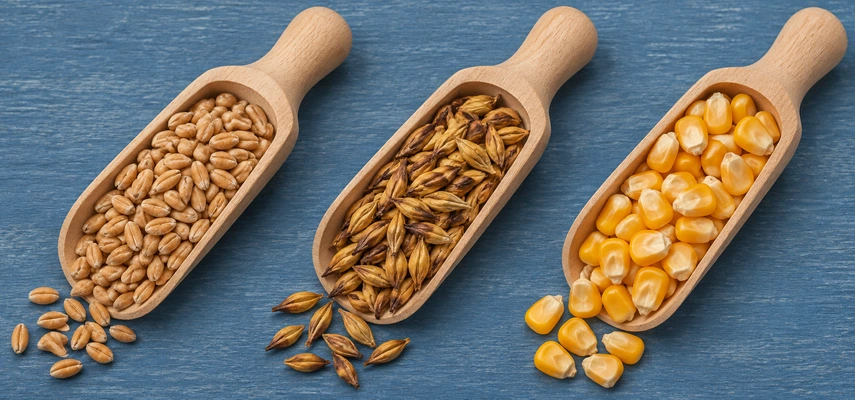

American whiskeys extend well beyond bourbon and rye. Wheat whiskey, malt whiskey and corn whiskey each have their own production identity, and the newer American single malt standard adds another important distinction. The label can also carry terms about maturation, blending, strength and origin that mean different things from the grain name.
The useful approach is to separate those layers. First establish the type, then examine the additional claim. A whiskey can be wheat-based without being wheated bourbon, and single malt does not mean single barrel. For Level 3, these additional types and labeling terms are Learning Outcome 3 knowledge, so the practice below uses MCQs.
Grain percentage identifies a starting point
Under the current US whiskey standards, wheat whiskey requires at least 51% wheat; malt whiskey at least 51% malted barley; rye malt whiskey at least 51% malted rye. Their familiar type requirements include distillation no higher than 80% ABV, entry into new charred oak no higher than 62.5% ABV and bottling at no less than 40% ABV.
Those percentages describe different stages. The grain percentage refers to the mash composition, not the proportion of grain flavor in a finished glass. Distillation and cask-entry limits constrain processing, while bottling strength describes the prepared drink. Mixing the numbers together produces an impressive-looking answer that can still be wrong.
The remaining grain share also matters. A minimum percentage establishes identity but does not describe the complete recipe. Two wheat whiskeys can use different supporting grains and still satisfy the same category threshold. Fermentation and maturation then introduce further variation, so a legal type does not amount to a single compulsory flavor profile.
Wheat whiskey differs from wheated bourbon
A wheated bourbon remains a bourbon with the required corn majority, using wheat as an important supporting grain. A wheat whiskey instead places wheat at the category’s required minimum or above. The words are similar enough to confuse, especially when the same producer makes both styles.
Heaven Hill’s own comparison identifies Bernheim’s recipe as 51% wheat, 37% corn and 12% malted barley. That is a useful concrete example of wheat whiskey. It is not a requirement that every producer use those exact proportions or treat wheat as a guarantee of a particular texture.
Wheat-led profiles can show cereal, fruit and softer spice associations, with wood adding another contribution during maturation. But grain choice is only one factor. A relatively delicate new make can be dominated by an active cask, while another expression retains more of its cereal identity. The type and the observed style should be described separately.
Malt whiskey is not automatically single malt
The established US malt-whiskey type requires a malted-barley majority, rather than automatically 100% malted barley. Its new-charred-oak requirement also differs from the vessel flexibility in the American single malt standard. Do not import a Scotch definition simply because malt appears on the label.
Malting and subsequent drying establish useful differences in the material before mashing. The producer then converts starch, ferments the prepared medium and selects a distillate. Those connected operations influence the character available for maturation. A malted-barley percentage supplies the category identity but cannot specify all the sensory detail arising from the process.
Malt is also not a synonym for peat. Some malt can be dried with smoke influence, but the word alone does not require it. A chocolate-like or toasted association can likewise have more than one production source, so the tasting note should not be used to invent an unverified recipe.
American single malt has a distinct newer standard
The TTB’s final-rule summary sets out 100% malted barley, mashing, distillation and aging in the United States, and distillation entirely at one US distillery to no more than 80% ABV. It permits used, new uncharred or new charred oak barrels no larger than 700 liters, with bottling at least 40% ABV.
Straight American single malt requires at least two years. Disclosed caramel coloring is permitted under this standard. The rules took effect in January 2025 with a specific transition for eligible pre-2030 bottlings; older labels need their context checked. Do not apply the familiar 62.5% entry ceiling from bourbon’s standard as an invented universal single-malt rule.
Westland describes its own use of several malt treatments, a six-day fermentation with Belgian brewing yeast and varied casks. That illustrates the range a producer can construct while remaining malt-focused. Its chosen recipe does not imply that all other producers’ material or fermentation methods are inferior.
Corn whiskey is more than bourbon without a name
Corn whiskey requires at least 80% corn and distillation no higher than 80% ABV. Wood storage is not compulsory in the same way as for most other whiskey types. If stored in oak, the current standard specifies entry no higher than 62.5% ABV in used or new uncharred oak. Straight corn whiskey requires at least two years in its prescribed vessel type.
The TTB’s corn-whiskey ruling also helps distinguish storage from qualifying age: time in metal or a paraffin-lined vessel is not the same as time aging in the specified oak arrangement. The ruling’s historic labeling language should not replace the current age-statement regulation.
An 80%-plus corn mash can become bourbon if it follows bourbon’s complete conditions, including the required new charred oak route. Grain percentage alone therefore does not decide between the two types. Nor does corn whiskey have to remain colorless: an allowed used vessel can contribute visible color and flavor during storage.
Straight adds conditions rather than a universal verdict
Straight identifies additional production and maturation requirements for a defined type. For the familiar straight wheat, malt and rye-malt standards, the prescribed new charred oak storage lasts at least two years, and coloring, flavoring and blending materials are not allowed. A straight designation is not simply a synonym for served without ice.
It also does not independently prove that the whiskey is better than every blend. The term establishes compliance with conditions, while quality concerns the finished result. Keep those judgments separate. A technically compliant young straight whiskey can have a very different profile from an older expression of the same type.
Blended can carry a specific US composition meaning
US blended whiskey is not merely any bottle containing more than one cask. The standard requires at least 20% straight whiskey on a proof-gallon basis and permits other whiskey, neutral spirits or a combination. Named blends such as blended wheat whiskey require at least 51% of the corresponding straight type on that alcohol-based measure.
A blend of straight whiskies is another designation, with a different composition from a neutral-spirit-containing blend. Read the complete phrase rather than making all products bearing blended equivalent. Proof-gallon percentages describe an alcohol-based composition, not simply the fraction of filled bottle volume that a particular liquid occupied before mixing.
Light whiskey describes distillation conditions
Light whiskey is produced above 80% ABV, within the general whiskey class’s below-95% ceiling, and stored in used or new uncharred oak. The higher rectification can leave a more restrained fermentation-derived contribution, although maturation still influences the finished drink. Light does not establish a low-calorie claim or a low bottling strength.
This example shows why a familiar sensory adjective can function as a regulated production term. The label’s meaning cannot be settled by its everyday English sense. A consumer might describe another whiskey as light in body without making it the legal light-whiskey type.
Bottled in bond combines several requirements
Under 27 CFR 5.88, bottled-in-bond whiskey comes from the same distiller and distillery in the same distilling season, meets the relevant same-kind conditions, spends at least four years in wood and is bottled at 50% ABV. Only pure water reduces proof, with tightly limited physical treatments rather than added flavor composition.
The term is therefore more specific than a general assurance of careful production. A 50% whiskey does not become bonded merely through its strength. A four-year age statement also does not independently establish the single-season and other conditions. Identify all the linked requirements instead of allowing the most memorable number to stand in for them.
Age and proof statements need their own reading
The current age regulation generally requires age statements for whiskey younger than four years, subject to its stated exceptions such as compliant bottled-in-bond labeling. For a whiskey without neutral spirits, the age reference is the youngest whiskey, not the oldest component or an arithmetic average.
US proof is twice ABV: 100 proof means 50% ABV. That makes conversion straightforward, but not every proof statement describes the same production stage. Distillation proof, entry proof and bottle proof answer different questions. Cask or barrel strength likewise needs to be interpreted through the actual product claim, rather than assumed to mean one fixed national ABV.
Single barrel and small batch describe different ideas
Single barrel points toward one cask as the source of a bottling; single malt points toward a malt-based type and, under the applicable standard, one distillery. Neither term means that the producer owns only one vessel or makes only one recipe. A single-malt expression can combine several qualifying casks.
Small batch does not supply one universal federal numerical limit on the number of barrels. Ask what the producer means. It can be useful production information when explained, but it should not be treated as equivalent to the detailed conditions of straight or bottled in bond. The label can mix regulated identity terms with less precisely defined marketing language.
What to remember
Identify grain, distillation and vessel requirements before decoding additional label claims. Distinguish wheat whiskey from wheated bourbon, malt whiskey from American single malt, and corn whiskey from a corn-heavy bourbon. Then keep straight, blended, bonded, age and proof information in their own roles. A label becomes far clearer when each phrase answers one specific question.
Knowledge check: 12 original practice questions
Independent TFE questions, not official WSET examination items. Choose one answer per question; explanations follow separately.
1. What distinguishes wheat whiskey from wheated bourbon?
2. Does single malt mean single barrel?
3. Must ordinary corn whiskey always have wood storage?
4. What is bottled-in-bond whiskey bottled at?
5. What does light whiskey identify?
6. Which casks can the American single malt standard permit?
7. What is the established US malt-whiskey grain minimum?
8. What is the corn-whiskey grain minimum?
9. Does straight automatically mean superior sensory quality?
10. What does US blended whiskey require at minimum?
11. What component usually determines an age statement for whiskey without neutral spirits?
12. What does American single malt require for grain?
Answers and explanations
- D — Wheat whiskey requires at least 51% wheat while bourbon retains its corn-majority identity. The supporting use of wheat in bourbon differs from the wheat-whiskey majority requirement. Mapping: LO3.
- D — No. A qualifying single malt can be composed from several casks from its one distillery. Mapping: LO3.
- B — No. Corn whiskey is an exception to the general whiskey oak-storage requirement. Mapping: LO3.
- A — 50% ABV. The 100 proof bottle requirement is one of several bonded conditions. Mapping: LO3.
- C — A higher-distillation-strength production type. The regulated meaning concerns production rather than the everyday adjective alone. Mapping: LO3.
- D — Used or new oak including charred and uncharred within the capacity limit. The vessel standard is more flexible than the familiar bourbon new-charred-oak rule. Mapping: LO3.
- D — 51% malted barley. The malt-whiskey type differs from the separate 100% American single malt standard. Mapping: LO3.
- A — 80% corn. The corn-whiskey threshold is higher than bourbon minimum corn content. Mapping: LO3.
- D — No it establishes additional production conditions. Legal compliance and the finished sensory assessment are different judgments. Mapping: LO3.
- A — 20% straight whiskey on a proof-gallon basis. The US composition standard is more specific than merely mixing several casks. Mapping: LO3.
- A — The youngest whiskey. The age claim cannot overstate the youngest component in that formulation. Mapping: LO3.
- D — 100% malted barley. The newer type has a complete malted-barley requirement. Mapping: LO3.
Continue exploring this series
11. How Grains Become Whisky: Malting, Mashing, Enzymes, and Starch Conversion
14. Bourbon Explained: Mash Bills, Distillation, New Oak, and Quality
15. Rye and Tennessee Whiskey Explained: Production Rules and Flavor Differences
29. Spirits Quality Explained: How Production Decisions Affect Balance and Complexity
31. Irish, Canadian, and Japanese Whisky Explained: Production, Laws, and Styles
49. How to Answer WSET Level 3 Spirits Written Questions: Structure, Reasoning, and Marks
50. WSET Level 3 Spirits Exam: Complete Revision Guide and Practice Examinations
34. Soju Explained: Korean Distilled and Diluted Spirits
36. Pisco, Grappa, and Brandy de Jerez Explained: Three Grape-Spirit Traditions












