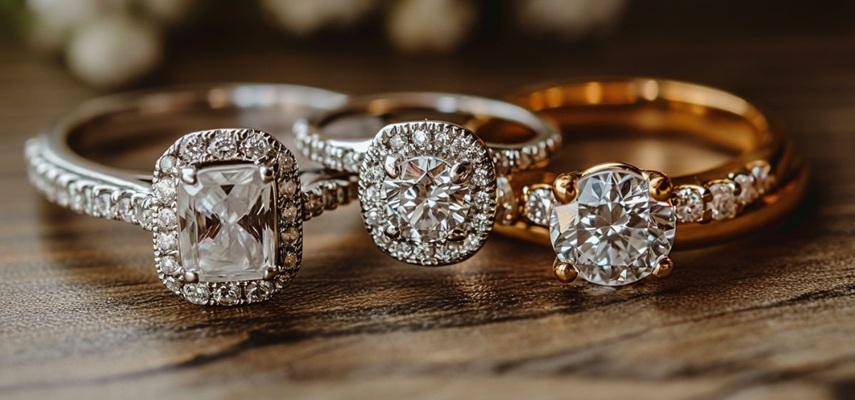

Image source: Pexels
In 1999, a former Bain consultant named Mark Vadon raised $6M to take over a small Seattle-based diamond website and rename it Blue Nile. The premise sounded improbable at the time. People were not supposed to spend $5,000 or more on a stone they had never held, from a company that did not have a storefront. A quarter of a century later, the engagement ring category has been reorganized around exactly that idea, and the operating assumptions of buyers, jewelers, and even the diamond industry have moved with it. The change has not been a single big break. It has been a long sequence of smaller ones, mostly led by direct-to-consumer brands, and they have touched 4 parts of the category in particular: how rings are priced, how they are designed, what stones go inside them, and how couples arrive at the purchase. Each of those threads is worth tracing on its own, because together they describe a market that looks materially different from the one a millennial buyer would have walked into in 2014.
Price Transparency in the Engagement Ring Category
For most of the 20th century, retail diamond pricing operated on opacity. A buyer would visit a jeweler, look at a small selection of stones in a tray, and accept a price that was justified vaguely in terms of rarity, craftsmanship, and the authority of the person behind the counter. Comparing across stores meant another visit, another tray, and another conversation. Prices were rarely listed. Margins were not discussed.
Online retailers broke that pattern by listing stones individually with their full grading reports. A 1.01-carat round, G color, VS1 clarity, with a GIA report number, became a unit a buyer could shop on a spreadsheet. The same buyer could compare the price of that exact specification across several sites in an afternoon. The information asymmetry that had supported much of the in-store markup quietly dissolved.
That structural change shows up in the numbers. The Knot’s 2024 Jewelry and Engagement Study put the average U.S. engagement ring at $5,200, down from $6,000 in 2021, $5,800 in 2022, and $5,500 in 2023. BriteCo’s 2025 figure came in higher at $6,504, but it also charted a downward drift from a 5-year peak of $9,025 in 2022. The averages move with the methodology, yet the direction is consistent. Couples are spending less in nominal terms, even before factoring in inflation, and they are doing so against a background of more stone choices and better information. Part of that compression reflects the fact that buyers can now read the same wholesale-adjacent price data the trade once kept to itself, which has tightened the gap between counter price and replacement value across the entire category.
Lab-grown supply has been the second compressing force on price. Bain & Company’s diamond reporting found that average polished lab-grown retail prices had fallen to roughly 30% of natural prices, with wholesale at about 14%, down from 35% and 20% respectively in 2020. A 0.50-carat lab-grown stone now tends to run around 40% below a natural diamond of the same grade, and a 1.0-carat lab-grown can run as much as 70% lower, per recent pricing analyses. Those gaps are visible to anyone with a browser and 10 minutes, which makes them difficult to ignore at the point of purchase.
Customization Moves Online
Custom engagement ring work used to require a workshop visit. A buyer described the design, often with a sketch torn out of a magazine, and the bench jeweler translated it into wax, then metal, over weeks of back-and-forth. The barrier was less about cost than friction. Few people had the time, or the confidence, to commission a piece they could not see until it arrived.
The category absorbed real change once configurators arrived online. Most direct-to-consumer bridal sites now offer a real-time 3D builder where the buyer selects the setting style, the metal, the prong type, the halo treatment, if any, the center stone shape, and the engraving on the inner band. The model spins on screen. Each choice updates the visualization and the price in the same motion. The buyer sees the ring before placing the order, from every angle, in the actual proportions of their selected diamond.
What used to be the work of a custom appointment is now closer to the work of configuring a piece of furniture, with a single important difference. The decisions still carry weight, because the ring still carries weight, and the better online platforms have been careful not to flatten the process into a checkout flow. They surround the configurator with educational pages on stone proportions, prong durability, metal hypoallergenicity, and ring sizing. The decision points are kept close to the buyer rather than abstracted away.
Deeper bespoke work, the kind that involves an antique cushion cut reset into a custom east-west bezel with hand-engraved gallery work, still takes longer and still benefits from human conversation. The category has not collapsed those projects into a configurator. It has separated standard customization (handled in software) from bespoke design (handled in dialogue), and pushed both online.
Lab-Grown Stones Move From Niche to Default
The single largest material change in the engagement ring category over the past decade has been the normalization of lab-grown diamonds. The numbers are easy to recite and worth pausing on. In 2015, lab-grown diamonds accounted for roughly 1% of global diamond jewelry demand. By 2024, that share had reached about 20%, according to figures cited by analyst Paul Zimnisky. In the United States engagement ring category specifically, lab-grown stones reached about half of all sales in 2024, with a widely cited figure putting it at 52%.
A category does not move from 1% to majority share inside 10 years without something fundamental changing on both the supply and the demand side. On supply, production capacity in China and India scaled rapidly. On demand, younger buyers absorbed the gemological reality faster than the industry expected. Lab-grown diamonds share the same chemical, physical, and optical properties as mined diamonds. The Gemological Institute of America grades both. The difference is origin, not material. Once that became common knowledge, the price gap did most of the rest of the work.
Generational data tracks the change. Over 70% of millennials surveyed in 2025 reported a preference for lab-grown diamonds in engagement rings. Spending behavior tracks differently across cohorts as well, with millennials averaging around $6,700 on the ring and Gen Z averaging around $4,100, per Michelson Jewelers survey data. The combined pattern points in the same direction: a younger buyer with less appetite for the legacy 3-months-salary framing, paired with a stone option that delivers more visible carat for the same dollar.
The trade press has started describing the engagement ring as having an identity crisis, partly because the old framing as a fixed financial benchmark no longer holds. The ring is increasingly treated as a personal style choice with a budget that ranges widely. Some buyers spend $2,000 on a carefully selected lab-grown solitaire. Others spend $20,000 on a natural cushion in a custom setting. The category has room for both, and the direct to consumer infrastructure makes both routes accessible from the same browser tab.
How Couples Now Research and Buy
The buying journey itself has been restructured, less by a single change and more by the layering of new habits on top of older ones. The starting point is almost always inspirational and online. Pinterest is consistently named as the leading platform for engagement ring research, used to assemble image boards of cuts, settings, and metal tones months before any conversation with a jeweler. Instagram sits close behind, with brand accounts and the algorithmic feeds of bridal influencers feeding the same visual library. By the time a buyer contacts a retailer, they often arrive with a saved board of 15 to 30 references and a fairly specific sense of what they want.
The middle of the journey is where the older retail pattern still has weight. The Knot’s 2021 study found that proposers commonly visit 2 to 3 retailers and view roughly 10 rings in person before making a final decision. People want to see a 1-carat stone on a hand. They want to feel the weight of platinum against 14-karat gold. The in-person check has not disappeared. What has changed is its purpose. It used to be the entire process. It is now a single validation step inside a longer arc.
The endpoint, the actual purchase, is where the most movement has happened. Earlier surveys conducted between 2020 and 2022 put online ring purchases at around 9 to 11% of buyers. More recent 2025 estimates from industry analysts place the figure closer to 66%. The methodologies vary and the true number sits somewhere inside that range, but the trend is unambiguous. Online engagement ring sales have been growing more than 20% annually in recent years, according to industry commentary. The remaining holdouts are mostly buyers who want a specific in-person handover, not buyers who do not trust the format.
The pandemic accelerated the change without inventing it. Couples who had planned to walk into a mall jewelry counter in 2020 found themselves running their entire search through video calls and shipped sample boxes, and many discovered the process to be smoother than expected. A non-trivial share never went back to the in-store-default approach.
The Online-First Bespoke and Concierge Model
The latest phase of the category brings the bespoke and the online together with a layer of human service that earlier waves of direct-to-consumer largely did not offer. A wave of online-first bridal houses now bundle full bespoke design work with dedicated concierge support, including GOODSTONE among the firms operating that model, as well as several other newer entrants in the category. The combination is straightforward in concept and harder than it sounds in execution. A buyer can run the design conversation through video calls and shared screens, work with a single point of contact across the entire commission, and still have access to the kind of 1-to-1 attention that used to require a retainer at a private jeweler.
The reason this configuration has gained ground is that it resolves the tradeoff buyers used to face. The traditional in-store luxury route delivered service but came with limited inventory, opaque pricing, and travel friction. The first generation of online-only retailers delivered transparency and selection but felt impersonal for a purchase weighted with this much meaning. The bespoke-plus-concierge model, run online, attempts to take the strengths of both and leave the weaknesses on either side.
What this looks like in practice is a buyer working with a single design lead from the first call through the proposal-day delivery. The conversation covers the partner’s daily wear patterns, hand proportions, sensitivities to certain metals, comfort with different stone shapes, and the household budget reality. The design moves from a mood board to renderings to a wax model to the finished piece, with the buyer seeing each step. The stones come with full grading reports. The pricing is itemized. The communication runs through whichever channel the buyer prefers, including text message, video call, or longer-form email between major design milestones.
The decade-long arc that began with Blue Nile’s $6M bet on web-listed diamonds has produced a category that looks structurally different from the one couples encountered in 2014. Pricing is more transparent. Customization is more accessible. The center stone is increasingly likely to be lab-grown. The buying journey starts online, mostly stays online, and increasingly ends online. The direct to consumer model did not invent the engagement ring, and the meaning carried by the object is what it has always been. What changed is the path between the decision to propose and the moment the ring arrives, and most of that change has happened inside the past 10 years.