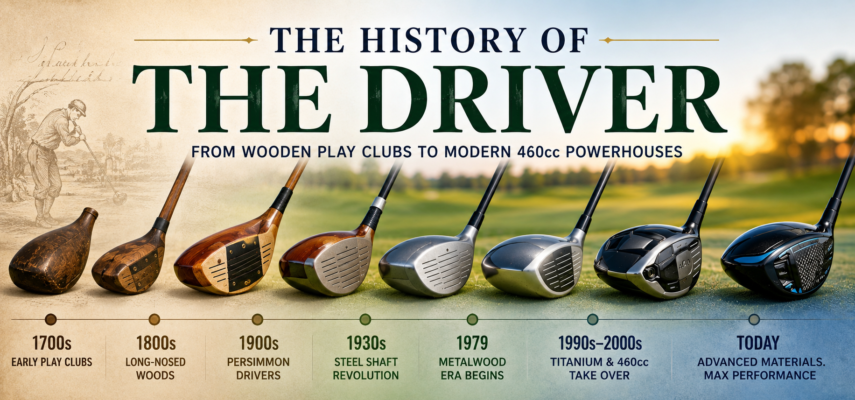
No club captures the ambition of golf quite like the driver.
It is the longest club in the bag, the fastest-moving club in the swing and, when struck properly, the one capable of launching the ball farther than any other. The driver has become a symbol of power, technological innovation and competitive advantage. Entire advertising campaigns are built around the promise of a few additional yards, while professional golfers devote enormous attention to launch angle, spin rate, ball speed and aerodynamic efficiency.
Yet the modern driver—with its oversized hollow head, lightweight graphite shaft and precisely engineered face—would be almost unrecognizable to the golfers who played the game several centuries ago.
The history of the driver is not merely the story of one golf club. It is the story of golf’s long pursuit of distance, from handmade wooden implements to computer-designed machines operating near the limits established by the sport’s governing bodies.
Before the Driver: Golf’s Early Long Clubs
The earliest golfers did not carry numbered woods, adjustable hosels or clubs specifically marketed as drivers. Instead, they used a collection of individually crafted wooden clubs designed for different types of shots.
Among the most important was the play club, sometimes called a long club. It was used primarily to strike the ball from the teeing ground or from favorable lies when maximum distance was required. In practical terms, the play club was the ancestor of the modern driver.
These early clubs were produced by specialist craftsmen. Heads were commonly made from hardwoods such as beech, apple, pear or holly, while shafts were often made from ash and, later, hickory. Because each club was shaped by hand, specifications varied substantially. Two clubs intended for the same purpose might have different head shapes, shaft lengths, weights and playing characteristics.
The golf balls of the period also influenced club design. Early wooden balls and later feather-filled leather balls did not behave like modern golf balls. They flew shorter distances, were less consistent and could be damaged by poorly made clubfaces.
As golf developed in Scotland, clubmakers gradually improved the long wooden club. Faces became deeper, shafts became more resilient and craftsmen learned how to shape the head to produce a stronger, more reliable strike.
Nevertheless, the early driver remained demanding. Its wooden head was relatively small, and its effective hitting area offered little forgiveness. Distance depended heavily on precise contact.
The Long-Nosed Era
By the 18th and early 19th centuries, wooden clubs often featured elongated heads that are now described as long-nosed woods. Their narrow profiles stretched backward from the face, giving them a shape that looked more like a slender wooden mallet than a modern driver.
The design was partly dictated by the featherie golf ball. A wide, aggressively shaped face could damage the ball’s stitched leather cover, so clubmakers created relatively shallow faces and long bodies that distributed the club’s mass behind the point of impact.
These clubs could produce impressive shots by the standards of the period, but they required considerable skill. The sweet spot was small, the shafts could vary dramatically in stiffness and moisture could affect both the clubhead and the ball.
A golfer could not simply purchase a standardized driver off the rack. Clubs were personal instruments, often ordered from a respected maker and adjusted through experience rather than data.
This began to change during the 19th century as golf expanded, manufacturing improved and a new golf ball transformed the equipment industry.
The Gutta-Percha Ball Changes the Driver
The introduction of the gutta-percha golf ball during the mid-19th century had a major effect on wooden-club design.
Made from the dried sap of trees native to Southeast Asia, the “guttie” was more durable, less expensive and easier to produce than the featherie. Because it could withstand harder contact, clubmakers were no longer required to protect the ball with long, shallow wooden faces.
Driver heads gradually became shorter from front to back and broader across the face. This shift helped produce the more compact, rounded profile that would eventually define the classic wooden driver.
The guttie also made golf more accessible. Lower ball costs encouraged wider participation, while growing demand supported a more organized clubmaking industry. Manufacturers could begin producing clubs in larger quantities instead of relying entirely on individual commissions.
During this period, the word driver became increasingly associated with the club used to “drive” the ball from the tee. The club was also commonly classified as the 1-wood, distinguishing it from higher-lofted wooden clubs intended for shorter shots.
Persimmon Becomes the Standard
By the late 19th and early 20th centuries, persimmon emerged as the preferred material for high-quality driver heads.
Persimmon was dense, durable and capable of being shaped with great precision. It could withstand repeated impacts while providing the solid feel valued by skilled golfers. Manufacturers dried and seasoned persimmon blocks before carving them into clubheads, often using carefully selected grain patterns to maximize strength.
The classic persimmon driver typically had a compact head, a relatively deep face and a sole plate attached to the bottom. A hard insert—frequently made from fiber, plastic or another durable material—was installed in the face to protect the wood at impact. Screws were often visible in the insert, contributing to the driver’s distinctive appearance.
For much of the 20th century, persimmon represented the highest standard in driver construction.
Companies such as MacGregor, Wilson, Spalding and PowerBilt produced some of the era’s most celebrated wooden drivers. Individual heads were shaped, sanded, weighted and finished with considerable craftsmanship. Better players sometimes had their drivers modified to achieve a preferred face angle, loft, swing weight or visual shape.
Persimmon drivers were beautiful, but they were not forgiving. Their heads were tiny compared with modern models, and mishits toward the heel or toe resulted in substantial losses of distance and accuracy. Golfers had to strike the ball near the center of the face to receive the club’s full performance.
The persimmon driver therefore rewarded precision. It also influenced swing technique, encouraging controlled timing and center-face contact rather than an unrestricted attempt to generate maximum speed.
Hickory Gives Way to Steel
The driver’s head was not the only part of the club undergoing change.
For generations, hickory had been the preferred shaft material because it combined strength with flexibility. However, no two pieces of hickory were identical. Shaft weight, stiffness and torque could vary, even among clubs produced by the same maker.
Steel shafts began appearing during the early 20th century and eventually gained approval for tournament play. By the 1930s, steel had largely displaced hickory in mainstream golf.
For drivers, steel offered greater consistency and durability. Manufacturers could produce shafts with more predictable characteristics, allowing golfers to replace clubs without searching for an exact piece of wood with the right flex.
Steel shafts were also less vulnerable to warping and changes in weather. Their adoption helped transform golf equipment from a craft-based product into a more standardized manufactured good.
The combination of a persimmon head and steel shaft became the defining driver construction of the mid-20th century.
The Persimmon Driver’s Golden Age
From the 1930s through the 1970s, many of golf’s greatest players built their reputations with persimmon drivers.
Ben Hogan, Sam Snead, Byron Nelson, Arnold Palmer, Jack Nicklaus and numerous other champions produced legendary tee shots with wooden heads that would look remarkably small beside today’s drivers.
Equipment mattered, but technique remained paramount. Players controlled trajectory by changing tee height, ball position and swing shape. They learned to curve drives intentionally and select the proper flight for wind and course conditions.
Jack Nicklaus became particularly associated with powerful driving. His combination of strength, speed and a high launch made him one of the longest players of his era, despite using equipment that offered little assistance on off-center strikes.
Persimmon drivers also possessed a sensory appeal that modern clubs cannot perfectly reproduce. A center strike created a dense, crisp sound and a distinctive feeling through the hands. For many traditionalists, that experience remains one of golf equipment’s lost pleasures.
However, the limitations of wood were becoming increasingly apparent.
A wooden head could not easily be made much larger without becoming excessively heavy. Face thickness and internal weight distribution were restricted by the properties of solid timber. Manufacturers could refine the shape, insert and sole plate, but the basic architecture remained unchanged.
Golf was ready for a more radical material.
The Birth of the Metalwood
The major break from tradition occurred in 1979 when TaylorMade introduced the Pittsburgh Persimmon, widely recognized as the company’s original metalwood.
Despite its name, the club was not made from persimmon. It featured a hollow stainless-steel head. The name helped communicate that the new club was intended to perform the same role as a traditional wooden driver, even though its construction was fundamentally different.
The original Pittsburgh Persimmon measured less than 200 cubic centimeters and carried approximately 12 degrees of loft—small and relatively lofted compared with many modern drivers. Nevertheless, it demonstrated the possibilities of hollow metal construction.
Metalwoods initially faced resistance. Many golfers disliked their unfamiliar appearance and sharper sound. Persimmon had centuries of tradition behind it, and elite players were reluctant to abandon clubs they trusted.
Yet metal offered advantages that wood could not match. Because the head was hollow, engineers could enlarge it without producing an unmanageably heavy club. Weight could be distributed around the perimeter, increasing stability on off-center strikes. Metal heads were also more consistent from one unit to another and less vulnerable to cracking, swelling or changes in moisture.
As manufacturing improved during the 1980s, metal drivers steadily gained acceptance.
The transition was gradual rather than immediate. Persimmon and steel drivers coexisted for years, and some professionals continued using wooden models into the early 1990s. But the long-term direction was unmistakable.
The wooden driver was becoming obsolete.
Graphite Shafts Accelerate the Distance Revolution
At roughly the same time that metal heads were replacing persimmon, graphite shafts began reshaping driver performance.
Graphite could be manufactured substantially lighter than steel. Reducing shaft weight allowed manufacturers to build longer clubs or redistribute mass into the head without making the complete driver excessively heavy.
A lighter shaft could also help some golfers generate additional clubhead speed. Just as importantly, graphite engineers could alter fiber orientation, wall thickness and material composition to influence launch, spin, torque and feel.
Early graphite shafts were not always consistent. Some felt unstable, twisted excessively or lacked the predictable response of steel. Over time, however, manufacturing improved dramatically.
By the 1990s, graphite had become the standard shaft material for drivers. Steel remained common in irons, but its dominance in the longest club had ended.
The combination of a hollow metal head and graphite shaft established the basic platform of the modern driver.
Titanium Makes the Driver Larger
Stainless steel had opened the door to hollow clubheads, but titanium pushed driver design into an entirely new era.
Titanium is strong relative to its weight. Manufacturers could create thinner walls and larger heads while keeping the club’s total mass within a playable range. The saved weight could be repositioned around the perimeter or toward the back of the head to increase stability and help launch the ball.
During the 1990s, titanium drivers expanded rapidly. Head volumes that once appeared enormous soon became ordinary. Designers moved beyond 200 cubic centimeters, approached 300 and eventually pushed toward 400 and beyond. By the early 2000s, a 350cc driver could already be considered relatively small.
One of the most influential models was Callaway’s Great Big Bertha, introduced during the 1990s as part of the company’s enormously successful Big Bertha family. Its size and forgiving profile helped convince recreational golfers that a larger head could inspire confidence without sacrificing distance.
Other manufacturers joined the race. Cobra, Ping, Titleist, TaylorMade and numerous competitors released increasingly powerful titanium designs.
The driver was no longer simply a wooden club recreated in metal. It had become a hollow, highly engineered structure.
The 460cc Era
As driver heads grew larger, golf’s governing bodies became concerned that unchecked technological development could fundamentally change the game.
The United States Golf Association and The R&A eventually established limits covering clubhead size, dimensions, spring-like effect and other performance characteristics.
Under the Equipment Rules, the volume of a wood-type clubhead cannot exceed 460 cubic centimeters, with a limited measurement tolerance. The rules also restrict head dimensions and moment of inertia, a measurement associated with the clubhead’s resistance to twisting.
The 460cc volume standard took effect in 2004, effectively creating the size framework that continues to define conventional drivers.
Manufacturers could no longer compete simply by making heads larger. They had to make better use of the available space.
That regulatory ceiling redirected innovation toward face design, aerodynamics, internal weighting, composite materials and adjustability.
The Battle Over Spring-Like Faces
Another crucial development involved the driver face.
When a golf ball strikes a driver, the face deforms slightly before returning to its original shape. This trampoline-like response can increase ball speed. Engineers learned that thinner and more flexible faces could produce greater distance, but without regulation, manufacturers could continue increasing the effect.
The governing bodies introduced limits on a clubface’s spring-like performance. Modern drivers are tested through a pendulum procedure that measures characteristic time, commonly abbreviated as CT.
Drivers used in elite competitions may also be required to appear on an official list of conforming driver heads maintained by the USGA and The R&A. The list is updated regularly, and clubs can become nonconforming if wear causes their faces to exceed the permitted limit.
This created an unusual engineering challenge. Manufacturers want a driver face to perform as close as possible to the legal threshold without crossing it. A model that falls substantially below the limit may sacrifice ball speed, while one that exceeds it cannot be used under the Rules of Golf.
Modern driver production therefore requires extremely precise manufacturing tolerances.
Composite Crowns and Strategic Weighting
Once titanium drivers approached the maximum permitted size and face performance, designers began combining multiple materials within a single head.
Carbon-fiber composites became particularly valuable. A carbon crown could weigh less than a comparable titanium structure, freeing discretionary mass that engineers could move elsewhere.
That weight might be positioned low and deep to promote a higher launch, moved toward the heel to encourage a draw, placed forward to reduce spin or distributed around the perimeter to increase forgiveness.
The visible size of the driver had stopped growing, but its internal sophistication continued to increase.
Modern manufacturers now use advanced simulation, robotics and high-speed impact testing to evaluate thousands of possible shapes. Engineers examine airflow around the crown, stress patterns across the face and the effect of minute weight changes on launch conditions.
The driver became less like a traditional woodworking product and more like a piece of aerospace engineering.
Adjustable Drivers Arrive
Adjustability represented another major step in the driver’s evolution.
Interchangeable hosel systems allowed golfers to alter loft, lie angle or face presentation without purchasing an entirely new club. Movable weights made it possible to modify the club’s center of gravity and influence launch, spin or directional bias.
TaylorMade’s r7 Quad, introduced in the 2000s, helped popularize movable-weight technology. Later adjustable-hosel systems spread throughout the industry.
These features gave clubfitters more tools to match a driver to an individual swing. A golfer who tended to slice could use a more upright or draw-biased configuration. A player producing excessive spin could test a lower-lofted or forward-weighted setup.
However, adjustability did not make professional fitting unnecessary. It made fitting more precise.
A modern driver contains more variables than any previous generation. Loft, shaft length, shaft weight, shaft profile, head weight, face angle, center-of-gravity location and grip size can all influence performance.
The best driver is not necessarily the newest or most expensive. It is the combination that delivers the most effective launch conditions for a particular golfer.
The Rise of Aerodynamics and Carbon Faces
With clubhead volume and face response regulated, manufacturers continued searching for additional performance through airflow and material science.
Aerodynamic shaping became increasingly important. Because the driver travels at high speed during the downswing, even small reductions in drag may help preserve clubhead speed. Rounded crowns, raised structures, altered sole geometries and streamlined trailing edges have all been used to improve airflow.
Some companies also experimented with nontraditional face materials. TaylorMade’s Stealth driver, released in 2022, attracted attention by replacing the conventional titanium face with a carbon-composite construction.
Whether made from titanium, carbon or another material, the modern face is rarely uniform in thickness. Engineers vary thickness across different areas to preserve ball speed when contact occurs away from the center.
This reflects one of the most important changes in driver philosophy.
Older drivers were designed primarily to reward the perfect strike. Modern drivers are designed to make imperfect strikes less damaging.
The Modern Driver
Today’s driver commonly features a head close to the 460cc limit, a graphite shaft, a lightweight grip and between roughly 8 and 12 degrees of stated loft, although models outside that range exist.
Its large footprint inspires confidence, but the true technological advantage lies beneath the surface.
Modern drivers may include:
- Variable-thickness faces
- Carbon-composite crowns or soles
- Internal titanium structures
- Movable sole weights
- Adjustable hosels
- Draw-biased or low-spin configurations
- Aerodynamically shaped crowns
- Artificial-intelligence-assisted face designs
- Multiple versions tailored to different swing characteristics
The result is a club that produces more consistent ball speed across a much larger portion of the face than a persimmon driver ever could.
That does not make the driver easy to hit. Its long shaft and low loft can magnify swing-path and face-angle errors. A modern driver is more forgiving, but it remains capable of sending a poorly struck ball far into trouble.
Its power raises the cost of both good and bad swings.
How the Driver Changed Golf-Course Strategy
The evolution of the driver changed more than equipment. It changed how golf courses are played and designed.
As players gained distance, bunkers and hazards that once challenged tee shots became easier to carry. Architects responded by lengthening courses, narrowing landing areas or introducing hazards farther from the tee.
Professional golfers increasingly treated distance as a strategic weapon. A player who could drive the ball well beyond competitors might approach greens with substantially shorter clubs, even after missing the fairway.
This contributed to the rise of the modern power game. Accuracy remained important, but distance became measurable advantage rather than mere spectacle.
Launch monitors reinforced the shift. Golfers could now measure clubhead speed, ball speed, launch angle, spin rate, carry distance, descent angle and impact location. Driver fitting became a data-driven process rather than a matter of appearance and feel alone.
The driver had completed its transformation from handcrafted tool to optimized performance system.
Why the Driver Remains Golf’s Most Fascinating Club
No other club combines risk, power and emotion in quite the same way.
A putter may determine the final score, and wedges may save more strokes for the average player, but the driver creates golf’s most dramatic opening statement. A great drive can change the shape of a hole, intimidate an opponent and give a golfer the feeling—however briefly—of mastering the game.
Its history also reflects a tension that has always existed within golf.
Players want greater distance. Manufacturers want to provide it. Governing bodies want to preserve the game’s traditional challenge. Course architects must respond to the results.
The driver sits at the center of that contest.
From Wooden Play Club to Engineered Powerhouse
The modern driver descended from simple wooden clubs shaped by hand for the purpose of sending a primitive golf ball as far as possible.
Over several centuries, long-nosed woods became compact persimmon drivers. Hickory shafts gave way to steel. Steel heads replaced wood. Graphite replaced steel in the shaft. Titanium enlarged the clubhead, composites redistributed its weight and adjustable components allowed golfers to fine-tune performance.
Yet the driver’s essential purpose has never changed.
It exists to begin a hole with ambition.
Every generation of golfers has stood on the tee and imagined the same outcome: a powerful strike, a soaring ball flight and a shorter path to the green.
The materials have changed. The dimensions have changed. The science has changed.
The desire to hit one farther has not.