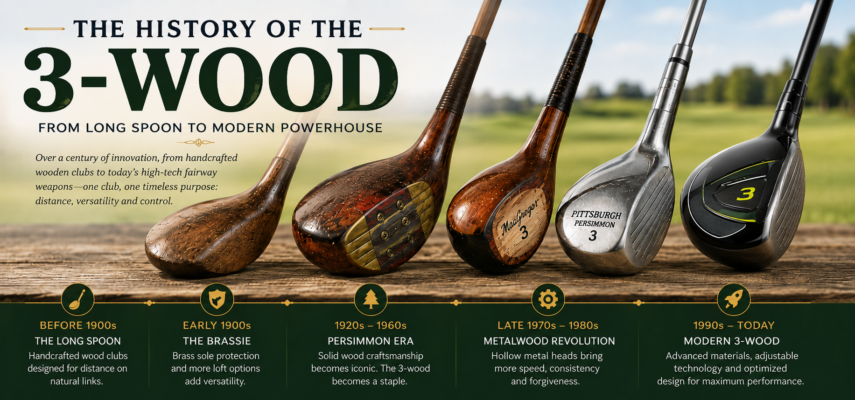
The 3-wood has always occupied an unusual position in the golf bag. It is not as powerful as the driver, not as precise as an iron and not as easy to launch as a higher-lofted fairway wood. Yet for more than a century, golfers have relied on some version of the club whenever they needed distance without completely surrendering control.
Long before golfers called it a 3-wood, its ancestors carried names such as the long spoon and, depending on their loft and construction, occasionally overlapped with the brassie. These wooden clubs helped players advance primitive golf balls across the firm, uneven terrain of early links courses.
Over time, the club evolved from a hand-shaped wooden implement into a hollow, precisely engineered metalwood. Its materials, dimensions and role have changed dramatically, but its central purpose has remained remarkably consistent: provide useful distance from places where a driver is either impractical or unnecessarily risky.
Before the 3-Wood: The Age of the Spoon
Golf clubs were not originally organized into standardized numbered sets. Early golfers selected clubs according to their shape and intended purpose, and clubmakers gave them descriptive names.
Among the long clubs was the spoon, a wooden-headed club with a slightly concave or “spooned” face. The spoon was designed to help lift the ball from the ground at a time when golf balls and playing surfaces made elevation difficult.
Different versions were produced for different shots. The long spoon was intended for distance and is generally considered the closest historical equivalent to the modern 3-wood. More-lofted middle and short spoons performed roles that would eventually be assigned to higher-numbered woods.
The brassie was another important early fairway club. It received its name from the brass plate attached to the sole, which protected the wooden head when the club struck the turf or hard ground. The brassie is usually compared with a 2-wood rather than a conventional 3-wood, although the boundaries between historical clubs were never perfectly standardized.
These distinctions mattered less to early golfers than they do to modern equipment historians. Clubs were handmade, lofts varied and two implements bearing the same name could perform quite differently.
Why Early Fairway Woods Were Necessary
The earliest forms of golf were played across natural coastal landscapes rather than carefully maintained courses. Fairways could be firm, sandy, uneven and filled with unpredictable lies.
Players needed a club that could send the ball a substantial distance after the opening shot. Drivers—or play clubs, as some early versions were known—were primarily built for use from a tee. A spoon or brassie had enough loft to play the ball from the ground while still producing the distance needed on long holes.
That combination made the early fairway wood one of the most versatile clubs available. It could be used for a second shot on a long hole, a controlled tee shot or an attempt to carry rough, bunkers and other natural obstacles.
The club was demanding, however. Wooden heads were small by modern standards, the sweet spot was narrow and hickory shafts could vary considerably in stiffness and response. The USGA notes that early woods made from hardwoods such as persimmon were relatively small and possessed far less spring-like performance than the hollow metal heads that followed.
From Named Clubs to the Numbered 3-Wood
As golf expanded during the late 19th and early 20th centuries, equipment manufacturing became increasingly organized. Clubs that had once been identified by traditional names gradually became parts of numbered sets.
The driver became the 1-wood. Lower-lofted fairway clubs could be designated as 2-woods, while the long spoon’s general place in the bag was assumed by the 3-wood. More-lofted fairway woods received progressively higher numbers.
This transition did not happen everywhere at once. Traditional names remained in use for years, and some manufacturers continued stamping words such as “spoon” on the soles of numbered clubs. Vintage examples marked “3 Spoon” illustrate how the older and newer naming systems overlapped.
Numbering made golf equipment easier to manufacture, advertise and understand. A golfer could purchase a matched set with a reasonably predictable progression of loft and length instead of relying entirely on the terminology of an individual clubmaker.
By the middle decades of the 20th century, the term 3-wood had become familiar throughout the game.
The Persimmon Era
For much of the 20th century, the classic 3-wood featured a solid head made from persimmon.
Persimmon became prized because it was dense, durable and capable of being shaped into the rounded profiles preferred by skilled clubmakers. A traditional persimmon 3-wood usually had a compact head, a deep face and a relatively heavy feel.
The bottom of the club commonly included a metal sole plate. A hardened face insert helped protect the hitting surface, while screws, whipping around the hosel and carefully applied finishes reinforced the head.
These clubs were beautiful, but they were not especially forgiving. A well-struck persimmon 3-wood could produce a powerful, penetrating flight. A strike toward the heel, toe or lower portion of the face lost far more speed than it would with a modern club.
That difficulty became part of the club’s identity. Hitting a persimmon 3-wood cleanly from the fairway was considered one of golf’s purest demonstrations of ball-striking ability.
Its usefulness was unquestioned. Golfers routinely used the club for second shots into par 5s, long approaches and controlled tee shots. Arnold Palmer, for example, famously played aggressive long shots with persimmon fairway woods, while Johnny Miller carried an exceptionally old MacGregor 3-wood during his record-setting final round at the 1973 U.S. Open.
Because persimmon clubs were shaped and finished individually, players often became deeply attached to a particular head. A trusted 3-wood might remain in a golfer’s bag through several generations of irons and drivers.
Steel Shafts Change the Club
The replacement of hickory by steel shafts transformed the 3-wood even before its wooden head disappeared.
Steel was more consistent than hickory and could be manufactured to tighter specifications. It reduced the variation between clubs and allowed manufacturers to create more predictable matched sets.
The change also affected the swing. Steel shafts generally produced a more stable feeling and gave players greater confidence when swinging aggressively. The 3-wood became less of an individually crafted specialty club and more of a standardized component in the modern golf bag.
Graphite shafts began appearing in golf equipment during the 1970s. Because graphite could be made lighter than steel, it eventually allowed manufacturers to increase club length and speed without making fairway woods excessively heavy. The USGA identifies the arrival of graphite shafts in 1973 as one of the important equipment developments preceding the metalwood revolution.
The Arrival of the Metalwood
The greatest transformation in the 3-wood’s history came when manufacturers began replacing solid wooden heads with hollow metal construction.
TaylorMade helped accelerate the revolution in 1979 with the introduction of the stainless-steel Pittsburgh Persimmon, one of the defining early metalwoods. The name reassured golfers that the unfamiliar metal club was intended to perform the same basic job as persimmon—even though it looked, sounded and behaved differently.
Early metalwoods were not immediately accepted. Traditionalists disliked their appearance and sharp impact sound. Persimmon remained common among professionals and accomplished amateurs through much of the 1980s.
But hollow construction offered advantages that solid wood could not easily match. Engineers could enlarge the head, redistribute weight around its perimeter and create a more responsive face. The resulting clubs retained more speed when the ball was struck away from the center.
During the 1980s and 1990s, metal-headed drivers and fairway woods steadily displaced persimmon. The USGA describes this period as one in which metal and titanium woods replaced wooden clubs and forced governing bodies to pay closer attention to spring-like face performance.
The 3-wood was no longer made of wood, but its traditional name survived.
The Modern 3-Wood Takes Shape
Once metal construction became standard, manufacturers began optimizing the 3-wood as a category of its own rather than simply building a smaller driver.
Modern heads became wider from heel to toe and more forgiving. Designers lowered the center of gravity to help golfers launch the ball from the turf. Thin faces increased ball speed, while sole shaping reduced resistance as the club moved through the grass.
A conventional modern 3-wood is frequently built with approximately 15 degrees of loft, although stronger and higher-launching versions are widely available. Some clubs include adjustable hosels that allow golfers to alter loft, face angle and trajectory.
Contemporary designs may combine stainless steel, titanium, carbon composite and dense movable weights within a single head. Carbon crowns remove mass from the top of the club so it can be repositioned lower or farther back. High-strength steel or titanium faces are engineered to flex efficiently, while internal weighting can promote a particular launch or shot shape.
The result is a club that is longer and more forgiving than its persimmon ancestor—but not necessarily easier for every golfer to use.
The 3-Wood’s Two Competing Jobs
The modern 3-wood is asked to perform two very different tasks.
From the tee, it acts as a controlled alternative to the driver. Its shorter shaft can make it easier to strike solidly, while its additional loft may produce a straighter and more predictable flight. For some golfers, a strong 3-wood functions almost like a compact second driver.
From the fairway, however, the same low loft and relatively deep face can make the club difficult to launch. The golfer must generate sufficient speed and strike the ball cleanly from the turf.
This tension has shaped modern 3-wood design. A deep-faced, low-spin model may be excellent from the tee but demanding from the ground. A shallow-faced, higher-launching model may be easier from the fairway but less powerful as a driving alternative.
Manufacturers now offer multiple interpretations of the club:
- Standard 3-woods designed for balanced tee and fairway performance
- Strong 3-woods with reduced loft for maximum distance
- Higher-lofted 3-woods or “4-woods” built for easier launch
- Tour models with compact heads and lower spin
- Draw-biased models intended to reduce a slice
- High-forgiveness models with larger profiles and rear weighting
The category has become more diverse precisely because one design cannot perfectly satisfy every version of the 3-wood’s job.
Competition From Hybrids and Higher-Lofted Woods
For most of the 20th century, the 3-wood was nearly automatic equipment. A conventional set often included a driver, 3-wood and 5-wood before progressing into the long irons.
That arrangement is no longer universal.
Hybrids gave golfers an easier way to replace difficult long irons. At the same time, improved 5-woods and 7-woods began producing enough speed to challenge the traditional 3-wood while launching the ball more easily.
Some players discovered that they carried a 3-wood but rarely used it. They could not consistently launch it from the fairway, and their driver was still the preferred option from the tee. Replacing it with a higher-lofted fairway wood sometimes produced better average distance because the golfer achieved more height and made more reliable contact.
Even professional golfers have adopted unconventional loft combinations. Some carry higher-lofted fairway woods because those clubs create the trajectory and stopping power required for long approaches. Equipment choices increasingly depend on launch conditions rather than the expectation that every bag must contain a club stamped with the number three.
Yet the 3-wood has not disappeared. For golfers with enough speed and consistent contact, it remains one of the most valuable clubs available.
Why the 3-Wood Has Endured
The 3-wood has survived because it addresses a problem that has existed throughout golf’s history: how to achieve substantial distance when the driver is not the appropriate tool.
Its form has changed repeatedly. The long spoon became a numbered wooden club. Persimmon gave way to steel. Steel was joined by titanium and carbon composite. Hickory shafts were replaced by steel and then graphite.
But the strategic role is recognizable across every era.
The club can advance the ball on a par 5, find a narrow fairway from the tee or produce a low, running shot in windy conditions. It asks the golfer to balance ambition against control.
That challenge explains both its appeal and its reputation. A 3-wood struck perfectly from the fairway remains one of golf’s most satisfying shots. The margin for error may be greater than it was during the persimmon era, but the club still rewards speed, confidence and precise contact.
The Legacy of the 3-Wood
The history of the 3-wood is a condensed history of golf equipment itself.
It began as a handcrafted wooden club created for natural terrain and unpredictable lies. It became part of the standardized numbered set, flourished during the persimmon era and then participated in the industry’s transition to hollow metal construction.
Today’s version may include adjustable loft, carbon composite, high-strength face alloys and computer-optimized weighting. It bears little physical resemblance to the long spoon, yet it continues to perform the same essential assignment.
The 3-wood is golf’s long-range utility club: powerful enough to change a hole, controlled enough to replace the driver and versatile enough to remain relevant after centuries of technological change.
As long as golfers need distance from somewhere other than a tee, the 3-wood—or a club inspired by it—will continue to have a place in the game.