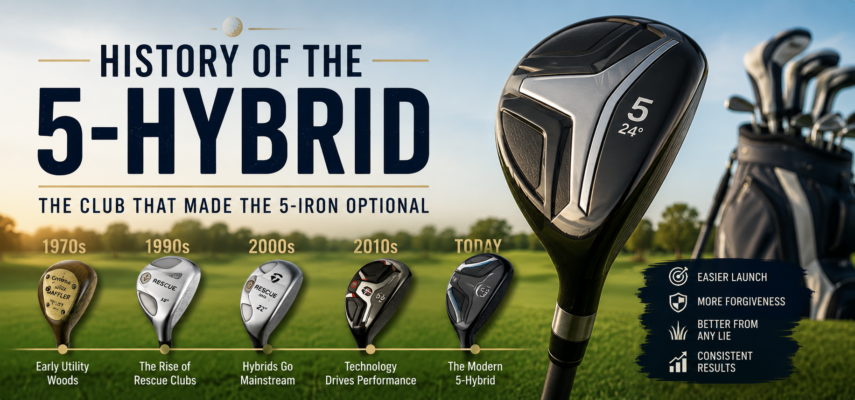
For much of golf history, the 5-iron occupied an important position in the standard set. It was expected to handle long approach shots, controlled tee shots and recovery shots that required more distance than a short iron could provide.
There was only one problem: many recreational golfers could not hit it consistently.
As iron lofts became stronger and club designs became more distance-oriented, the traditional 5-iron became increasingly demanding. Its relatively long shaft, limited loft and compact head required sufficient swing speed and precise contact. Shots struck low on the face often failed to launch, while off-center contact produced substantial losses in distance.
The 5-hybrid emerged as a solution.
Combining characteristics of an iron and a fairway wood, the 5-hybrid offered golfers a larger clubhead, a lower center of gravity and greater forgiveness. It could perform many of the same jobs as a 5-iron while making it easier to launch the ball from the fairway, rough and other difficult lies.
The club was not created in a single moment. Instead, it developed from decades of experimentation with utility woods, rescue clubs and hollow-headed iron replacements. By the early 21st century, the 5-hybrid had become one of the most practical clubs available to recreational golfers.
Before the 5-Hybrid
Long before manufacturers used the word “hybrid,” clubmakers experimented with designs that did not fit neatly into the traditional categories of woods and irons.
Golfers had always faced a difficult transition between their shortest fairway wood and longest playable iron. Fairway woods were easier to launch but had longer shafts and larger heads. Long irons provided greater precision but were much less forgiving.
Early utility clubs attempted to bridge that divide.
One of the most influential was the Cobra Baffler, introduced in 1975 by Cobra founder Thomas Crow. The original Baffler was a laminated utility wood with approximately 23 degrees of loft—close to the loft eventually associated with many 4- and 5-hybrids. Its defining feature was a pair of rails on the sole designed to reduce resistance as the club moved through grass and uneven lies.
The Baffler was not identical to the modern hybrid, but it established several important principles. A compact wood-style head could replace a difficult iron. A low center of gravity could help launch the ball. A specialized sole could make the club useful from rough and imperfect lies.
Other utility clubs, including the Stan Thompson Ginty, explored similar territory during the 1970s. These clubs demonstrated that golfers were interested in alternatives to traditional long irons, even if the equipment industry had not yet agreed on what to call them.
The Rise of the Rescue Club
The modern hybrid category began taking recognizable form during the late 1990s and early 2000s.
TaylorMade played a major role by marketing compact utility clubs under the name “Rescue.” The Firesole Rescue appeared around 1999, while subsequent Rescue models helped bring the concept to a much broader golfing audience. TaylorMade positioned the club as a versatile option that could produce high, long shots from a variety of lies.
The name was effective because it described what the club was supposed to do. A Rescue could help a golfer escape heavy rough, negotiate a poor lie, avoid using a difficult long iron or find the fairway on a narrow hole.
“Rescue” was a TaylorMade product name, but many golfers began using it as a general term. Other manufacturers preferred labels such as “utility,” “iron-wood” or “hybrid.” Eventually, hybrid became the standard category name because the club blended recognizable elements of woods and irons.
By the middle of the 2000s, hybrids were spreading rapidly. According to figures cited by Keiser University’s College of Golf, approximately 7 percent of golfers used a hybrid in 2004, compared with roughly 30 percent by 2007.
The hybrid was no longer an unusual specialty club. It was becoming a normal part of the golf bag.
Why the 5-Hybrid Developed
The earliest mass-market hybrids were commonly designed to replace 2-, 3- and 4-irons. Those were the clubs most recreational golfers struggled to elevate and strike consistently.
The 5-iron initially appeared safer.
Compared with a 3-iron, it had more loft, a shorter shaft and a reputation for being manageable. Many golfers therefore kept it even after replacing their longer irons with hybrids.
Over time, however, several developments made the 5-hybrid increasingly relevant.
Modern iron lofts became stronger. A contemporary game-improvement 5-iron could have loft similar to an older 3- or 4-iron. Although manufacturers used perimeter weighting, wider soles and flexible faces to make irons more forgiving, the reduced loft could still make them difficult for golfers with moderate or slower swing speeds to launch.
Golfers also became more willing to evaluate clubs based on performance rather than tradition. Instead of asking whether a 5-iron belonged in a “proper” set, players began asking which club produced the best combination of distance, height and consistency.
For many of them, the answer was a 5-hybrid.
What Defines a 5-Hybrid?
A 5-hybrid is generally intended to replace a 5-iron, although the relationship is not exact. Loft, shaft length and clubhead design vary considerably among manufacturers.
Many 5-hybrids fall somewhere around 24 to 27 degrees of loft. Stronger models may have less loft, while hybrids designed for slower swing speeds may have more.
The head is normally larger and deeper than that of a 5-iron but smaller than a fairway wood. Its hollow construction allows designers to position weight low and toward the rear of the clubhead. This increases stability and helps the ball launch higher.
The sole is wider than an iron’s and often curved or shaped to move efficiently through turf and rough. The face may incorporate high-strength steel, variable thickness or other technologies designed to retain ball speed on off-center strikes.
A 5-hybrid shaft is usually longer than a 5-iron shaft but shorter than the shaft in a comparable fairway wood. Graphite is common, helping manufacturers reduce total weight and potentially increase clubhead speed.
The result is not simply a 5-iron with a different shape. It is a distinct club engineered to perform the same general distance role through a different combination of launch, spin, speed and forgiveness.
The 5-Hybrid Versus the 5-Iron
A well-struck 5-iron can be an excellent club. Skilled golfers may prefer its compact appearance, lower trajectory and ability to shape shots. An iron can also provide a more penetrating flight in windy conditions.
The 5-hybrid offers a different set of advantages.
Its deeper center of gravity generally helps the ball rise more easily. Its larger head provides greater stability when contact occurs away from the center. Its wider sole can prevent the club from digging as severely into the ground.
The hybrid may therefore produce a higher average distance even when its best shot does not travel much farther than the golfer’s best 5-iron. The improvement comes from reducing the penalty for imperfect contact.
This distinction explains much of the hybrid’s appeal. Golf is not played entirely with perfect swings. A club’s usefulness is often determined by what happens on average, not by what happens when the golfer strikes the exact center of the face.
The 5-hybrid made the traditional 5-iron optional because it often delivered more repeatable results.
A Club for the Rough
The 5-hybrid’s ability to perform from rough became one of its defining features.
A conventional iron can be difficult to use when grass becomes trapped between the ball and clubface. The hosel and leading edge may catch in thick vegetation, causing the face to close or the clubhead to lose speed.
The hybrid’s rounded, wood-like head and wider sole can move through grass more effectively. Its additional mass behind the face also helps maintain momentum.
This does not mean a 5-hybrid can escape every lie. Deep rough may still require a wedge or short iron. However, from moderate rough, the hybrid frequently allows golfers to advance the ball farther than they could with a comparable iron.
That versatility reinforced the older “rescue club” identity. The hybrid was useful not only from ideal fairway lies but also when a golfer needed to recover from trouble.
The Growth of Hybrid-Iron Sets
As hybrids became accepted, manufacturers began extending the concept deeper into iron sets.
Some combination sets replaced the 3- and 4-irons with hybrids. Others included 5- and even 6-hybrids. Super game-improvement sets sometimes blended full hybrids into hybrid-irons, hollow irons and conventional cavity-back scoring clubs.
Cobra, for example, later applied its Baffler heritage to hybrid-iron sets designed around easy launch, forgiveness and improved turf interaction. Some versions included full hybrids in the 4- and 5-iron positions before transitioning into hybrid-style or cavity-back irons.
These sets reflected a major philosophical shift in equipment design. Every numbered club no longer needed to share the same construction.
Instead, manufacturers could use a hybrid where launch and forgiveness were most important, an iron where precision became more valuable and a wedge where spin and trajectory control took priority.
The 5-hybrid sat near the center of this transition.
Acceptance Among Better Players
Hybrids were initially associated primarily with beginners, seniors and golfers with slower swing speeds. Some traditionalists viewed them as equipment for players who could not hit long irons.
That perception gradually weakened.
Professional and elite amateur golfers began using hybrids when the clubs fit a specific distance requirement or performed better from demanding lies. Manufacturers responded by creating more compact models with flatter trajectories, less offset and greater workability.
Not every professional adopted them. Many elite players continued to favor long irons, driving irons or high-lofted fairway woods. But the presence of hybrids in high-level competition legitimized the category.
The hybrid was no longer merely a corrective tool. It was a strategic option.
The 5-hybrid remained less common on professional tours than lower-lofted hybrids because elite golfers generally possess the speed needed to launch a 5-iron. Nevertheless, its growing use among skilled amateurs demonstrated that choosing one did not automatically indicate a lack of ability.
It indicated a preference for a particular ball flight and performance profile.
The Influence of Launch-Monitor Fitting
Launch monitors further accelerated the 5-hybrid’s acceptance.
Before detailed fitting technology became widely available, golfers often selected clubs according to the number stamped on the sole. A player owned a 5-iron because an iron set traditionally included one.
Launch monitors allowed fitters to compare actual performance.
A golfer could hit a 5-iron and 5-hybrid while measuring launch angle, spin rate, ball speed, carry distance, peak height and landing angle. In many cases, the hybrid launched higher, carried more consistently and descended at a steeper angle.
That final measurement was especially important.
A long approach club must do more than travel the required distance. It must also produce a trajectory capable of holding the green. A low-flying 5-iron may run through the putting surface, while a higher 5-hybrid may land more softly.
Launch-monitor data helped turn the decision from a question of tradition into a question of measurable performance.
The Modern 5-Hybrid
Today’s 5-hybrid represents decades of refinement.
Manufacturers can manipulate weight distribution with tungsten, carbon composites and lightweight crowns. Thin faces help generate ball speed. Adjustable hosels on some models allow golfers to alter loft and lie angle. Internal weighting can reduce excessive spin, encourage a draw or create a more neutral flight.
The category has also diversified.
Some 5-hybrids are large, forgiving and designed to launch the ball as high as possible. Others have compact heads intended to appeal to better players. Certain models resemble miniature fairway woods, while others look more like oversized irons.
Despite these variations, the club’s central purpose remains unchanged: to provide a more playable alternative to the traditional 5-iron.
Why the 5-Hybrid Matters
The significance of the 5-hybrid extends beyond one position in the golf bag.
It helped challenge the assumption that every golfer should carry the same sequence of clubs. A traditional set might include a 3-iron through pitching wedge, but modern golfers can build the top and middle of the bag around their individual needs.
One player may carry a 5-iron. Another may use a 5-hybrid. A third may prefer a 9-wood or a hollow utility iron.
None of those arrangements is automatically correct or incorrect.
The emergence of the 5-hybrid encouraged golfers to think in terms of distance gaps, launch conditions and shot requirements rather than fixed equipment conventions.
It also made golf more accessible. Players who once struggled to elevate a 5-iron gained a club that could produce useful distance without demanding perfect contact. Older golfers could maintain long-game performance as swing speed declined. Beginners could experience successful shots sooner.
The 5-hybrid did not eliminate the 5-iron. It gave golfers a choice.
The Legacy of the 5-Hybrid
The 5-hybrid’s history is part of the broader story of golf equipment becoming more specialized and forgiving.
Its roots can be traced to utility woods such as the Cobra Baffler, its popular identity was shaped by TaylorMade’s Rescue clubs, and its expansion was driven by the needs of everyday golfers searching for a reliable alternative to long and middle irons.
What began as an unconventional replacement club eventually became a standard option.
The 5-hybrid succeeded because it addressed a genuine problem. Many golfers needed a club that could cover 5-iron distances without requiring a textbook 5-iron strike. By combining the launch characteristics of a wood with the length and directional control of an iron, manufacturers created one of the most useful clubs in the modern bag.
The number on its sole may correspond to the 5-iron, but the 5-hybrid represents something larger: golf’s gradual movement away from rigid tradition and toward equipment selected according to how players actually perform.