Bordeaux is one of those wine words that can feel intimidating before you understand it.
It sounds expensive. It sounds old-world. It sounds like something serious collectors talk about in hushed tones while debating vintages, châteaux, and auction prices.
But Bordeaux matters for a much simpler reason: it helped define what great wine could be.
For centuries, Bordeaux has shaped how people think about red blends, aging, wine regions, vineyard reputation, and the relationship between place and prestige. Even if you never buy a famous bottle from Château Lafite Rothschild, Château Margaux, or Château Latour, Bordeaux still matters because its influence shows up almost everywhere in the wine world.
If Cabernet Sauvignon, Merlot, red blends, cellar-worthy wines, or steakhouse wine lists are part of the conversation, Bordeaux is usually somewhere in the background.
What Is Bordeaux?
Bordeaux is a wine region in southwest France, near the Atlantic Ocean. It is also the name of the city at the center of the region.
The wines of Bordeaux are best known for red blends, usually made from some combination of Cabernet Sauvignon, Merlot, Cabernet Franc, Petit Verdot, Malbec, and sometimes Carménère.
Unlike many beginner wine conversations that focus on a single grape — Cabernet Sauvignon, Pinot Noir, Chardonnay — Bordeaux is often about blending. The goal is not usually to make a wine from one grape. The goal is to combine grapes in a way that creates balance, structure, depth, and ageability.
That blending tradition is one of Bordeaux’s biggest contributions to wine.
A Bordeaux-style red blend made in California, Chile, Australia, South Africa, or Washington State is often inspired by the same basic model: Cabernet Sauvignon for structure, Merlot for softness and fruit, Cabernet Franc for aroma, and smaller amounts of other grapes for complexity.
That is one reason Bordeaux matters. It did not just become famous as a French region. It became a global template.
The Left Bank and Right Bank Explained
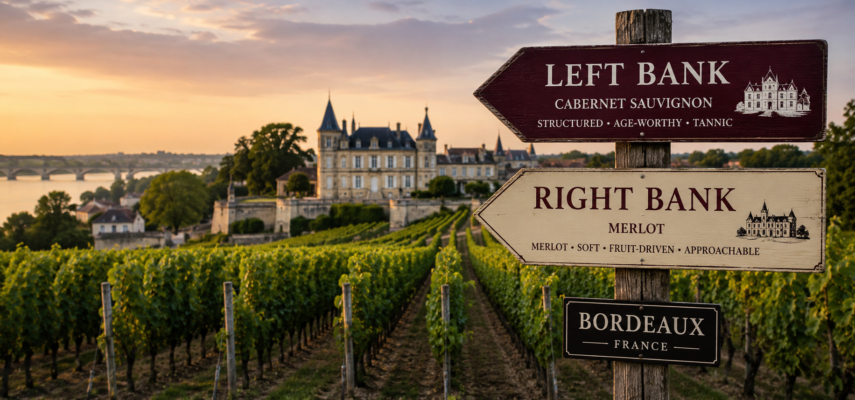
One of the easiest ways to understand Bordeaux is to split it into two broad areas: the Left Bank and the Right Bank.
The Left Bank is generally associated with Cabernet Sauvignon-dominant wines. These wines are often more structured, tannic, and built for aging. Famous Left Bank areas include Médoc, Haut-Médoc, Pauillac, Margaux, Saint-Julien, Saint-Estèphe, and Pessac-Léognan.
The Right Bank is generally associated with Merlot-dominant wines, often with Cabernet Franc playing an important role. These wines can feel softer, rounder, and more approachable when young. Famous Right Bank areas include Saint-Émilion and Pomerol.
This does not mean every Left Bank wine tastes the same or every Right Bank wine tastes the same. Bordeaux is too complex for that. But for beginners, this is a useful shortcut:
Left Bank usually means more Cabernet Sauvignon, more structure, and more firm tannin.
Right Bank usually means more Merlot, more plush fruit, and a rounder texture.
Once you understand that, Bordeaux starts to feel less mysterious.
Why Bordeaux Became So Famous
Bordeaux became famous for several reasons at once.
First, it had geography on its side. Bordeaux’s location near rivers and the Atlantic made it easier to trade wine internationally, especially with England and other markets. Wine regions do not become globally important on quality alone. They also need access, trade, reputation, and buyers.
Second, Bordeaux developed a powerful château system. Instead of just talking about a village or grape, Bordeaux became known for specific estates. Names like Château Margaux, Château Latour, Château Mouton Rothschild, Château Haut-Brion, and Château Lafite Rothschild became brands long before modern luxury branding was common.
Third, Bordeaux wines could age. The best bottles were not just enjoyable when young. They evolved over years or decades, developing flavors of cedar, tobacco, leather, earth, dried fruit, graphite, and spice. That ability to age made Bordeaux especially attractive to collectors.
Fourth, Bordeaux was classified. The famous 1855 Classification ranked many top Médoc estates from First Growth to Fifth Growth, along with sweet wines from Sauternes and Barsac. That classification helped turn Bordeaux into a hierarchy of prestige, reputation, and price.
Whether you love or dislike the idea of classifying wine estates, there is no denying its effect. Bordeaux became one of the clearest examples of wine as both agriculture and luxury.
Bordeaux Is Not Just Expensive Wine
One of the biggest misconceptions about Bordeaux is that it is only for wealthy collectors.
Yes, the most famous bottles can be extremely expensive. First Growth Bordeaux can sell for hundreds or thousands of dollars per bottle depending on the producer and vintage.
But most Bordeaux is not First Growth Bordeaux.
There are many bottles labeled simply Bordeaux, Bordeaux Supérieur, Côtes de Bordeaux, Entre-Deux-Mers, Médoc, Graves, Fronsac, Castillon Côtes de Bordeaux, and other less-famous appellations that can be far more affordable.
For beginners, this is important. You do not need to start with a legendary château. In fact, you probably should not.
A $15 to $30 bottle of Bordeaux can teach you a lot. It can show you what balanced red blends taste like. It can show you how tannin, acidity, fruit, oak, and earthiness work together. It can also show you that wine does not need to taste jammy, sweet, or overly heavy to be satisfying.
Bordeaux is often less about obvious power and more about structure.
That can take some getting used to, especially if you are used to fruit-forward New World wines. But once your palate adjusts, Bordeaux can become one of the most rewarding wine categories to explore.
What Bordeaux Tastes Like
Red Bordeaux usually has flavors of blackcurrant, plum, cherry, cedar, tobacco, graphite, herbs, earth, and spice.
Left Bank wines often lean toward blackcurrant, cedar, pencil lead, firm tannin, and a more structured feel.
Right Bank wines often lean toward plum, black cherry, softer tannins, chocolate, herbs, and a rounder texture.
You may also notice that Bordeaux does not always taste as fruity as some California Cabernet or Australian Shiraz. That is part of the style. Bordeaux often balances fruit with savory, earthy, herbal, and mineral notes.
This is one reason it pairs so well with food.
Why Bordeaux Is Great With Food
Bordeaux is one of the classic food wines.
The tannins in red Bordeaux work especially well with protein and fat. That makes it a natural match for steak, lamb, burgers, roast beef, short ribs, duck, mushrooms, and aged cheeses.
A young, tannic Bordeaux can feel a little firm on its own. But with a ribeye, lamb chops, or a mushroom-heavy dish, the wine can soften and become much more enjoyable.
This is an important lesson for beginners: some wines are not designed to be cocktail wines. They are built for the table.
Bordeaux teaches that lesson well.
Bordeaux Also Makes White and Sweet Wine
Although Bordeaux is most famous for red wine, the region also produces white and sweet wines.
Dry white Bordeaux is usually made from Sauvignon Blanc, Sémillon, and sometimes Muscadelle. These wines can be crisp, citrusy, grassy, creamy, or textured depending on the style.
Entre-Deux-Mers is one of the better-known areas for approachable dry white Bordeaux.
Then there is Sauternes, one of the world’s great sweet wines. Sauternes is made from grapes affected by noble rot, which concentrates sugars and flavors. The result can be a rich, golden wine with notes of honey, apricot, orange marmalade, vanilla, and spice.
This matters because Bordeaux is not one single thing. It is a region with range.
What Bordeaux Teaches You About Wine
Bordeaux matters because it teaches several major wine lessons at once.
It teaches blending. Great wine does not always come from one grape. Sometimes the best result comes from combining grapes with different strengths.
It teaches structure. Fruit is only one part of wine. Tannin, acidity, alcohol, oak, texture, and finish all matter.
It teaches aging. Some wines are made to be enjoyed young. Others are built to develop over time.
It teaches place. A Cabernet-dominant wine from Pauillac will not taste exactly like a Merlot-dominant wine from Saint-Émilion, even though both are Bordeaux.
It teaches reputation. Wine pricing is not just about taste. It is also about scarcity, history, classification, critic scores, vintage, and global demand.
And perhaps most importantly, Bordeaux teaches patience. Some wines reveal themselves slowly.
How a Beginner Should Approach Bordeaux
If you are new to Bordeaux, do not start by chasing the most famous names.
Start with the basics.
Try an affordable Left Bank Bordeaux and compare it with an affordable Right Bank Bordeaux. Look for labels from Médoc, Haut-Médoc, Graves, Saint-Émilion, Fronsac, or Côtes de Bordeaux.
Open them with food, not just by themselves.
Pay attention to the structure. Does the wine feel firm or soft? Is the fruit dark or red? Do you notice cedar, herbs, tobacco, earth, or graphite? Does the wine feel better after 30 minutes in the glass?
You do not need to identify everything perfectly. The goal is to build familiarity.
A good beginner exercise is to buy two bottles:
One Cabernet Sauvignon-dominant Bordeaux from the Left Bank.
One Merlot-dominant Bordeaux from the Right Bank.
Taste them side by side with dinner. That one comparison can teach you more than reading a dozen tasting notes.
Why Bordeaux Still Matters Today
Bordeaux matters because it remains one of the world’s reference points for serious wine.
Collectors still follow its top estates. Sommeliers still use it as a benchmark. Winemakers around the world still make Bordeaux-style blends. Restaurants still build wine lists around it. And wine students still study it because understanding Bordeaux helps unlock a huge part of wine culture.
But Bordeaux also matters because it is practical.
It can help you understand Cabernet Sauvignon and Merlot. It can help you understand blending. It can help you understand why some wines age and others do not. It can help you order better at restaurants, pair wine with food, and recognize value on a wine list.
You do not need to worship Bordeaux to appreciate it.
You just need to understand why it became important.
Bordeaux is not the only great wine region in the world. It is not automatically better than Burgundy, Napa, Rioja, Tuscany, Champagne, or the Rhône.
But Bordeaux is one of the foundations.
And if you want to understand wine, Bordeaux is one of the places you eventually have to visit — even if you only visit through a glass.