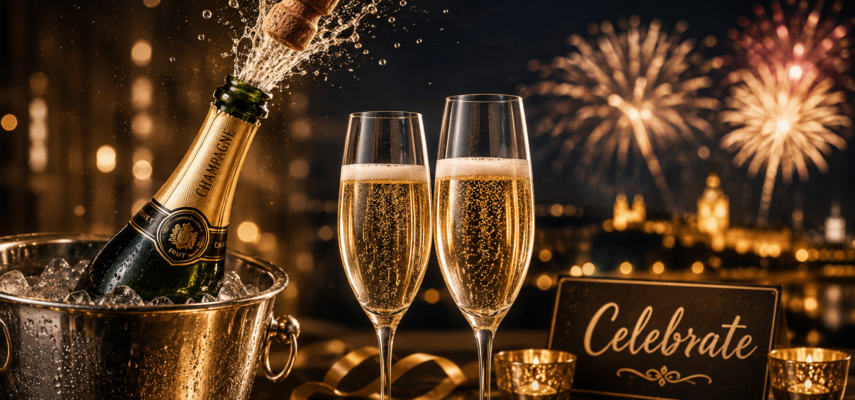
Champagne is not just wine with bubbles. It is a signal.
A bottle pops, and everyone in the room understands the message before a word is spoken: something good has happened. A wedding. A promotion. A championship. A ship launch. A New Year. A deal closed. A life milestone reached.
No other wine has managed to become such a universal symbol of celebration. Cabernet may suggest seriousness. Burgundy may suggest refinement. Bordeaux may suggest tradition. But Champagne says one thing more clearly than almost any drink in the world:
This moment matters.
The story of how that happened is not just about taste. It is about geography, royalty, religion, technology, marketing, scarcity, and centuries of cultural reinforcement.
Champagne became the drink of celebration because it learned to combine three powerful things: prestige, theater, and pleasure.
Champagne Was Prestigious Before It Was Sparkling
The Champagne region sits in northeastern France, far north for wine production. Today, that cool climate is one of the reasons Champagne tastes so bright, crisp, and refreshing. But historically, it made winemaking difficult.
Before Champagne became famous for bubbles, the region produced still wines. These wines were often lighter, sharper, and paler than those from warmer parts of France. They were not yet the sparkling wines we recognize today.
What Champagne did have, however, was location.
The city of Reims was deeply tied to French monarchy. Clovis, king of the Franks, was baptized there in 496, and Reims later became the coronation city for many French kings. The official Champagne trade body notes that wine flowed at these coronation banquets, helping give the region’s wines an early association with royalty, ceremony, and national importance.
That mattered enormously.
Wine has always been more than a beverage. It is a social object. The people who drink it, the places where it is served, and the rituals surrounding it shape its meaning. Champagne’s first great advantage was that it was connected to kings before it was connected to parties.
Long before anyone was spraying Champagne in a locker room or raising a flute at midnight, the wines of Champagne were already linked to power.
The Bubbles Were Once a Problem
Today, bubbles are the whole point. In earlier centuries, they were often considered a defect.
Champagne’s cold climate created a winemaking challenge. Fermentation would sometimes stop during the winter before all the sugar had been converted into alcohol. When spring arrived and temperatures warmed, fermentation could restart inside the bottle. That second fermentation produced carbon dioxide, creating pressure and bubbles.
This was dangerous. Bottles could explode. Cellars could become hazardous. Winemakers did not yet fully understand the science behind fermentation, so sparkling wine was difficult to control.
Over time, however, what looked like a flaw became Champagne’s defining feature.
Between roughly 1670 and 1720, sparkling wine production in Champagne became more deliberate. The region developed techniques that helped preserve effervescence and create a more reliable sparkling wine. Cork stoppers, stronger glass bottles, and better cellar practices all helped turn bubbles from an accident into an art.
This is one of the great transformations in wine history: Champagne did not simply invent a product. It learned how to make a mistake desirable.
Dom Pérignon Did Not “Invent” Champagne — But He Helped Refine It
One of the most famous myths in wine is that Dom Pérignon invented Champagne and exclaimed, “Come quickly, I am drinking the stars.”
It is a wonderful story. It is also not quite true.
Dom Pierre Pérignon was a Benedictine monk and cellar master at the Abbey of Hautvillers. He did not single-handedly invent sparkling wine. In fact, some of his work was aimed at improving wine quality and controlling problems that came with unstable fermentation. But his importance is still real.
He helped refine blending, one of Champagne’s most important arts. Blending allows producers to combine grapes, vineyards, villages, and vintages to create balance and consistency. The official Champagne history credits Dom Pérignon as one of the early figures who saw that different wines and crus could complement one another when blended carefully.
That idea remains central to Champagne today.
Most non-vintage Champagne is not the product of one vineyard or one year. It is a carefully assembled house style. The producer’s goal is not simply to express one harvest, but to create a recognizable identity year after year.
This is part of Champagne’s genius. It is both agricultural and branded. It comes from vines, but it also comes from a house, a label, a reputation, and a promise.
Champagne Had Theater Built Into the Bottle
Champagne does something still wine cannot do: it performs.
The cork pops. The bubbles rise. The foam appears. The glass sparkles. The sound, motion, and visual drama all announce that something is happening.
That theatrical quality helped Champagne become associated with special occasions. It is not just consumed; it is opened. And opening it feels like an event.
This matters more than people realize.
Most wines are quiet. Champagne is audible. Most wines enter a room politely. Champagne makes an entrance.
That sensory drama made it ideal for public rituals. Weddings, banquets, launches, victories, and holidays all benefit from a drink that visibly marks transition. Champagne became a liquid punctuation mark: the exclamation point at the end of an achievement.
The Champagne Houses Turned Wine Into Luxury
By the 18th century, Champagne Houses began to emerge in Reims, Épernay, and Aÿ. These firms specialized in producing sparkling wine and building reputations around quality, consistency, and style. The official Champagne history lists names such as Ruinart, Moët, Delamotte, Veuve Clicquot, Heidsieck, and others as part of this early development.
This was crucial.
A still wine region can become famous through vineyards. Champagne became famous through houses.
The great Champagne Houses did more than produce wine. They created identities. They sold refinement, elegance, celebration, and access to a world of taste and status.
Veuve Clicquot, Moët & Chandon, Bollinger, Krug, Louis Roederer, Taittinger, Pol Roger, Perrier-Jouët — these names became more than producers. They became symbols.
Champagne was not simply something you drank. It was something you were seen drinking.
That made it perfect for aristocrats, elites, and later the rising bourgeoisie. It offered a way to participate in luxury. Even if only for one evening, a bottle of Champagne let people borrow the language of royalty.
Technology Made Champagne Reliable
For Champagne to become a global celebration drink, it had to become dependable. Early sparkling wines could be unstable, cloudy, overly sweet, or physically dangerous because bottles might burst under pressure.
The 19th century brought major improvements.
Riddling racks helped move sediment into the neck of the bottle so it could be removed. Better understanding of sugar levels helped producers control the pressure created by the second fermentation. In 1837, Jean-Baptiste François developed a method for measuring how much sugar should be added for proper effervescence, reducing bottle breakage. Later, cold disgorging made sediment removal cleaner and more efficient.
These advances mattered because luxury depends on confidence.
People do not celebrate with a product that feels unreliable. Champagne became more elegant as it became more controlled. The bottle could now deliver the same magic more consistently: clear wine, fine bubbles, a lively mousse, and a dramatic opening.
The science supported the myth.
Scarcity Helped Build the Brand
Champagne also benefited from a powerful limitation: real Champagne could only come from Champagne.
Over time, producers fought to protect the name. In 1887, a French court ruling held that the term Champagne referred specifically to wine produced from the Champagne region. In the 20th century, regulations became more formalized, and Champagne’s appellation rules were officially recognized.
This exclusivity made the word “Champagne” more valuable.
Plenty of regions make sparkling wine. Spain makes Cava. Italy makes Prosecco and Franciacorta. France produces Crémant outside Champagne. England, California, Tasmania, and many other places now produce excellent sparkling wines.
But Champagne has something the others do not: the name.
The protected identity reinforced the idea that Champagne was not generic. It was specific. It came from a particular place, followed particular rules, and carried a particular cultural meaning.
Scarcity and regulation made it easier for Champagne to remain special.
Celebration Became Champagne’s Natural Habitat
By the 19th and 20th centuries, Champagne was no longer only a royal or aristocratic drink. It became a marker of modern celebration.
Industrialization, global trade, restaurants, ocean liners, hotels, nightlife, and advertising all helped spread the image. Champagne became part of high society and then popular culture.
The Roaring Twenties were especially important. After World War I, Champagne became a symbol of pleasure, release, glamour, and social life. The Champagne trade body describes the 1920s as a golden age for Champagne, when it symbolized social pleasures and was poured liberally.
That image never fully disappeared.
Champagne became the drink of nightclubs, movie stars, luxury hotels, New Year’s Eve, weddings, and victory celebrations. It moved from royal courts to public imagination.
The message stayed the same, but the audience expanded.
Why Champagne Feels Different From Other Wine
Part of Champagne’s power is that it balances opposites.
It is serious, but festive.
Expensive, but widely understood.
Traditional, but glamorous.
Elegant, but fun.
Luxurious, but approachable enough that even non-wine drinkers know what it means.
That is rare.
Many great wines require explanation. Champagne explains itself. You do not need to know about dosage, lees aging, méthode traditionnelle, Grand Cru villages, or vintage declarations to understand that Champagne means celebration.
The bubbles do a lot of the work.
They lift the aroma. They refresh the palate. They make the wine feel alive. They also make Champagne incredibly food-friendly, pairing well with oysters, fried foods, soft cheeses, caviar, potato chips, sushi, roast chicken, and even French fries.
But most people do not first fall in love with Champagne because of pairing theory. They fall in love with what it represents.
Champagne tastes like permission to enjoy the moment.
The Marketing Was Brilliant — Because It Was True Enough
Champagne’s success was not accidental. Producers marketed it brilliantly.
They leaned into royalty. They leaned into glamour. They leaned into scarcity. They leaned into romance. They leaned into the pop of the cork and the sparkle in the glass.
But the marketing worked because it had real foundations.
Champagne really did have royal associations. It really did come from a specific region. It really was technically difficult to make. It really did require time, skill, blending, and patience. It really did look and feel different from ordinary wine.
The best luxury marketing does not invent meaning from nothing. It amplifies meaning that already exists.
Champagne had the raw materials: history, bubbles, rarity, and beauty.
The producers turned those materials into one of the strongest brands in the world.
Champagne Today: Celebration, But Also Wine
The irony is that Champagne became so successful as a symbol that many people forget it is also one of the world’s great wines.
It can be simple and joyful, but it can also be complex, savory, mineral, age-worthy, and deeply expressive. Great Champagne can show notes of citrus, apple, pear, brioche, almond, chalk, honey, toast, flowers, ginger, and sea spray. Some bottles are light and crisp. Others are rich and powerful. Some are bone-dry. Others are softer and rounder.
Champagne is not one thing.
There is non-vintage Champagne for consistency. Vintage Champagne for special years. Blanc de Blancs made from Chardonnay. Blanc de Noirs made from red grapes such as Pinot Noir and Pinot Meunier. Rosé Champagne. Prestige cuvées. Grower Champagne. Extra Brut. Demi-Sec.
The celebration image gets people in the door. The wine itself gives them a reason to stay.
The Simple Explanation
So, how did Champagne become the drink of celebration?
Because it had the perfect combination of history and sensation.
It was linked to French kings and coronations.
Its bubbles made it visually and emotionally dramatic.
Its production required skill and innovation.
Its houses built luxury brands around it.
Its name became protected and prestigious.
Its cork pop turned opening a bottle into a ritual.
Champagne became celebration because it does what celebration itself does: it transforms an ordinary moment into something memorable.
That is why people do not usually open Champagne quietly, alone, without reason. They open it when life crosses a threshold.
A beginning.
An ending.
A victory.
A promise.
A countdown.
A toast.
The wine became famous because of kings. It became beloved because of bubbles. But it became immortal because people gave it the most valuable role any drink can have:
They trusted it with their happiest moments.
Key Takeaway
Champagne became the drink of celebration not simply because it is sparkling, but because its sparkle became attached to power, luxury, ritual, and joy. Over centuries, the wine moved from royal coronations to weddings, holidays, victories, and personal milestones. Today, opening Champagne is more than drinking wine — it is a way of announcing that a moment deserves to be remembered.