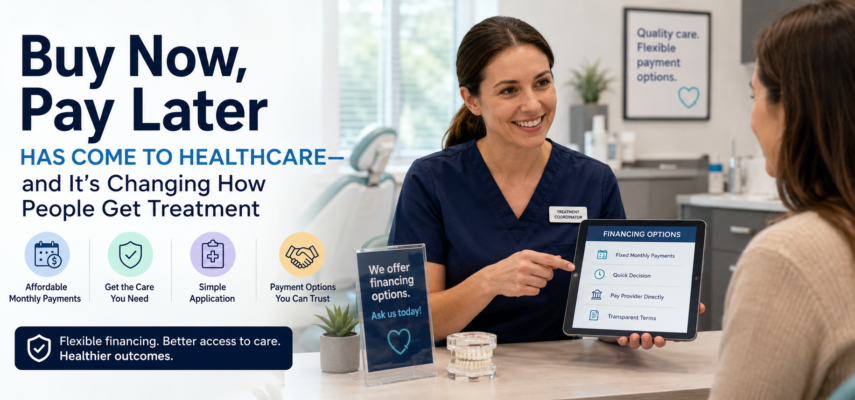
Buy now, pay later has exploded in retail. Now it’s quietly reshaping something far more consequential: how people access medical and dental care.
The same installment-based logic that made it easier to split a new laptop or sofa into four payments has migrated into healthcare-adjacent services over the past several years. The global BNPL market hit roughly $560 billion in transaction volume in 2025, up nearly 14% year over year — and healthcare is now one of its fastest-growing segments.
The trend reflects both a gap in traditional health insurance coverage and a broader change in how people think about managing large, necessary expenses.
Why Healthcare Was a Natural Next Step
Retail BNPL took off because it removed the friction between wanting something and being able to afford it in the moment. Healthcare financing works on a similar principle, but the stakes are different. Nobody needs a new jacket the way they might need a root canal or a pair of prescription eyeglasses.
The sense of urgency, along with ongoing high out-of-pocket costs, made healthcare a natural choice for expansion. Traditional health insurance has many gaps. Cosmetic and elective procedures are often not covered at all, and even when services are included, deductibles and co-pays can add up fast. Dental insurance especially tends to limit annual benefits, and these limits have not kept up with the real cost of care.
The result is a large population of people who need treatment, want treatment, and are still walking away from it because the upfront cost is too high. Financing programs step into that gap.
How It Works at the Point of Care
Unlike retail BNPL, which typically lives inside an app or e-commerce checkout, healthcare financing usually happens in person — at the front desk, in the treatment coordinator’s office, or on a tablet handed to a patient after a procedure is recommended.
Patients usually fill out a short online form and get a decision fast. If they are approved, the financing company pays the provider directly. The patient then pays back the lender in fixed monthly payments over a set period.
These programs are not all the same. Some work like credit cards, with revolving balances and special offers that may lead to extra interest if you do not pay off the balance in time. Others are simple installment loans with fixed payments and a clear end date. If you are considering your options, it helps to compare how each program works before you decide, since this can affect your total cost.
The Providers Offering It
The range of healthcare settings now offering financing has expanded considerably. Dentistry was an early adopter, given the frequency of large out-of-pocket expenses and the elective nature of many procedures. Vision care followed a similar path. Med-spas and cosmetic dermatology practices have embraced financing as a standard part of their business model, given that most services are cash-pay by nature.
Veterinary care is a more recent but fast-growing segment. Pet owners face many of the same dynamics as human patients: unexpected diagnoses, high treatment costs, and no insurance to fall back on.
According to NAPHIA’s 2025 State of the Industry Report, only about 7 million pets are insured across North America out of an estimated 180 million total — meaning the vast majority of pet owners are self-paying when something goes wrong. Several financing companies have developed veterinary-specific programs in response to that demand.
In all these situations, the main issue is that the cost of care is now more than most people can pay at once. Providers have noticed that when they offer financing options during patient decision-making, more patients choose to proceed with treatment.
What Consumers Should Watch For
Making healthcare financing more common generally helps people get care, but it comes with the same risks as other financial products. The key thing to know is the difference between deferred interest and true zero-interest financing.
With deferred interest, if you do not pay off the promotional balance within a set time, interest is charged from the original purchase date. This often surprises people who thought the deal was interest-free. In contrast, true installment loans have a fixed rate and payment schedule from the beginning.
Consumers should also pay attention to whether an application involves a hard or soft credit inquiry, as the former can affect a credit score and may be worth considering before applying at multiple providers.
A Shift Still in Progress
Healthcare financing is not as widespread as retail BNPL yet, but it is moving in that direction. As more providers offer these programs and more patients use them, having a payment option at the point of care is becoming common in more medical and dental offices.
For patients, that represents a genuine expansion of access. For the financing companies competing for provider partnerships, it represents one of the largest untapped markets in consumer finance. The retail BNPL wave took about a decade to mature — healthcare may move faster, given how much demand was already there.