










History of 3M
A small mining venture that became an industrial imagination
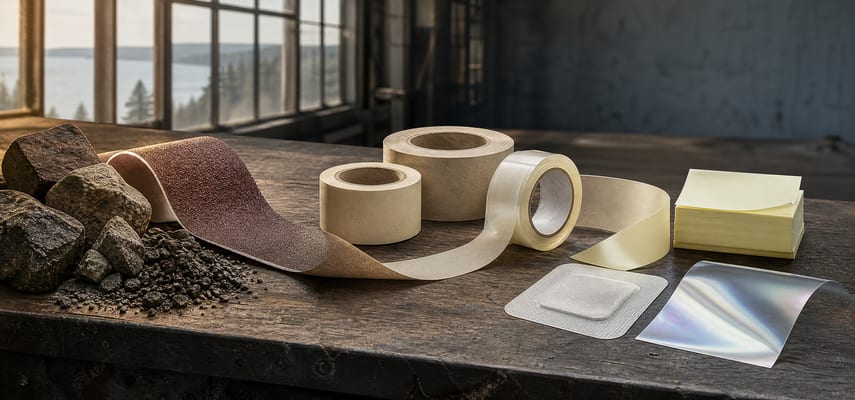
3M began with a narrow, practical idea: turn a local mineral into an industrial abrasive. The Minnesota Mining and Manufacturing Company was founded in 1902 to harvest corundum from a deposit near Two Harbors, Minnesota, and to convert that abrasive into sandpaper. That modest origin helps explain 3M’s recurring habit—spot a simple manufacturing problem, invent a material or a process to solve it, then reapply that capability beyond the original use.
The company’s arc—from a struggling, single-product mining outfit to a diversified materials and technology group known simply as 3M—matters because the firm did not grow by chasing a single market. It built a repeatable approach: materials invention, rapid productization, decentralized experimentation and licensing of new ideas across industrial, safety, health-care and consumer markets. Many products that shaped modern offices, factories and medical practice—pressure-sensitive tape, masking tape, adhesives and the Post-it Note—trace back to that mentality.
Chronology: select milestones
- 1902 — Minnesota Mining and Manufacturing Company founded in Two Harbors.
- 1910s–1920s — Transition from raw mining to coated abrasives (sandpaper, grinding wheels).
- 1920s–1930s — Development of masking tape and transparent adhesive tapes (Scotch).
- 1968 — Discovery of a low-tack adhesive that led to repositionable notes.
- 1970s–early 1980s — Development and wider rollout of the Post-it product.
- Mid-20th century — Diversification into health care, safety equipment and electronics materials.
- Late 20th–early 21st centuries — Targeted acquisitions and technical partnerships.
- 2000s–2010s — Public and regulatory attention on PFAS chemicals.
- 2018 — CEO succession continuing focus on costs and portfolio simplification.
- 2020 — COVID-19 pandemic placed N95 respirators and PPE at the center of public attention.
- Most recent five years — Ongoing litigation, regulatory engagement and strategic refocusing.
Origins and founding in Two Harbors (1902)
In 1902 a small group of businessmen incorporated Minnesota Mining and Manufacturing Company in Two Harbors, on the north shore of Lake Superior. The original venture aimed to mine and mill corundum, a naturally abrasive mineral used for making sandpaper. The deposit turned out to contain low-grade anorthosite rather than corundum, making it unsuitable for abrasives. Early mills produced abrasive cloth and sandpaper, but profits were elusive; the company repeatedly struggled with capital and production problems in the first decade.
The failure of the mine forced a change of tack. Rather than cling to a single raw material, 3M’s early leaders began to experiment with improved abrasives, coatings and adhesive formulations and to look for customers beyond local builders and lumber mills. Relocating facilities and sales closer to markets and transportation hubs helped stabilize manufacturing and distribution.
Early development: making abrasives into a platform (1910s–1920s)
During the 1910s and 1920s 3M moved from being a one-product mining play into a manufacturer of coated abrasives—sandpaper and grinding wheels that combined mineral, backing and adhesives. That technical fusion was decisive: making a reliable abrasive required controlling mineral quality, backing cloth or paper, and the adhesive layer that bonded them; success in those three areas created a capability that could be repurposed.
Manufacturing experiments showed that small-scale R&D and shop-floor tinkering could yield commercially viable products. Engineers and technicians learned to make adhesives that stuck consistently and to coat minute layers of abrasive in repeatable ways. Those skills later migrated into different product families.
William L. McKnight and the managerial culture of experimentation
A crucial turning point in 3M’s evolution was managerial rather than technological. William L. McKnight, who rose through the company’s ranks in the early 20th century, is associated with an operating philosophy that encouraged delegated authority, tolerance for failure and broad product experimentation across business units. Under his influence, 3M adopted decentralized decision-making: small teams were given latitude to develop ideas, and managers were judged on results rather than the avoidance of mistakes.
That culture meant that when researchers stumbled on unusual chemistries—low-tack adhesives, optical films, novel abrasives—people inside the company had both the permission and the structural path to test, scale and attempt commercialization. McKnight’s approach built an institutional appetite for iterative discovery rather than one-shot gambles.
Scotch, masking tape and the expansion into consumer brands (1920s–1930s)
The ability to make pressure-sensitive adhesives and coatings led 3M into tape products in the 1920s and 1930s. Masking tape and transparent adhesive tapes—later marketed under the Scotch name—were early consumer-facing hits born from the same adhesive-and-coating expertise that produced abrasives. The brand work of those decades gave 3M a durable public identity: industrial know-how married to everyday utility.
Two consequences followed. First, a consumer brand opened retail distribution and enabled premium pricing for quality. Second, the tape business established pressure-sensitive adhesives as a platform technology, enabling later products such as medical tapes, labels and protective films.
The sticky invention that became a cultural icon: the Post-it Note (1968–early 1980s)
One of the clearest examples of 3M’s experimental culture producing an unexpected global product began with a laboratory quirk. In 1968, 3M scientist Spencer Silver discovered an adhesive that stuck lightly and repeatedly without bonding tightly to surfaces. For years the technology seemed a curiosity without an obvious application. In 1974, fellow 3M employee Art Fry used the adhesive to anchor a paper bookmark in a hymnbook without damaging the pages; that informal demonstration suggested a new product category: low-tack, repositionable paper notes.
3M developed the idea through the 1970s, tested the notes in four cities in 1977 under the name Press ’n Peel, conducted the successful Boise Blitz sampling campaign in 1978, and introduced Post-it Notes nationally in 1980. The sticky note altered office behavior—creating ephemeral reminders, organizing drafts and enabling visible, collaborative note-taking—and became an instructive case for launching playful, consumer-facing products from a largely industrial company.
Post-war diversification: healthcare, electronics and industrial systems (mid-20th century)
From the mid-20th century, 3M expanded beyond tape and abrasives into health-care products, safety equipment, electronic materials and industrial systems. The company applied its materials expertise to wound-care dressings and surgical tapes; to safety headgear, respirators and protective films; and to films and coatings for electronics and displays.
Those moves changed the firm’s revenue profile. No longer dependent on cyclical construction and automotive markets alone, 3M gained steady institutional buyers—hospitals, factories and governments—which smoothed demand and opened R&D-funded product pipelines.
Acquisitions, technical alliances and selective divestitures (late 20th–early 21st centuries)
Throughout the late 20th and early 21st centuries, 3M augmented internal invention with targeted acquisitions and technical partnerships. The company bought specialty firms to gain capabilities in health-care disposables, electronics materials, optical films and specialty adhesives. It also pruned businesses that did not fit a materials-and-solutions core—spinning off or selling units that were peripheral to long-term technological platforms.
These transactions mattered because 3M’s growth model depended both on in-house chemistry and on bolt-on additions that supplied new customers or distribution channels. Acquisitions accelerated entry into regulated markets such as medical devices but also increased exposure to sector-specific liabilities and integration challenges.
Challenges and controversies: environmental chemicals and product litigation (2000s–2010s and beyond)
As 3M’s product reach widened, so did its exposure to safety and environmental scrutiny. A long-running source of controversy has been per- and polyfluoroalkyl substances (PFAS), a class of persistent chemicals that 3M used in products such as protective coatings and stain repellents. Public concern and regulatory attention grew in the 2000s and 2010s as PFAS showed environmental persistence and potential health implications. In May 2000, following negotiations with the EPA, 3M announced a phaseout of PFOS-related chemistry; company filings say the decision also covered PFOA, PFHxS and precursor compounds, with the vast majority of manufacturing and use ending within about two years. Litigation and regulatory inquiries continued because of historical uses and environmental persistence.
Another major legal exposure stemmed from Combat Arms earplugs sold or manufactured by Aearo Technologies and 3M. In 2019, federal claims were centralized in multidistrict litigation alleging that the dual-ended earplugs were defective and caused hearing loss or tinnitus. In August 2023, 3M agreed to contribute $6 billion between 2023 and 2029 to resolve the litigation, without admitting liability; the federal court described the settlement as covering more than 240,000 pending cases.
Both controversies illustrate a broader tension: materials that enable performance and convenience can, when widely used and persistent, create long-term liabilities. For a company whose core business is designing and scaling new chemistries and coatings, regulatory scrutiny is an operational and financial reality.
Modernization: organization, leadership and digital manufacturing (21st century)
In the 21st century 3M pushed to modernize manufacturing, integrate digital tools, and reorganize business units to reflect product and customer clusters. The company grouped its operations around broad end markets to align R&D and go-to-market functions with customer needs:
- Safety and industrial
- Transportation and electronics
- Health care
- Consumer
These structural changes were intended to shorten the cycle from lab discovery to customer adoption and to improve margin visibility in a more competitive global environment.
Leadership changes over recent decades reinforced that thrust. Inge Thulin served as CEO in the 2010s and emphasized operational rigor; his successor, who took the role in 2018, continued focusing on costs, product-portfolio simplification and investment in core growth platforms. These transitions reflected a recurring question in 3M’s history: how to balance the decentralized innovation culture that produced Post-it and Scotch with the discipline required for a global public company in highly regulated markets.
3M during the COVID-19 pandemic and recent strategic pressures (2020)
The COVID-19 pandemic put 3M’s respiratory-protection capability squarely at the center of global policy and public attention. N95 respirators and other personal protective equipment became strategic products in 2020; 3M ramped production, retooled factories and faced urgent orders from governments. The pandemic highlighted both the firm’s manufacturing strengths and the fragility of global supply chains: 3M’s masks were indispensable for hospitals and first responders, and the company found itself managing inventory, export requests and domestic priorities under intense public scrutiny.
At the same time, 3M confronted secular pressures: slowdowns in certain industrial markets, margin pressure from competitors, and the continuing costs of litigation and environmental remediation. The company responded with portfolio reshaping—divestitures of non-core units, targeted investments in higher-growth health-care and electronics materials, and operational programs to reduce costs.
Recent years: litigation, regulatory engagement and strategic refocusing (most recent five years)
Over the most recent five years, legal and regulatory matters have been among the most consequential influences on 3M’s strategic choices. PFAS-related claims, long-running product suits and large-scale litigation over legacy products required multi-year responses: scientific testing, negotiations with public authorities, settlement discussions and, in some cases, appeals. Those matters shaped capital allocation and forced management to be more explicit about risk and remediation plans.
Concurrently, 3M continued to invest in materials and systems that fit its historic strengths—adhesives, optical films, infection-prevention products and industrial filtration—while streamlining businesses that fell outside those focus areas. The company emphasized higher-margin specialties where the combination of chemistry, testing and regulatory know-how created barriers to entry.
Legacy and significance: what 3M changed in industry and everyday life
3M’s legacy is both visible and technical. On the visible side, consumer and office staples—Scotch tape, masking tape and Post-it Notes—changed daily routines in homes and workplaces around the world. Those products show how a materials company can create enduring cultural artifacts by solving mundane problems.
On the technical side, 3M demonstrated how mastery of surface chemistry, coatings and adhesives can be redeployed across industries: from abrasive cloth to optical films for displays; from consumer tapes to medical dressings and respirator filters. Perhaps more important, 3M institutionalized an approach—small-scale experimentation, tolerance for repeated failure and decentralized product development—that other engineering-driven companies have emulated. That managerial legacy influenced how industrial R&D was organized beyond the firm.
At the same time, 3M’s troubles with persistent chemicals and product litigation carry a cautionary lesson about scaling materials into mass markets. Innovation at the chemical level can create long-lasting societal risks if environmental persistence and exposure pathways are not adequately anticipated. Those tensions have become part of the company’s modern narrative.
Conclusion: a materials company still wrestling with scale and accountability
From a struggling corundum mine to a global maker of adhesives, films and medical products, 3M’s history is a story of restless technical creativity matched with manufacturing competence. The company grew by repeating a simple cycle: invent a material or process, find an application, scale it, then look for new problems that material can solve. That approach produced both everyday conveniences and industrial technologies that reshaped factories, hospitals and offices.
But scale brought complexity. As 3M entered regulated sectors and placed millions of chemically treated products into commerce, legacy practices and long-lived chemistries produced risks that demanded legal settlements, regulatory engagement and corporate restructuring. In recent years the company’s central challenge has been to protect the inventive, experimental culture that produces new products while meeting the accountability expectations that come with being a pervasive supplier to consumers, governments and institutions.
That balance—between invention and oversight, between rapid prototyping and long-term stewardship—continues to define 3M’s path. The firm that began as Minnesota Mining and Manufacturing now measures its future not only by the next material it can invent but by how it manages the consequences of the materials it already put into the world.












