










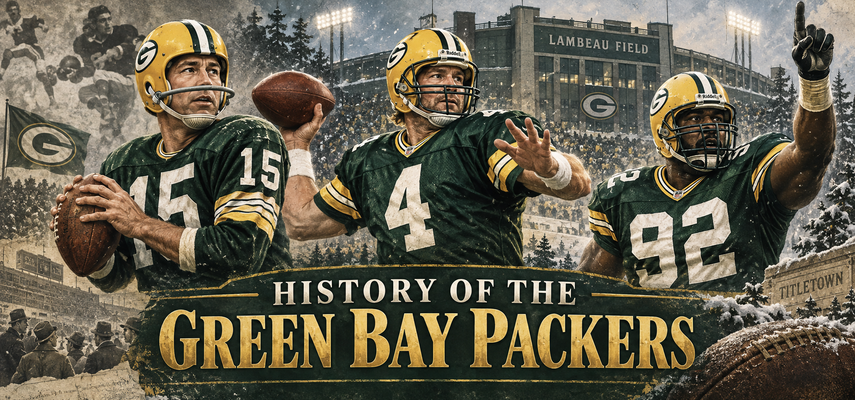

The Green Bay Packers developed into one of professional football’s most durable institutions from an unlikely small-city beginning. Curly Lambeau’s early champions established the record, Vince Lombardi’s teams gave Titletown its defining modern identity, and later quarterbacks sustained national relevance across changing eras. Community ownership and Lambeau Field make the organization distinctive beyond its championship totals. Thirteen recognized championship seasons connect those periods, with the first two Super Bowls overlapping earlier NFL titles. This history follows Green Bay through the completed 2025 season, separating those results from subsequent developments and the still-unfinished competition of the following 2026 campaign.
Franchise at a glance
| Field | Details |
|---|---|
| Founded | 1919; joined the APFA in 1921 |
| First season | 1919 independent team; first APFA season in 1921 |
| Original city and name | Green Bay, Wisconsin — Green Bay Packers |
| Current city and name | Green Bay Packers; Green Bay, Wisconsin |
| Previous cities and names | No franchise relocation; also played home games in Milwaukee, 1933–1994 |
| League and conference/division | NFL — National Football Conference North |
| Home venue | Lambeau Field; opened in 1957 as City Stadium |
| League championships | 13 NFL championship seasons, including 4 Super Bowl victories |
| Other recognized championships | 11 pre-merger NFL titles; 1966–1967 overlap Super Bowl wins; 3 NFC titles |
| Historical coverage | 2025 NFL season, including postseason completed in February 2026; later developments through October 16, 2026 |
Origins and early years
Curly Lambeau and George Whitney Calhoun helped organize a local Green Bay team in 1919 with sponsorship from the Indian Packing Company. The Packers name came from that industrial connection. The early team played an independent schedule before joining the American Professional Football Association in 1921. Its founding and first league season are therefore different dates, both important to the franchise’s history.
Financial instability repeatedly threatened the club’s survival. Community ownership developed to keep the team in Green Bay. Lambeau served as a player and coach, developing the roster and football operation while supporters worked to sustain the institution. The team remained rooted in Green Bay even when it later played part of its home schedule in Milwaukee. That arrangement expanded its regional audience without creating a separate franchise or changing the ownership of its earlier records. Competitive success and institutional survival developed together.
Defining eras
1919–1931: Survival and the first championship run
The Packers’ first years depended on local backing, improvised financing and Lambeau’s ability to recruit players. Entry into the professional league supplied a stronger competitive framework but did not remove financial uncertainty. The team gradually developed into a contender through players such as Verne Lewellen and later additions including Cal Hubbard, Johnny Blood and Mike Michalske. Their different skills helped build a complete team rather than a single-star attraction.
Green Bay won the 1929 championship through the league standings, then repeated in 1930 and 1931. There was no scheduled championship game in those seasons, so the titles should not be described through invented final opponents or scores. The three-season sequence established the franchise nationally and showed that a small market could support a powerful professional team. Its importance also extended beyond the immediate victories: the success strengthened an institution whose financial position had repeatedly been uncertain. The early Packers now had a championship identity that could survive changes in individual personnel.
1932–1958: Hutson’s innovation and another decline
Don Hutson’s arrival in 1935 transformed Green Bay’s passing possibilities. His route running, receiving production and relationship with quarterbacks such as Arnie Herber and Cecil Isbell helped expand the position’s importance. The Packers won NFL titles in 1936, 1939 and 1944 under Lambeau. Those championships came through scheduled title games, marking a different league structure from the earlier standings-based victories.
The postwar years were more difficult. Personnel changes and financial pressures eroded the team’s position, and Lambeau’s long association as head coach ended after the 1949 season. Successive coaches struggled to restore consistent winning. The organization nevertheless secured a new stadium, dedicated as City Stadium in 1957, reinforcing the team’s future in Green Bay. A 1–10–1 season in 1958 showed how far competitive performance had fallen. The next appointment would have to change expectations and preparation as well as tactics. The institution had survived another dangerous period, but its championship reputation needed rebuilding on the field.
1959–1967: Lombardi creates Titletown’s defining era
Vince Lombardi became head coach in 1959 and immediately restored a winning record. He inherited important talent, including Bart Starr, Paul Hornung, Jim Taylor and Ray Nitschke, then developed a demanding structure around it. After losing the 1960 championship game to Philadelphia, Green Bay won consecutive NFL titles against the Giants in 1961 and 1962. The running game, offensive line and disciplined defense gave the teams a coherent identity.
The Packers won another NFL title in 1965, then completed a second three-season championship sequence in 1966 and 1967. The latter two seasons also included victories in the first two Super Bowls, against Kansas City and Oakland. The Ice Bowl victory over Dallas decided the 1967 NFL title before the second Super Bowl. These were successive competitions within the same season, not four different championship seasons. Starr earned MVP honors in both Super Bowls. Lombardi stepped away from coaching the Packers afterward, leaving five title seasons and an organizational standard that would remain difficult for successors to match.
1968–1991: Living with the championship standard
The years after Lombardi brought a long decline from the earlier peak. Phil Bengtson, Dan Devine and later Bart Starr worked to replace aging championship players while facing expectations shaped by an exceptional dynasty. The 1972 team won its division, but that progress did not become another sustained title run. Starr’s later return as head coach carried enormous emotional significance without reproducing his playing-era success.
Forrest Gregg’s coaching tenure also failed to restore the championship position. Lindy Infante later produced a promising 10–6 season in 1989, but Green Bay did not reach the playoffs and could not sustain the improvement. Individual players such as James Lofton supplied major performances amid the uneven results. The organization eventually required a broader personnel and leadership reconstruction. The appointment of general manager Ron Wolf in 1991 began that process. Preserving the team’s identity was no longer enough; Green Bay needed a new competitive method capable of working in a league that had changed substantially since the Lombardi years.
1992–2007: Favre, Holmgren and the return to the top
Wolf hired Mike Holmgren and acquired Brett Favre in 1992, beginning a new offensive era. Reggie White’s arrival added a foundational defender and strengthened the perception that Green Bay could again attract elite players. Favre’s passing, Holmgren’s coaching and a deeper roster gradually turned regular-season improvement into championship contention. The Packers also consolidated their home schedule in Green Bay after ending the Milwaukee arrangement in 1994.
The 1996 team won Super Bowl XXXI, defeating New England 35–21. Desmond Howard earned MVP honors through his return-game contribution, while White helped control the defensive finish. Green Bay returned the next season but lost to Denver. Favre’s three consecutive AP NFL MVP awards reflected the offense’s exceptional level during the period. Later teams under Mike Sherman and Mike McCarthy continued reaching the playoffs without another championship during Favre’s tenure. The 2007 NFC Championship Game defeat to the Giants closed his final Green Bay season and set up another major quarterback transition.
2008–2025: Rodgers, Love and continuing expectations
Aaron Rodgers became the starter in 2008 and led Green Bay to another championship after the 2010 season. The Packers entered the playoffs as a wild card, won three road games and defeated Pittsburgh 31–25 in Super Bowl XLV. Rodgers earned the game’s MVP, with the wider roster supplying important defensive contributions throughout the run. The achievement demonstrated another successful succession at quarterback.
Rodgers later earned four AP NFL MVP awards, while repeated conference-final defeats kept the team from returning to the Super Bowl. Matt LaFleur succeeded McCarthy in 2019 and sustained strong regular-season results. Jordan Love took over after Rodgers’s departure, leading the 2023 team to a playoff victory at Dallas before San Francisco ended the run. Later postseason trips also stopped short of the final stages. The 2025 Packers finished 9–7–1 and lost their wild-card game at Chicago. The organization remained a regular contender, but another title had not followed the one earned by the 2010 team.
Recent history
The latest completed season is 2025, when Green Bay finished 9–7–1 and qualified for the playoffs. Chicago recovered from a large deficit to win their wild-card meeting 31–27 in January 2026. That game belongs to the 2025 season and did not change the Packers’ championship total.
As of October 16, 2026, Matt LaFleur remained head coach, Jordan Love continued the quarterback era that followed Rodgers and the next campaign was underway. Ed Policy had succeeded Mark Murphy as president and CEO in 2025, preserving the distinction between executive leadership and the club’s community ownership structure. Lambeau Field remained the home venue. The ongoing season’s final result was undecided. Green Bay’s completed record stood at thirteen championship seasons, including four Super Bowl victories, with the overlapping NFL and Super Bowl honors of 1966 and 1967 counted within their respective seasons.
Greatest players and influential figures
Don Hutson
Hutson helped redefine the receiving position through precise routes, separation and exceptional production in an era dominated by the running game. His contribution supported three Green Bay championship teams under Lambeau. His entire NFL career belonged to the Packers, whose retired No. 14 recognizes that foundational offensive influence.
Bart Starr
Starr directed Lombardi’s offense with efficiency, judgment and dependable execution in major games. His leadership helped produce five NFL championship seasons, including the first two Super Bowl victories and their MVP awards. Those overlapping honors belong to the same seasons rather than separate additions to the Packers’ title count.
Ray Nitschke
Nitschke supplied the defensive intensity and middle-linebacker play associated with Lombardi’s strongest teams. His contribution helped balance an offense often remembered through the power sweep. His entire NFL career belonged to Green Bay, including five championship seasons, and the franchise later retired his No. 66.
Brett Favre
Favre restored exceptional quarterback play and a distinctive attacking style to Green Bay’s offense. His three consecutive AP NFL MVP awards accompanied the period that produced Super Bowl XXXI. Later service with other teams belongs to his wider career, while the Packers contribution includes both the championship and subsequent postseason disappointments.
Reggie White
White gave the returning contender a foundational defender and helped establish Green Bay as a destination for elite talent. His pass rushing became decisive in Super Bowl XXXI, while his leadership extended across the defense. Earlier achievements in Philadelphia remain a separate chapter from the championship he helped secure with the Packers.
Aaron Rodgers
Rodgers led Green Bay to the Super Bowl XLV championship and earned the game’s MVP. Four AP NFL MVP awards later recognized his sustained individual excellence. His Packers tenure also included repeated conference-final defeats, giving a complete account both the championship breakthrough and the opportunities that did not produce another title.
Curly Lambeau
Lambeau helped found the team, played for it and coached the Packers through six NFL championship seasons. His personnel decisions and offensive development made Green Bay competitive while the organization fought for financial survival. The franchise’s small-city identity and earliest championship record developed together under his unusually broad influence.
Vince Lombardi
Lombardi restored Green Bay’s competitive standard through demanding preparation, coordinated execution and development of a complete roster. His teams won five championship seasons in seven years, including the first two Super Bowls. His influence outlasted the tenure, giving later generations a benchmark whose exceptional nature should not be mistaken for routine success.
Championships and postseason milestones
Green Bay recognizes thirteen championship seasons. Eleven NFL titles through 1967 and four Super Bowl victories overlap in 1966 and 1967, so adding them as fifteen separate title seasons would be incorrect. Three later NFC championships include the 1997 season, which ended in a Super Bowl defeat. Early standings-based championships had no final-game opponent.
On smaller screens, scroll horizontally to see all columns.
| Season/year | Competition | Opponent | Result | Defining figure(s) |
|---|---|---|---|---|
| 1929 | NFL Championship — standings | Not applicable | League title; 12–0–1 | Curly Lambeau; Verne Lewellen |
| 1930 | NFL Championship — standings | Not applicable | League title; 10–3–1 | Curly Lambeau; Johnny Blood |
| 1931 | NFL Championship — standings | Not applicable | League title; 12–2 | Curly Lambeau; Arnie Herber |
| 1936 | NFL Championship | Boston Redskins | Won 21–6 | Arnie Herber; Don Hutson; Curly Lambeau |
| 1939 | NFL Championship | New York Giants | Won 27–0 | Cecil Isbell; Don Hutson; Curly Lambeau |
| 1944 | NFL Championship | New York Giants | Won 14–7 | Ted Fritsch; Don Hutson; Curly Lambeau |
| 1961 | NFL Championship | New York Giants | Won 37–0 | Paul Hornung; Bart Starr; Vince Lombardi |
| 1962 | NFL Championship | New York Giants | Won 16–7 | Jim Taylor; Ray Nitschke; Vince Lombardi |
| 1965 | NFL Championship | Cleveland Browns | Won 23–12 | Paul Hornung; Jim Taylor; Vince Lombardi |
| 1966 | NFL Championship | Dallas Cowboys | Won 34–27 | Bart Starr; Vince Lombardi |
| 1966 | Super Bowl I | Kansas City Chiefs | Won 35–10 | Bart Starr; Max McGee; Vince Lombardi |
| 1967 | NFL Championship | Dallas Cowboys | Won 21–17 | Bart Starr; Jerry Kramer; Vince Lombardi |
| 1967 | Super Bowl II | Oakland Raiders | Won 33–14 | Bart Starr; Herb Adderley; Vince Lombardi |
| 1996 | Super Bowl XXXI | New England Patriots | Won 35–21 | Desmond Howard; Brett Favre; Mike Holmgren |
| 2010 | Super Bowl XLV | Pittsburgh Steelers | Won 31–25 | Aaron Rodgers; Charles Woodson; Mike McCarthy |
Rivalries, venues and team identity
Rivalries
Chicago supplies the foundational rivalry through a shared history extending back to the league’s early years. Minnesota adds a regional relationship shaped by division races and changing quarterback eras. Dallas occupies a distinct postseason place, from the Lombardi championship games to later playoff meetings, rather than being simply another annual divisional opponent.
Home venues and traditions
The Packers’ first grounds preceded the older City Stadium, followed by the current venue in 1957. Renamed Lambeau Field in 1965, it became the central setting for the franchise’s public identity. Home games in Milwaukee extended the regional audience until that arrangement ended after 1994. Green and gold, cold-weather football and the community ownership structure connect supporters across those changing settings and competitive eras.
Retired numbers and team honors
Green Bay’s formally retired numbers include Hutson’s 14, Starr’s 15, Nitschke’s 66, White’s 92 and Favre’s 4, alongside Tony Canadeo’s 3. The Packers Hall of Fame recognizes a broader group of contributors, while the Pro Football Hall of Fame is a separate institution. Those honors should not be confused with a uniform number merely being withheld from current use.
Legacy
Green Bay’s importance comes from the combination of sporting achievement and institutional distinctiveness. Its small-city setting and community ownership survived periods when the team’s future was uncertain, while successive championship generations renewed its national relevance. Lambeau and Lombardi established different foundations, and later quarterbacks worked within the expectations those eras created. Thirteen recognized championship seasons anchor the record without requiring every later contender to match them. The Packers’ legacy includes survival, innovation and successful succession, alongside the repeated postseason disappointments that demonstrate how difficult sustained championship success remains even within an enduring institution.
Where to eat in Green Bay
Planning a visit? Explore our best restaurants in Green Bay guide.












