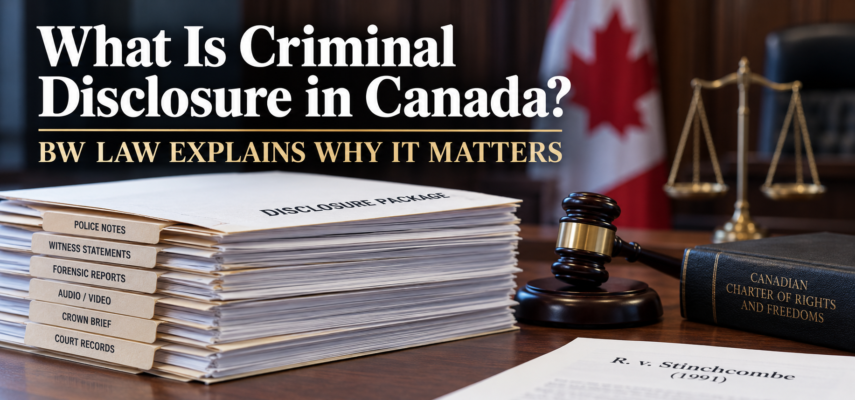

Quick Answer
Criminal disclosure in Canada is the Crown’s legal duty to give an accused person every relevant piece of evidence gathered by police, whether it helps or hurts the prosecution. This right flows from Section 7 of the Charter and the Supreme Court’s ruling in R. v. Stinchcombe. It lets an accused understand the case against them and make an informed decision before entering a plea.
Introduction
An accused person cannot answer a charge they cannot see. Every year, people across Alberta walk into a first court appearance without a clear picture of the evidence police have collected against them, and that gap shapes decisions that carry lifelong weight. Criminal disclosure in Canada exists to close it, since the prosecution carries a legal duty to turn over its file and the strength of a defence often depends on how carefully that file gets read.
Obtaining the material is rarely automatic, though, because it must be requested, reviewed line by line, and tested for whatever is absent. That work usually begins the moment someone retains counsel, which is why securing experienced criminal defence assistance early tends to matter more than most people expect. Edmonton’s Crown prosecutors can take weeks to assemble a file, and a defence built on a partial record starts at a disadvantage.
What Disclosure Means in Criminal Law and Why It Exists
The accused gets to see the case before answering it. Once police lay a charge, the prosecution holds a record of evidence, and the accused holds a constitutional right to receive it. That exchange sits at the centre of a fair trial.
The Charter Right Behind It
The right traces to Section 7 of the Canadian Charter of Rights and Freedoms and to the Supreme Court’s 1991 ruling in R. v. Stinchcombe, which held that the prosecution must surrender all relevant material in its possession. The Court framed evidence gathered by police as public property held to see justice done, rather than a file the prosecution owns outright.
The Case to Meet
The purpose is practical, because a person weighing whether to plead or go to trial needs to know the strength of the evidence first. Understanding what disclosure in criminal law is comes down to two linked ideas, and the duty rests on more than a single obligation:
- The right to know the case to meet, so the accused grasps every allegation and the proof behind it.
- The right to make full answer and defence, so nothing relevant stays hidden before a plea or trial.
- The joint duty on Crown and police, who together must preserve and pass on what the investigation produced.
- The ongoing nature of that duty, which reaches fresh evidence surfacing after the first handover, through trial and appeal.
Taken together, these ideas treat early, complete access as the foundation of everything that follows, and skipping it leaves the decisions ahead resting on guesswork.
Inside a Disclosure Package and What the Crown Must Hand Over
With the right established, the practical question is what actually arrives. The bundle the prosecution builds from the police investigation is the product of every note, statement, and recording, filtered down to what is relevant. Reading it closely is where a defence begins.
What the File Typically Contains
Contents shift with the charge, yet a working file usually holds a predictable set of materials. Defence counsel studies each item for the inconsistencies or gaps that might support the accused.
- The Crown Brief or Crown Sheet, a narrative summary of the evidence and a list of available witnesses.
- Police notes, the handwritten observations officers made during the investigation.
- Witness statements, recorded in writing, audio, or video.
- Physical and forensic results, from surveillance footage to DNA or fingerprint findings where they apply.
- The accused’s criminal record and any related court orders, such as probation or prohibition orders.
- Audio from 911 calls, police dispatch, or ambulance transmissions tied to the incident.
How and When You Receive It
The file does not arrive on its own, and the office you approach depends on the charge. Handling a disclosure package criminal case means routing the request correctly: drug offences and other federal matters go through the Public Prosecution Service of Canada, while most Criminal Code charges run through the provincial prosecutor.
A reputable firm makes that request on a client’s behalf, often before the first appearance, and Crown disclosure in Canada can take weeks to prepare. The sooner counsel reviews the material, the sooner weak points in the prosecution’s case come into view.
When Disclosure Is Late or Incomplete and Your Options to Compel It
Most guides stop once the bundle arrives, yet the harder problem starts there. A package can land incomplete, and the right to disclosure in Canada includes a claim on whatever is still missing. Knowing how to force the rest is where many cases turn.
Spotting What Is Missing
An initial file is often just that. Counsel cross-references the Crown Brief against the police notes and witness lists, hunting for referenced items that never made it in: a mentioned video, an officer’s notebook, a forensic result.
Once a gap surfaces, counsel puts the request for the outstanding material in writing, and the prosecution’s continuing duty means it must respond. Sometimes the Crown delays for a valid reason, such as an active investigation that early release could jeopardize, though that pause is narrow and does not erase the obligation.
First-Party Records Versus Third-Party Records
Not all evidence sits in the prosecution’s hands, so the route to obtain it depends on who holds the record. A short comparison clarifies the two paths counsel uses most.
| Material sought | Who holds it | How it is compelled |
| Police and Crown investigation file | The prosecution | Written request, then a Charter application if refused |
| Records held by an outside party | A third party, such as a therapist or hospital | A formal court application under the O’Connor procedure |
The distinction matters because the wrong route can stall a request for months.
Pro Tip: Keep every page the police or the court hand you, including anything given at your first appearance, and pass all of it to counsel. A single missing page can hide the inconsistency that reshapes a case.
When the Crown Withholds
Where non-disclosure affects a trial’s fairness, the remedy can be significant. A court may order the material produced, adjourn proceedings, or in serious cases revisit a conviction on appeal. That leverage is why timely, complete access counts as a fundamental protection rather than a formality.
Why This Right Protects Every Accused Person
An accused who sees the full file can test it, question it, and answer it, while one left in the dark cannot. Courts across the country have treated that access as a cornerstone of a fair trial for more than three decades. Criminal disclosure in Canada, read early and read closely, remains the single clearest measure of whether the process is working as it should.