










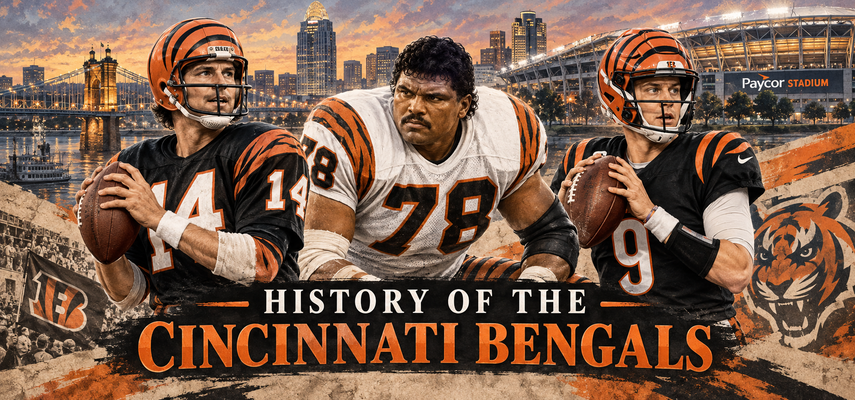

The Cincinnati Bengals began as Paul Brown’s return to professional football and developed an identity shaped by inventive offense, exceptional individual players and repeated near misses. Ken Anderson and Boomer Esiason led the first two Super Bowl teams, while Joe Burrow brought a later generation back to championship contention. Anthony Muñoz supplied a durable standard of excellence across the earlier eras. The long stretches between those peaks are essential to understanding the franchise. This history follows Cincinnati from its AFL establishment through the completed 2025 season, separating those results from the subsequent developments and unfinished competition of the 2026 campaign.
Franchise at a glance
| Field | Details |
|---|---|
| Founded | 1967; American Football League expansion franchise |
| First season | 1968, American Football League |
| Original city and name | Cincinnati, Ohio — Cincinnati Bengals |
| Current city and name | Cincinnati Bengals; Cincinnati, Ohio |
| Previous cities and names | None |
| League and conference/division | NFL — American Football Conference North; AFL in 1968–1969 |
| Home venue | Paycor Stadium; opened in 2000 as Paul Brown Stadium |
| League championships | 0 Super Bowl titles through the completed 2025 season |
| Other recognized championships | 3 AFC championships: 1981, 1988, 2021; no AFL championship |
| Historical coverage | 2025 NFL season, including postseason completed in February 2026; later developments through October 16, 2026 |
Origins and early years
Paul Brown had already built a championship institution in Cleveland before his departure after the 1962 season. He later assembled the group that obtained Cincinnati’s AFL franchise in 1967. The new team began play in 1968, adopting a name previously used by professional teams in the city. Those earlier Bengals supplied a local naming connection, but the modern franchise did not inherit their competitive records or the Cleveland Browns’ championships.
Brown became the first head coach and established a disciplined approach to preparation and personnel. Cincinnati initially played at the University of Cincinnati’s Nippert Stadium while a larger riverfront venue was being built. The early roster mixed expansion acquisitions with young players who could develop under Brown’s system. The organization joined the NFL at the merger in 1970, retaining its own AFL record. Its quick rise to a division title that season showed that the project had become competitive. A more durable offensive identity would emerge with the arrival of quarterback Ken Anderson and the development of Brown’s coaching staff.
Defining eras
1968–1975: Brown establishes a contender
The first Bengals endured the expected limitations of a new roster, but Brown’s team improved quickly enough to win the AFC Central in 1970. Moving into Riverfront Stadium that year placed professional football alongside the city’s major-league baseball institution. Cincinnati had a more substantial home and a clear organizational direction, even though its first playoff appearance ended against the Baltimore Colts.
Anderson arrived in the 1971 draft and developed into an accurate, efficient quarterback. Assistant coach Bill Walsh contributed to a passing approach that valued timing, shorter completions and yards after the catch. The Bengals reached the playoffs again in 1973 and 1975, but those appearances did not produce a postseason victory. Brown retired from coaching after the latter season while retaining personnel leadership. His contribution was therefore both foundational and continuing: he created the institution, shaped its early methods and left a roster capable of further contention under another head coach.
1976–1981: Anderson and Gregg reach the Super Bowl
The years immediately after Brown’s coaching retirement did not sustain the same consistency. Bill Johnson and Homer Rice coached teams that struggled to establish a lasting direction. Forrest Gregg’s arrival in 1980 brought another reconstruction. The Bengals selected Anthony Muñoz in that year’s draft, securing the offensive tackle who would become the franchise’s most celebrated player. Anderson remained the experienced quarterback around whom the offense could recover.
The 1981 team combined Anderson’s AP NFL MVP season with a stronger defense and a distinctive new tiger-striped helmet. Cincinnati defeated Buffalo for its first playoff victory and then beat San Diego 27–7 in the bitterly cold AFC Championship Game. San Francisco won Super Bowl XVI, 26–21, after the Bengals’ second-half recovery fell short. The defeat did not erase the breakthrough: Cincinnati had become a conference champion for the first time, and Anderson’s late-career revival had given the team a national identity beyond its founder.
1982–1990: Wyche’s offense and another narrow defeat
Sam Wyche became head coach in 1984 and developed an offense whose tempo became one of its defining features. Boomer Esiason succeeded Anderson at quarterback, while Muñoz anchored the line and James Brooks supplied versatile production. The team’s no-huddle approach challenged opponents’ substitutions and gave Cincinnati a tactical identity. It also required coordination across the roster rather than depending only on an exceptional quarterback.
The 1988 Bengals rebounded from the previous year’s disappointing record to finish 12–4. Esiason earned AP MVP honors, and Cincinnati defeated Seattle and Buffalo to win another AFC championship. In Super Bowl XXIII, the Bengals held a late lead before Joe Montana directed San Francisco’s winning touchdown drive. The 20–16 loss became the era’s most painful near miss. Cincinnati returned to the playoffs after the 1990 season and beat Houston before losing to the Raiders. That victory would stand as the club’s last postseason win for more than three decades.
1991–2002: A long competitive decline
Paul Brown’s death in 1991 left Mike Brown leading the organization, while the team entered a period of persistent losing. Coaching changes from Wyche to David Shula, Bruce Coslet and Dick LeBeau did not produce a durable turnaround. Quarterback transitions and uneven roster building made it difficult to create a coherent contender. The distance between the late-1980s championship opportunity and the subsequent results became an enduring frustration for supporters.
Individual players still supplied memorable football. Corey Dillon’s running gave the offense a major strength, and other productive careers developed without corresponding team success. Cincinnati moved from Riverfront Stadium into the new Paul Brown Stadium in 2000, improving its facilities while the competitive problems continued. The venue alone could not repair the organization’s performance. By the end of 2002, another coaching approach was necessary. The next appointment would restore regular-season credibility and produce repeated playoff appearances, though converting those appearances into victories would remain a separate challenge.
2003–2018: Lewis restores relevance
Marvin Lewis became head coach in 2003 and helped return Cincinnati to competitive respectability. Carson Palmer’s development and Chad Johnson’s receiving gave the offense a recognizable core. The 2005 team won the AFC North, but Palmer suffered a major knee injury early in the playoff loss to Pittsburgh. That abrupt ending became one of the defining setbacks of a promising era.
Later teams built around Andy Dalton, A.J. Green and a stronger defense reached the playoffs repeatedly. Five consecutive appearances from the 2011 through 2015 seasons did not produce a victory. The final defeat in that sequence, against Pittsburgh, included late penalties that helped turn a potential breakthrough into another painful exit. Cincinnati had escaped its earlier period of chronic losing but had not solved the postseason problem. Lewis’s long tenure ended after 2018, leaving a record of restored expectations alongside the inability to complete the playoff advance that those expectations demanded.
2019–2025: Burrow brings the Bengals back
Zac Taylor’s difficult first season positioned Cincinnati to select Joe Burrow first overall in the 2020 draft. Burrow’s rookie knee injury interrupted the immediate transition, but his return and the addition of Ja’Marr Chase transformed the passing game. The 2021 Bengals ended the postseason victory drought against Las Vegas, won at Tennessee and overcame Kansas City in overtime for their third AFC championship.
The Rams won Super Bowl LVI, 23–20, leaving Cincinnati with another narrow final-game defeat. The Bengals returned to the AFC Championship Game after the 2022 season, where Kansas City won the rematch. Subsequent seasons illustrated how quickly an established contender could lose momentum through injuries and defensive difficulties. Burrow’s 2025 toe injury cost him much of the campaign, and the Bengals finished 6–11 without a playoff berth. The completed record still contained three AFC titles and no Super Bowl victory, while the organization retained Taylor for another attempt.
Recent history
The latest completed season is 2025, when Cincinnati finished 6–11 and missed the playoffs. Burrow’s prolonged absence with a toe injury disrupted the offense, and the team acquired veteran Joe Flacco during the season. The result extended the gap since the Bengals’ most recent playoff appearance after the 2022 campaign.
The organization retained Zac Taylor and personnel leader Duke Tobin for 2026. As of October 16, 2026, Taylor remained head coach and the new season was underway, with its final record and postseason outcome still undecided. Paycor Stadium remained the home venue. The historical question was whether the organization could restore the balance that supported its recent conference-title teams, while separating that possibility from an achievement already completed. Cincinnati’s recognized championship record remained three AFC titles and no Super Bowl or AFL championship through the latest completed season.
Greatest players and influential figures
Ken Anderson
Anderson gave Cincinnati its first enduring quarterback identity through accuracy, efficiency and long service. His AP NFL MVP season in 1981 helped produce the franchise’s first AFC championship. His entire professional playing career belonged to the Bengals, connecting Brown’s early teams with the later transition to Esiason.
Anthony Muñoz
Muñoz anchored the offensive line throughout both 1980s Super Bowl runs. His pass protection, run blocking and sustained excellence established the franchise’s clearest individual standard. Selected in the 1980 draft, he became a foundational figure whose contribution extended across different quarterbacks and coaching approaches in Cincinnati.
Ken Riley
Riley supplied exceptional cornerback play across the franchise’s early development and first conference championship. His interceptions and durability made him a defining defender during an era often remembered for its quarterbacks. His entire NFL playing career belonged to Cincinnati, and his later Hall of Fame election recognized that contribution.
Boomer Esiason
Esiason directed Wyche’s inventive offense and earned AP NFL MVP honors for the 1988 season. His leadership helped Cincinnati reach Super Bowl XXIII, where a narrow defeat ended the championship pursuit. Later service with other teams forms a wider career; the Bengals contribution remains his strongest team-specific chapter.
Chad Johnson
Johnson helped restore Cincinnati’s national visibility through exceptional receiving and a distinctive public personality. His partnership with Palmer gave the offense a major strength as the Bengals returned to division contention. The memorable individual performances belong alongside a team record that did not produce a postseason victory during his tenure.
Joe Burrow
Burrow led the Bengals out of their long playoff-victory drought and into Super Bowl LVI. His passing partnership with Chase helped establish a new championship opportunity, followed by another AFC Championship Game appearance. Those completed achievements remain distinct from the injuries and missed postseasons that followed.
Paul Brown
Brown founded the modern Bengals, coached their first eight seasons and continued to shape personnel decisions afterward. His methods linked Cincinnati to important developments in professional football preparation and offense. His earlier Cleveland championships belong to the Browns; the Bengals contribution was the creation of a separate institution.
Sam Wyche
Wyche gave the late-1980s Bengals a distinctive tactical identity through tempo and the no-huddle offense. His strongest team won the 1988 AFC championship before narrowly losing the Super Bowl. That innovation and conference-title run remain central to his Cincinnati legacy, alongside the uneven seasons surrounding the peak.
Championships and postseason milestones
Cincinnati has no Super Bowl championship through the completed 2025 season. Its three AFC titles led to three narrowly lost Super Bowls. The table identifies those separate competitions explicitly. The 2021 postseason also ended the long wait for a playoff victory, while the 2022 team reached another AFC final without winning the conference.
On smaller screens, scroll horizontally to see all columns.
| Season/year | Competition | Opponent | Result | Defining figure(s) |
|---|---|---|---|---|
| 1981 | AFC Championship | San Diego Chargers | Won 27–7 | Ken Anderson; Anthony Muñoz; Forrest Gregg |
| 1981 | Super Bowl XVI | San Francisco 49ers | Lost 21–26 | Ken Anderson; Anthony Muñoz; Forrest Gregg |
| 1988 | AFC Championship | Buffalo Bills | Won 21–10 | Boomer Esiason; Ickey Woods; Sam Wyche |
| 1988 | Super Bowl XXIII | San Francisco 49ers | Lost 16–20 | Boomer Esiason; Anthony Muñoz; Sam Wyche |
| 2021 | AFC Championship | Kansas City Chiefs | Won 27–24 (OT) | Joe Burrow; Ja’Marr Chase; Zac Taylor |
| 2021 | Super Bowl LVI | Los Angeles Rams | Lost 20–23 | Joe Burrow; Ja’Marr Chase; Zac Taylor |
Rivalries, venues and team identity
Rivalries
Cleveland supplies the Ohio rivalry and the personal connection through Paul Brown, although the teams have separate records. Pittsburgh became an especially consequential opponent through repeated division races and painful playoff defeats. Kansas City added a more recent championship-stage rivalry during the Burrow era, reflecting the changing balance of the AFC.
Home venues and traditions
Nippert Stadium housed the first teams before Riverfront Stadium became the long-term home in 1970. The Bengals moved into Paul Brown Stadium in 2000, and the venue became Paycor Stadium in 2022. Orange and black, striped helmets and the riverfront setting connect successive generations. The stripes became particularly associated with the first Super Bowl team and remain a visible link across later reconstructions.
Retired numbers and team honors
Bob Johnson’s No. 54 is the franchise’s formally retired jersey number. The Ring of Honor recognizes a broader group of foundational contributors, including figures whose numbers have not been formally retired. Muñoz’s place in the Pro Football Hall of Fame is another separate honor. Distinguishing those systems preserves the difference between team recognition, number retirement and recognition across professional football.
Legacy
Cincinnati’s history is distinguished by the contrast between offensive innovation and championships that remained just out of reach. Brown created the institution, Anderson and Esiason gave it national relevance, and Burrow renewed its greatest opportunity after decades of frustration. The losing periods and playoff drought are part of the same record as the conference titles. Together they explain why a postseason breakthrough carried such meaning. The franchise’s lasting contribution includes exceptional players and tactical influence, while its three completed AFC championships remain distinct from the Super Bowl victory it had not yet earned.
Where to eat in Cincinnati
Planning a visit? Explore our best restaurants in Cincinnati guide.












