










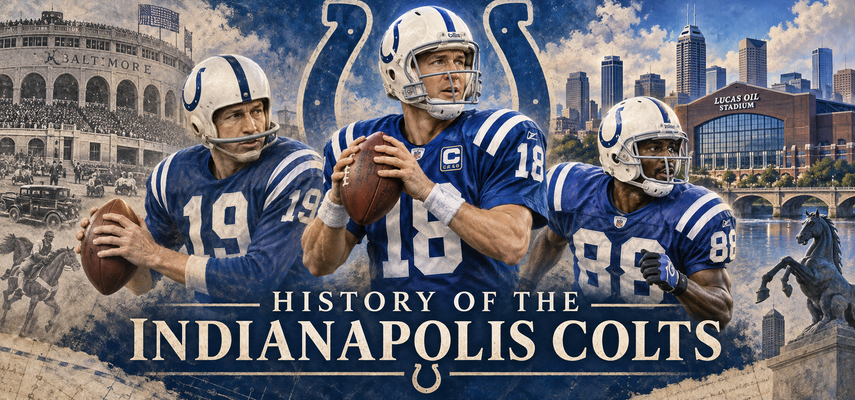

The Indianapolis Colts carry a history shaped by two cities and two exceptional quarterback eras. Johnny Unitas made Baltimore a center of the NFL’s growing popularity, while Peyton Manning helped establish Indianapolis as a sustained contender. Between those periods came championships, relocation, rebuilding and memorable near misses. The franchise’s record begins in 1953, distinct from the earlier Baltimore Colts, and includes both pre-merger NFL titles and Super Bowl victories. This account follows that continuous Baltimore-to-Indianapolis history through the completed 2025 season, with later developments separated from results still unfolding during the 2026 campaign and its unfinished postseason race.
Franchise at a glance
| Field | Details |
|---|---|
| Founded | January 23, 1953; NFL franchise awarded |
| First season | 1953, National Football League |
| Original city and name | Baltimore, Maryland — Baltimore Colts |
| Current city and name | Indianapolis Colts; Indianapolis, Indiana |
| Previous cities and names | Baltimore Colts, 1953–1983; Indianapolis from 1984 |
| League and conference/division | NFL — American Football Conference South |
| Home venue | Lucas Oil Stadium; opened in 2008 |
| League championships | 2 Super Bowl victories: 1970, 2006; 3 earlier NFL titles: 1958, 1959, 1968 |
| Other recognized championships | 3 AFC championships: 1970, 2006, 2009; the 1968 NFL title preceded a Super Bowl defeat |
| Historical coverage | 2025 NFL season, including postseason completed in February 2026; later developments through October 16, 2026 |
Origins and early years
Baltimore received a new NFL franchise in January 1953 after demonstrating support for another attempt at major professional football. This Colts organization is separate from the Baltimore club that played in the AAFC and then the NFL before folding after 1950. Personnel associated with the unsuccessful 1952 Dallas Texans helped populate the new roster, but the Colts’ recognized team record begins in 1953. Their later Indianapolis history continues that same franchise.
The early organization needed time to become competitive. Weeb Ewbank became head coach in 1954 and helped assemble a team around players whose abilities complemented one another. Johnny Unitas developed into an exceptional quarterback, Raymond Berry supplied precise receiving and Lenny Moore created threats as both runner and receiver. A formidable line and defense gave those offensive players support. Memorial Stadium became the setting for a close relationship between the club and Baltimore supporters. By the end of the decade, the team had moved from a new franchise seeking stability to the center of one of professional football’s most influential championship moments.
Defining eras
1953–1959: Baltimore becomes a championship city
The Colts’ rise depended on a group whose development was more important than any single signing. Unitas became a remarkably composed passer, Berry refined the timing of the receiving game and Moore offered speed in several roles. Ewbank’s coaching helped combine those strengths with the physical work of players on both lines. Baltimore improved into a team capable of challenging the league’s established powers, giving Memorial Stadium a distinct football identity.
The 1958 NFL Championship Game against the New York Giants supplied the breakthrough. The Colts won 23–17 in overtime at Yankee Stadium, with Alan Ameche scoring the deciding touchdown. Its television audience helped make the game a landmark in the NFL’s expanding national appeal. Baltimore defeated the Giants again for the 1959 title, this time 31–16. The consecutive championships established the Colts as a leading franchise and gave Unitas an enduring place in football history. Their significance rests on both the victories themselves and the wider audience they helped attract.
1960–1970: Another NFL title and the first Super Bowl victory
Don Shula became head coach in 1963 and maintained Baltimore’s competitive standing. The Colts reached another NFL title game in 1964 but lost to Cleveland. In 1968, Earl Morrall led much of the offense while Unitas dealt with injury. Baltimore dominated Cleveland 34–0 for the NFL championship, then lost 16–7 to the New York Jets in Super Bowl III. The NFL title remains an official honor, but it did not make the Colts that season’s Super Bowl winners.
After the merger placed Baltimore in the AFC, Don McCafferty coached the 1970 team to Super Bowl V. The Colts defeated Dallas 16–13 on Jim O’Brien’s late field goal, securing their first Super Bowl victory. Unitas connected with John Mackey for a notable touchdown before leaving the game injured. The result added a new kind of championship to Baltimore’s earlier NFL titles. It also closed a long period in which the organization remained prominent across changes in coaching, personnel and the structure of professional football.
1971–1997: Ownership, relocation and a new audience
Robert Irsay acquired the Colts in 1972 through an ownership exchange involving the Rams. Baltimore later returned to division-winning form under Ted Marchibroda, but it did not convert those opportunities into another Super Bowl appearance. Disputes over the stadium and the club’s future became increasingly consequential. In March 1984, the organization moved to Indianapolis. The relocation continued the Colts’ franchise record while leaving a painful break in Baltimore’s relationship with the team.
Indianapolis initially watched uneven football at the Hoosier Dome, later called the RCA Dome. Eric Dickerson’s arrival helped produce a division title in 1987. A different contender emerged in 1995, when Jim Harbaugh led a dramatic playoff run under Marchibroda. The Colts came close to another Super Bowl before Pittsburgh won the AFC Championship Game. That team demonstrated the new city’s capacity to embrace a contender. Sustained success still required a more durable answer at quarterback and a stronger long-term roster, which the organization would soon attempt to build through the draft.
1998–2011: Manning establishes an Indianapolis powerhouse
Peyton Manning arrived as the first overall draft choice in 1998. His partnership with Marvin Harrison, later joined by Reggie Wayne and other accomplished offensive players, made Indianapolis one of the league’s most dependable regular-season contenders. Jim Mora coached the initial improvement, and Tony Dungy took over in 2002. Dwight Freeney and Robert Mathis supplied pressure on defense, while Manning’s preparation and command became the offense’s central characteristics.
The breakthrough came in the 2006 season. Indianapolis overcame New England in the AFC Championship Game and defeated Chicago 29–17 in Super Bowl XLI. Manning earned MVP honors, and Dungy completed a championship pursuit that had repeatedly encountered postseason disappointment. Jim Caldwell later coached the 2009 team to another Super Bowl, where New Orleans won 31–17. Lucas Oil Stadium opened in 2008, giving the successful era a new home. Manning missed the entire 2011 season with neck problems, and the team’s collapse brought an abrupt end to the continuity built around him.
2012–2019: Luck’s promise and an unexpected ending
The Colts released Manning in 2012 and selected Andrew Luck first overall. Luck immediately helped restore playoff football under Chuck Pagano, whose treatment for leukemia also made the season an important story of organizational resilience. The team continued to reach the postseason and advanced to the AFC Championship Game following the 2014 season. New England ended that run decisively, leaving the new quarterback era with substantial promise but no Super Bowl appearance.
Injuries became an increasingly important part of Luck’s career. Frank Reich’s arrival as head coach helped produce another playoff season in 2018, including a victory at Houston. Yet Luck retired before the 2019 campaign, explaining the toll of repeated injury and rehabilitation. His decision changed the franchise’s immediate direction. Indianapolis had moved directly from Manning to another exceptional quarterback, but it could no longer assume that such continuity would last. The organization now faced the challenge of building a balanced roster while searching again for a dependable long-term leader behind center.
2020–2025: Searching for continuity after Luck
Philip Rivers led Indianapolis to the playoffs in the 2020 season, but a succession of quarterbacks followed. Carson Wentz and Matt Ryan each had a short period in the leading role. Coaching changes also interrupted continuity, with Reich departing during 2022 and Shane Steichen taking over for 2023. Anthony Richardson’s arrival offered a younger developmental path, while injuries and inconsistent results kept the position unsettled. Jonathan Taylor remained an important offensive strength amid those changes.
The 2025 campaign brought another complicated chapter. Daniel Jones helped lead the offense before an Achilles injury ended his season. Rivers returned at age forty-four for a brief late-season comeback, an unusual development several years after his earlier Indianapolis stint. The Colts finished 8–9 and missed the playoffs. The result continued a period in which individual promise and stretches of competitive football had not produced another sustained postseason run. At the end of the completed season, Indianapolis still needed to turn its offensive pieces into durable organizational progress.
Recent history
Indianapolis finished the 2025 regular season 8–9 and did not qualify for the postseason. Jones’ Achilles injury contributed to another late change at quarterback, including Rivers’ return for three starts. Rookie Riley Leonard then started the season finale, adding another young quarterback to a campaign already marked by considerable change at the position. The team’s last completed playoff appearance remained the 2020 season.
Steichen and general manager Chris Ballard remained in place for 2026 under owner and chief executive Carlie Irsay-Gordon. Their continued leadership followed evaluation of a disappointing finish rather than the beginning of a separate franchise or a reset of its records. As of October 16, 2026, the new season was underway. Its final outcome is not included here. The completed title record remained two Super Bowl victories and three earlier NFL championships, with the 1968 NFL honor correctly distinguished from that season’s Super Bowl loss.
Greatest players and influential figures
Johnny Unitas
Unitas gave Baltimore its defining quarterback and helped make the passing game central to the franchise’s identity. His composure and partnership with precise receivers supported the consecutive NFL championships of 1958 and 1959. He also contributed to the 1970 Super Bowl team, linking several generations of Colts success.
Lenny Moore
Moore threatened defenses as both a runner and receiver, providing a versatile complement to Unitas’ passing. His speed and ability to exploit space helped make Baltimore’s championship offense difficult to contain. His entire NFL playing career belonged to the Colts, and the franchise retired his No. 24.
Raymond Berry
Berry’s preparation, precise routes and dependable hands made him a crucial partner for Unitas. His receiving in the 1958 championship game became part of the sport’s enduring history. He represented a form of offensive excellence built on timing and detailed work rather than physical speed alone.
Peyton Manning
Manning transformed Indianapolis into a sustained contender through preparation, passing production and control at the line of scrimmage. He led the Colts to victory in Super Bowl XLI and another appearance three seasons later. His later Denver championships and accomplishments belong to his wider career rather than Indianapolis’ team totals.
Marvin Harrison
Harrison’s timing with Manning became one of the defining partnerships of the Indianapolis era. His precise routes and consistency helped the offense maintain a high standard through repeated playoff seasons. He contributed to the Super Bowl XLI championship and spent his entire NFL playing career with the Colts.
Dwight Freeney
Freeney’s speed and pass-rushing technique gave the Colts a defensive threat suited to protecting leads created by their offense. His partnership with Robert Mathis helped define the team’s defensive approach. He was a major contributor to the Super Bowl XLI title and later received Pro Football Hall of Fame recognition.
Weeb Ewbank
Ewbank coached the Colts’ first championship teams and helped develop the combination of talent around Unitas. The 1958 and 1959 NFL titles established Baltimore as a major professional football city. His later success with the Jets belongs to another franchise, although it intersects dramatically with Colts history.
Tony Dungy
Dungy supplied stability and defensive leadership during the Manning era’s championship pursuit. His Indianapolis teams became consistent contenders before winning Super Bowl XLI. He became the first Black head coach to win a Super Bowl, giving that victory a significance extending beyond the Colts’ own franchise record.
Championships and postseason milestones
The Colts won three NFL championships before the merger-era league structure and two Super Bowls. Their 1968 NFL title preceded a loss to the Jets in Super Bowl III; it is not an additional Super Bowl victory. AFC championships in 1970, 2006 and 2009 identify conference honors. The table lists the franchise’s five title-winning finals.
On smaller screens, scroll horizontally to see all columns.
| Season/year | Competition | Opponent | Result | Defining figure(s) |
|---|---|---|---|---|
| 1958 | NFL Championship | New York Giants | Won 23–17, overtime | Johnny Unitas; Alan Ameche; Weeb Ewbank |
| 1959 | NFL Championship | New York Giants | Won 31–16 | Johnny Unitas; Lenny Moore; Weeb Ewbank |
| 1968 | NFL Championship | Cleveland Browns | Won 34–0 | Earl Morrall; Don Shula |
| 1970 | Super Bowl V | Dallas Cowboys | Won 16–13 | Johnny Unitas; Jim O’Brien; Don McCafferty |
| 2006 | Super Bowl XLI | Chicago Bears | Won 29–17 | Peyton Manning; Tony Dungy |
Rivalries, venues and team identity
Rivalries
Baltimore’s strongest opponents included the Giants during the Unitas championships. Indianapolis’ rivalry with New England became especially prominent during the Manning years, combining repeated playoff encounters with contrasting organizational identities. Houston, Jacksonville and Tennessee provide the regular AFC South contests that now shape the division schedule.
Home venues and traditions
Memorial Stadium anchors the Baltimore chapter, while the Hoosier Dome and RCA Dome names belong to the first Indianapolis home. Lucas Oil Stadium opened in 2008. The horseshoe helmet and blue-and-white colors connect both cities, even though the circumstances and memories of relocation remain sharply different for their supporters.
Retired numbers and team honors
The Colts recognize major contributors through retired numbers and the Ring of Honor. Unitas’ No. 19, Manning’s No. 18 and Moore’s No. 24 are formal retired jerseys. Such tributes belong to the franchise’s continuing Baltimore–Indianapolis history; they do not incorporate the record of the separate Baltimore team that folded after 1950.
Legacy
The Colts’ history demonstrates how a franchise can preserve its records while profoundly changing its relationship with place. Baltimore’s Unitas teams helped enlarge the NFL’s audience, and Indianapolis’ Manning teams established another period of sustained national prominence. The relocation remains part of that story alongside the championships. Later quarterback transitions have shown how difficult it is to reproduce such exceptional continuity. Across both cities, the enduring football thread is an ability to build memorable passing offenses whose greatest seasons became important chapters in the wider history of the league.
Where to eat in Indianapolis
Planning a visit? Explore our best restaurants in Indianapolis guide.












