










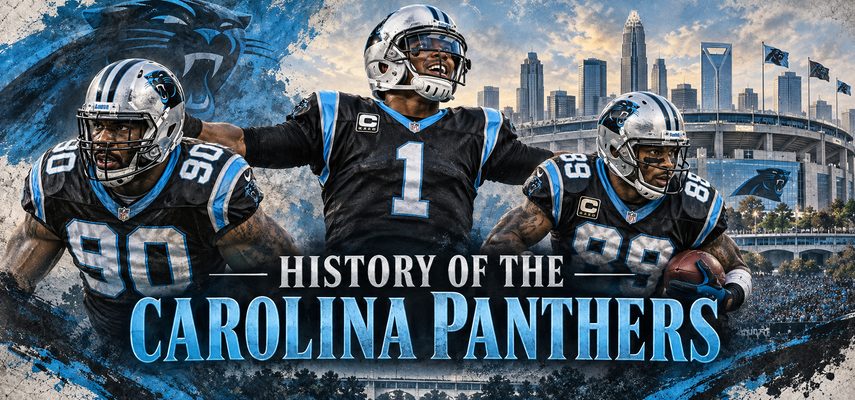

The Carolina Panthers quickly turned an expansion opportunity into a place among the NFL’s contenders. Their strongest teams have combined forceful defense with very different offensive leaders, from Jake Delhomme and Steve Smith to Cam Newton’s unusually dynamic quarterback play. Two NFC championships brought Super Bowl appearances, while difficult rebuilding periods repeatedly interrupted that success. The franchise also carries a regional identity spanning both Carolinas, expressed most clearly through its Keep Pounding tradition. This history follows the Panthers from their founding through the completed 2025 season, with later developments distinguished from the ongoing 2026 campaign and its unfinished results.
Franchise at a glance
| Field | Details |
|---|---|
| Founded | October 26, 1993; NFL expansion franchise awarded |
| First season | 1995, National Football League |
| Original city and name | Carolina Panthers; first-season home in Clemson, South Carolina |
| Current city and name | Carolina Panthers; Charlotte, North Carolina |
| Previous cities and names | No franchise renaming or permanent relocation; inaugural season at Clemson |
| League and conference/division | NFL — National Football Conference South |
| Home venue | Bank of America Stadium; Charlotte venue opened in 1996 |
| League championships | 0 Super Bowl victories |
| Other recognized championships | 2 NFC championships: 2003, 2015 |
| Historical coverage | 2025 NFL season, including postseason completed in February 2026; later developments through October 16, 2026 |
Origins and early years
Jerry Richardson led the effort to bring an NFL franchise to the Carolinas, building support across state lines and presenting a stadium plan centered on Charlotte. The league awarded the team in October 1993, and the Panthers began play alongside Jacksonville in 1995. The regional name reflected an intention to draw supporters from both North and South Carolina rather than identify solely with one city.
While the Charlotte stadium was being completed, Carolina played its inaugural home schedule at Clemson’s Memorial Stadium in South Carolina. Dom Capers became the first head coach, and the roster combined younger players with experienced professionals such as linebacker Sam Mills. The Panthers won seven games in their first season, an unusually competitive beginning for an expansion club. Their permanent home opened in Charlotte the next year. The move from Clemson was part of the original launch plan, not a later franchise relocation. That opening period established both the team’s regional reach and the expectation that it could compete much sooner than many earlier expansion organizations.
Defining eras
1995–1996: A remarkably fast expansion breakthrough
Carolina’s initial success depended on more than enthusiasm for a new team. Capers brought a defensive approach, and experienced players helped establish standards for a roster assembled through the expansion process. Mills supplied leadership, while Kerry Collins became an important early quarterback. The first season’s seven victories gave the organization a credible foundation before it settled into its new Charlotte stadium.
The 1996 team made an even larger advance, winning its division with a 12–4 record. Carolina defeated Dallas 26–17 in its first playoff game and reached the NFC Championship Game in only its second season. Green Bay won that conference final 30–13, ending the run. The achievement nevertheless placed the Panthers alongside Jacksonville as an unusually successful expansion story. It also created a demanding benchmark. The franchise had shown that it could contend quickly, but maintaining that level would require repeated renewal rather than simply preserving the momentum of its first two years.
1997–2003: Decline gives way to the Cardiac Cats
The early contender did not become a stable long-term power. Coaching changes, roster problems and declining results culminated in a 1–15 season in 2001. That collapse made the next organizational decisions especially important. John Fox became head coach in 2002 and emphasized a physical defense and a dependable running game. Julius Peppers’ arrival supplied an exceptional young defensive player around whom the team could build.
The 2003 Panthers combined that approach with Delhomme’s quarterback play, Smith’s receiving and Stephen Davis’ running. Their repeated close victories earned the Cardiac Cats nickname. Carolina won an overtime divisional playoff at St. Louis and defeated Philadelphia for its first NFC championship. New England then won Super Bowl XXXVIII 32–29 on a late field goal. The narrow defeat left the final ambition unfinished, but the season transformed a team recently at the bottom of the standings into a conference champion with a highly recognizable competitive personality.
2004–2010: A physical contender searches for consistency
Fox’s teams remained capable of strong postseason runs without establishing uninterrupted success. Smith became the offense’s defining receiver, combining intensity with the ability to turn short opportunities into major gains. Delhomme supplied the quarterback partnership, while players such as Peppers and linebacker Thomas Davis shaped the defense. Carolina reached another NFC Championship Game following the 2005 season, where Seattle ended its run.
The Panthers later assembled a strong regular season in 2008, supported by an effective running game. A divisional playoff defeat to Arizona exposed the limits of that opportunity. Injuries and offensive inconsistency then contributed to decline, culminating in another difficult season in 2010. The organization moved beyond Fox and prepared for a different offensive direction. The next major draft choice would change not only the quarterback position but also the way opponents had to defend Carolina, opening a period with a more distinctive balance between passing and quarterback rushing.
2011–2015: Newton and Rivera reach the conference summit
Ron Rivera became head coach in 2011, and Carolina selected Cam Newton first overall. Newton’s size, running ability and arm strength gave the offense an unusual range of possibilities. Luke Kuechly’s arrival strengthened the defense, joining Davis and other established contributors. The Panthers gradually became a regular division contender, with a style built around defensive preparation and the quarterback’s ability to challenge opponents in several ways.
The 2015 team produced the franchise’s most accomplished regular season, finishing 15–1. Newton earned AP NFL MVP honors, while the defense helped make Carolina difficult to control. The Panthers defeated Seattle and then overwhelmed Arizona 49–15 for the NFC championship. Denver won Super Bowl 50 by a 24–10 score, preventing the outstanding season from ending with the league title. The result left Carolina with a second conference championship and another Super Bowl defeat, but the team’s combination of defensive leadership and distinctive quarterback play remains a defining chapter.
2016–2023: Injuries, new ownership and repeated resets
The peak proved difficult to sustain. Carolina returned to the playoffs following the 2017 season but lost at New Orleans. Injuries increasingly affected Newton, while the departures and retirements of other major players changed the roster’s leadership. David Tepper purchased the franchise in 2018, beginning a new ownership period. Rivera’s tenure ended the following year, closing the central coaching chapter associated with Newton and Kuechly.
Matt Rhule’s appointment did not produce a lasting recovery, and subsequent quarterback changes left the offense searching for direction. Steve Wilks handled an interim coaching period in 2022. The organization then hired Frank Reich and selected Bryce Young first overall in 2023, but that season also brought disappointing results and another midseason coaching change. The repeated resets complicated development. Carolina needed more than another prominent appointment; it needed enough continuity to evaluate and support its young quarterback while rebuilding the broader roster that earlier contenders had relied upon.
2024–2025: Canales and Young begin another recovery
Dave Canales became head coach in 2024 with the task of restoring an offensive structure around Young. The transition included a temporary move away from the young quarterback before his return to the starting role. That difficult period made patience and development central themes rather than immediate championship expectations. Carolina was attempting to create a more stable path after several seasons in which coaching and quarterback changes had repeatedly interrupted progress.
The 2025 team won the NFC South with an 8–9 record, returning to the playoffs for the first time since the 2017 season. Its wild-card game against the Rams was competitive, ending in a 34–31 defeat. The division title represented a meaningful organizational step without implying that the Panthers had matched the strength of their earlier conference champions. The season renewed local expectations and gave Young a completed playoff appearance. Sustaining that improvement remained the next challenge as Carolina entered another campaign under the same head coach.
Recent history
Carolina finished the 2025 regular season 8–9 and won the NFC South through the division’s tiebreaking outcome. Its postseason ended with a 34–31 home loss to the Los Angeles Rams on January 10, 2026. Those results describe the completed 2025 campaign, not a completed 2026 season. The division title also does not add to the franchise’s two NFC championships.
Canales remained head coach as the following season began, with Young continuing as the central offensive development story. The organization’s historical recognition also expanded through Kuechly’s 2026 Pro Football Hall of Fame induction, adding to the honors associated with its strongest defensive era. As of October 16, 2026, the current season was still underway and its final record and playoff outcome remained unassigned. Bank of America Stadium continued as the home venue, preserving the Charlotte base of a team whose name and support span both Carolinas.
Greatest players and influential figures
Sam Mills
Mills brought veteran leadership to the expansion roster and later served as a coach. His example became closely associated with the Keep Pounding message that remains central to the franchise’s identity. His No. 51 is formally retired, and his wider professional career also received Pro Football Hall of Fame recognition.
Steve Smith
Smith’s intensity, route running and ability after the catch made him Carolina’s defining receiver. He helped drive the first Super Bowl run and remained productive through changing offensive circumstances. His Panthers years established the central chapter of a wider career that later included successful seasons in Baltimore.
Julius Peppers
Peppers supplied rare size and athletic ability on the defensive line. His pressure and range helped support Carolina’s first Super Bowl team, and a later return connected him with another generation. His Hall of Fame career included important service elsewhere, while his Panthers beginnings remained foundational to the franchise’s defense.
Cam Newton
Newton changed Carolina’s offense through the combination of passing, power running and improvisation. He earned AP NFL MVP honors while leading the 2015 team to a 15–1 regular season and NFC championship. Injuries complicated the later chapter, but his peak supplied one of the franchise’s clearest individual identities.
Luke Kuechly
Kuechly organized the defense through anticipation, preparation and exceptional range. His partnership with Davis helped anchor the team that reached Super Bowl 50. He spent his entire NFL playing career with Carolina and entered the Pro Football Hall of Fame in 2026, extending the recognition of that defensive era.
Thomas Davis
Davis’ athleticism and persistence helped define Carolina’s linebacking play across different contenders. His return from repeated knee injuries became an important part of his reputation, while his partnership with Kuechly supported the second Super Bowl team. He connected several coaching and roster periods through consistent leadership and physical commitment.
John Fox
Fox rebuilt a team that had finished 1–15 and coached it to a Super Bowl appearance two seasons later. His emphasis on defense and the running game supplied a clear competitive identity. The 2003 and 2005 postseason runs established an enduring standard for later Panthers coaching staffs.
Ron Rivera
Rivera coached the franchise’s most successful regular-season team and guided its second NFC championship. His leadership linked Newton’s distinctive offense with a defense organized around Kuechly and Davis. Repeated division titles marked his best period, even though the Super Bowl victory remained beyond the group’s completed achievements.
Championships and postseason milestones
Carolina’s two NFC championships produced Super Bowl appearances, both ending in defeat. Division titles, including the 2025 honor, are a different level of achievement. The table records the conference-winning games and their corresponding Super Bowls using NFL season years rather than the calendar year in which the postseason finals were played.
On smaller screens, scroll horizontally to see all columns.
| Season/year | Competition | Opponent | Result | Defining figure(s) |
|---|---|---|---|---|
| 2003 | NFC Championship | Philadelphia Eagles | Won 14–3 | Jake Delhomme; Steve Smith; John Fox |
| 2003 | Super Bowl XXXVIII | New England Patriots | Lost 29–32 | Jake Delhomme; Steve Smith |
| 2015 | NFC Championship | Arizona Cardinals | Won 49–15 | Cam Newton; Luke Kuechly; Ron Rivera |
| 2015 | Super Bowl 50 | Denver Broncos | Lost 10–24 | Cam Newton; Luke Kuechly |
Rivalries, venues and team identity
Rivalries
Atlanta, New Orleans and Tampa Bay supply Carolina’s regular NFC South rivalries. The Saints matchup gained additional importance through competitive division races and the playoff meeting following the 2017 season. Earlier postseason encounters with Seattle also connect several different Panthers teams, even though those clubs are not division opponents.
Home venues and traditions
Clemson hosted the inaugural season before the Charlotte stadium opened in 1996. The black, blue and silver identity and Keep Pounding tradition connect generations of supporters. Mills’ influence gives that message a specific historical foundation, turning a phrase associated with persistence into a recognizable part of the home atmosphere.
Retired numbers and team honors
Mills’ No. 51 is formally retired. The Hall of Honor and Pro Football Hall of Fame recognize contributors through different processes, and neither automatically establishes a jersey retirement. Peppers and Kuechly’s Canton honors add national recognition to the Panthers’ defensive tradition while remaining distinct from the team’s own tributes.
Legacy
Carolina’s history shows how quickly a franchise can contend and how difficult it is to preserve that momentum. The expansion breakthrough, the Cardiac Cats and Newton’s MVP team each supplied a different version of success, connected by strong defensive leadership and a regional following. Neither Super Bowl opportunity ended with the title, but both became lasting points of reference. The newer rebuilding chapter inherits those expectations alongside the Keep Pounding tradition. Its task is to turn renewed competitiveness into continuity while adding another distinct era to a relatively young franchise.
Where to eat in Charlotte
Planning a visit? Explore our best restaurants in Charlotte guide.











