










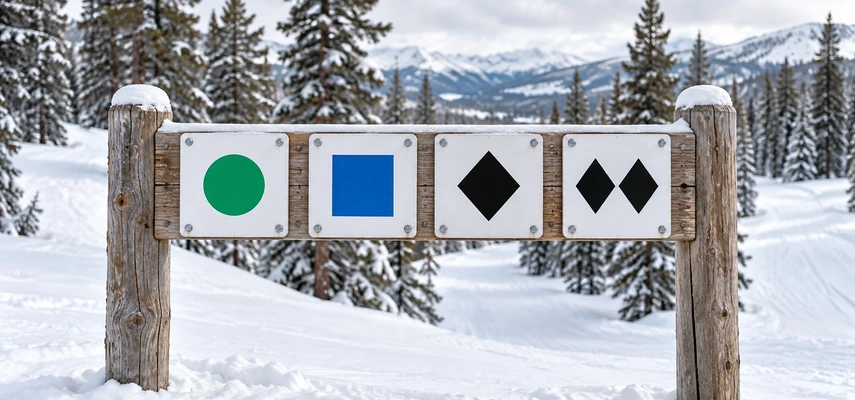

A green circle looks reassuringly definite. So does a blue square. Unfortunately, the mountain didn’t sign a contract promising that every trail with the same symbol would feel identical.
Ski trail ratings are useful precisely because they simplify a complicated landscape. They help you compare routes, identify a sensible starting point, and recognize terrain that demands more skill. The trouble begins when a skier asks the symbol to answer questions it was never designed to answer.
A rating doesn’t tell you today’s snow texture, whether fog has swallowed the next turn, or how confidently you can stop after lunch. It also doesn’t translate perfectly from one resort to another. Treat it as an important piece of information, then add conditions, local advice, and an honest assessment of your control.
The four familiar symbols
At many North American ski areas, a green circle identifies the easiest category of terrain. A blue square identifies more difficult terrain. Black diamonds identify the most difficult category, with double black diamonds used for especially demanding terrain commonly described as expert-only.
The National Ski Areas Association’s signage guidance explains the familiar symbols and emphasizes their relative meaning. They describe the mountain’s terrain hierarchy, not a universal examination administered to every hillside.
You may hear the everyday shorthand beginner, intermediate, advanced, and expert. That’s useful conversation, provided it doesn’t turn into a personal identity. Calling yourself an intermediate skier doesn’t mean every blue route is appropriate in every condition.
Learn the resort’s own legend before choosing a lift. Some areas add local distinctions, and not every map uses every possible category. The legend, signs, current trail status, and staff advice belong together.
Green circle: easiest at this resort
Green runs are generally where learners spend much of their early time, but the category includes different experiences. A designated learning slope may be very short and open. Another green route may travel farther, cross intersections, or include narrower sections.
That difference matters to a new skier. Being comfortable gliding in a protected teaching area doesn’t automatically mean being ready to navigate traffic for an entire mountain descent. The required skills include stopping, turning, controlling speed, and choosing a route around other users.
A green rating also doesn’t mean the snow will always be soft. A gentle slope with a firm surface or poor visibility can require more care than its geometry suggests. Ask which open green terrain fits your current ability rather than simply asking where the green trails are.
If you’re taking your first lesson, let the instructor select the setting. A learning area is designed to make the task manageable; there is no prize for replacing it with the longest possible descent immediately.
Blue square: a change in the task
Blue runs usually ask for more developed control than the easiest terrain. The difference may involve steeper pitches, tighter space, longer sustained skiing, or a combination of features.
The word intermediate doesn’t specify one exact movement. A skier might make parallel turns on a wide, forgiving run but struggle when the surface is scraped or the available turning space narrows. Another might manage a short pitch well, then lose coordination through fatigue on a longer descent.
This is why moving to blue terrain should be a decision about repeatable skills and suitable conditions. Can you turn both ways, regulate speed throughout the run, and stop deliberately? Can you maintain room for others without relying on a wide empty trail?
An instructor who has watched you ski can help answer those questions. A friend who remembers surviving the same run last season has useful enthusiasm, but not necessarily the information needed for your next step.
Black diamond: greater demands, not one specific hazard
Black terrain asks for advanced judgment and skiing skill. Depending on the resort and route, the challenge can include steepness, bumps, narrow passages, variable snow, or combinations that leave less room for error.
Don’t infer that a black run is necessarily ungroomed or that a groomed black run is automatically comfortable. Grooming changes the surface; it doesn’t remove the pitch or give every skier the ability to manage it.
Likewise, the label doesn’t describe how you should ski it. Different terrain and snow require different tactics. Reading a general rating guide doesn’t provide the technique or judgment to attempt a demanding slope.
If you are still building basic stopping and speed control, black terrain isn’t a useful practice shortcut. Develop skills on appropriate slopes, seek instruction, and choose harder terrain only when your performance and current conditions support that decision.
Double black: take the warning seriously
Double black diamonds indicate a higher level of difficulty within the resort’s system. They may be associated with particularly steep, confined, exposed, or otherwise demanding terrain, but no single feature defines every double black everywhere.
A skier shouldn’t use the absence of one dramatic feature as reassurance. A route doesn’t need a cliff to be beyond someone’s ability. Firm snow, constrained turning space, and a consequential fall can make a slope serious without looking spectacular in a photograph.
Nor does a double black symbol tell you whether terrain is open. A closed expert route is closed, regardless of your skills or the visibility of tracks beyond the rope.
The sensible interpretation is that the resort is warning of substantial demands. Get local information, respect restrictions, and stay within your experience. Curiosity is useful for learning; it isn’t a substitute for preparation at the entrance to expert terrain.
Why the same color can feel different elsewhere
Imagine two restaurants labeling a dish spicy. The label helps within each menu, but it doesn’t tell you that the kitchens used the same amount of chili. Trail ratings work with a similar limitation, although their consequences deserve much more serious attention than an unexpectedly lively lunch.
Each resort evaluates its own terrain. Geography, available routes, and local rating conventions influence the comparisons. At a new mountain, start conservatively and ask how the system is used there.
Big Sky’s official safety guidance explicitly warns that equally colored runs don’t ski the same at every resort. Ski California’s mountain safety guide also notes local variations and the importance of understanding the area you’re visiting.
Avoid universal slope-angle charts that claim to convert every degree of steepness into a guaranteed color. Pitch is important, but a trail’s experience includes more than one number. A narrow icy section and a wide soft section with similar angles may present very different problems.
A trail contains more than its average slope
The pitch you see from the entrance may not represent the entire route. A trail can begin gently, roll out of sight, narrow, intersect another run, or finish somewhere you didn’t expect.
Study the map for the full connection, including the route back to an appropriate base or lift. Confirm whether every segment you need is open and within your ability. A friendly-looking access road can deliver you to terrain that isn’t a friendly next step.
Ask concrete questions: Is there a steeper section below? Is the route groomed today? Does it become narrow? Is there an easier open way down from this lift? Those questions produce more useful answers than whether a run is fun.
If you discover a route is beyond you, stop where you’re visible and not obstructing traffic, then seek help from staff or patrol. Don’t keep descending merely because turning back would feel embarrassing. A map-reading error doesn’t need a second act.
Conditions change the challenge without changing the sign
The sign usually stays put while snow and visibility change. A familiar run can become more demanding when the surface firms up, bumps develop, snowfall obscures features, or flat light makes the terrain harder to read.
Traffic matters too. A wide slope can feel spacious when quiet and leave much less usable room when crowded. Your speed and route must account for people ahead, not only for what you could do on an empty hill.
Fatigue changes the skier as well as the mountain. Being able to manage a route once while fresh isn’t a promise about the final run of the day. If controlled movements become difficult, choose an easier option or finish the session.
The NSAA responsibility code makes control a continuing duty. It doesn’t create an exception because the trail happened to be labeled blue.
Symbols that don’t belong on a simple difficulty ladder
An orange oval identifies freestyle terrain in the NSAA system. It isn’t a color above double black and doesn’t describe a normal beginner-to-expert slope progression. Terrain parks have their own features, signs, and rules.
A closure sign also overrides the temptation to reason from difficulty alone. Closed terrain may present operational or natural hazards you cannot assess from the entrance. Respect ropes, gates, warnings, and staff instructions.
Beyond resort boundaries, trail ratings aren’t a backcountry safety assessment. Avalanche conditions, navigation, rescue access, and unmanaged hazards require different knowledge. Neither a familiar color nor visible ski tracks establish that a route is safe.
If you travel internationally, learn the local system rather than translating colors by intuition. European piste maps commonly use a different sequence, and local usage varies. Read the actual legend and ask local professionals before selecting terrain.
Use the rating to make a better decision
Before boarding a lift, know which suitable open route comes down from it. At a new resort, begin on easier terrain than your most demanding familiar run. Give yourself time to learn how the snow, layout, and local labels compare with what you know.
When considering a harder route, discuss the specific demands with an instructor or qualified staff member. Describe what you can reliably do, not only what color you skied once. Repeatable control is more informative than a souvenir claim.
The most useful progression isn’t a collection of symbols. It’s a growing ability to choose a path, maintain space, and stop intentionally across an appropriate range of conditions.
A rating helps you ask the right questions. Your skiing, the day’s conditions, and local knowledge help answer them. That leaves the green circle doing a valuable job—without asking it to predict the entire afternoon.












