










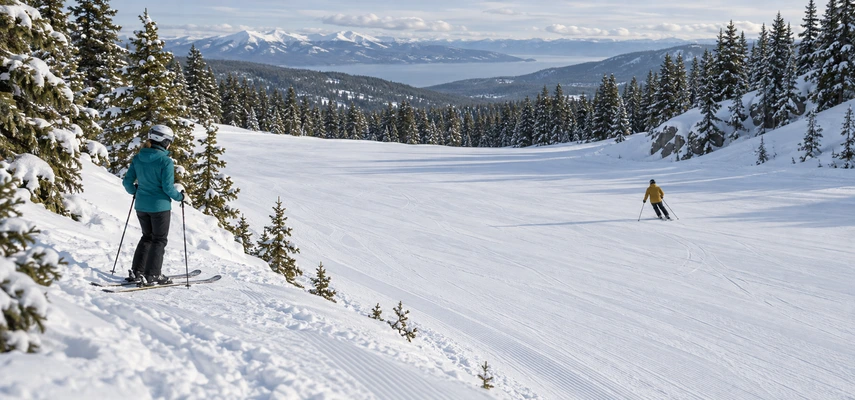

A ski slope has no painted lanes, and the person ahead may turn in a direction you weren’t expecting. That makes good etiquette more than a collection of pleasant manners. It is part of how strangers share a moving, changing space.
The useful habits are mostly practical: leave room, look before joining traffic, stop somewhere visible, and don’t let your plan depend on everyone else behaving exactly as you predicted. Courtesy makes the day more enjoyable because it also makes your decisions easier for others to live with.
Some expectations are formal responsibilities. Others are considerate ways to handle queues, equipment, and shared facilities. Learn both, and follow the area’s specific rules. You don’t need to become an expert skier before you can be a thoughtful person on the mountain.
Start with control, not confidence
Being confident and being in control aren’t the same thing. Control means being able to manage your speed and route so you can stop or avoid people and objects. Feeling certain that you probably won’t need to is a different proposition.
Choose terrain and speed that leave room for changing conditions and other users. A clear run can become crowded below a rollover, and a firm patch can reduce the margin you thought you had.
The NSAA’s Your Responsibility Code sets out the central duties, including control, downhill priority, visible stops, uphill checks, secure equipment, signs, closures, lift knowledge, impairment, and incident information exchange.
Read the full code rather than relying on a slogan remembered from years ago. The point is not to win an argument about whose turn looked more predictable. It is to make decisions that reduce the chance of needing that argument at all.
Give people ahead room to make their own turns
People ahead or downhill have priority, and you must avoid them. Don’t assume a learner will continue on the line you imagined, or that a snowboarder has noticed you approaching from behind.
Leave a margin that accounts for changes in direction and speed. If you cannot pass with ample clearance, wait. A shouted warning doesn’t create a right to squeeze through an unsuitable gap.
This matters particularly around lessons and families. Beginners may need more space and may not yet produce symmetrical turns. Their presence is information to adapt to, not a reason to demonstrate how closely an experienced skier can pass.
If you’re traveling with friends, resist treating the space between them as reserved group property. Other people still use the same run. Rejoin your party at a suitable stopping place rather than cutting unpredictably across traffic to keep a formation intact.
Look uphill before starting or merging
Before you set off from a stop or enter another trail, check uphill and avoid approaching users. Don’t let a conversation, a map, or the excitement of seeing your friends distract you from the traffic you’re about to join.
An uphill glance isn’t a ceremonial head movement. Use it to assess whether there is enough room and time for your intended start. If you’re uncertain, wait for a clearer opportunity.
At junctions, understand which route you’re taking before beginning the maneuver. A last-second change because you spotted a sign can affect people around you. Slow and stop appropriately to read the map when necessary.
Priority rules and caution work together. Everyone should still act to avoid a collision rather than treating an assigned duty as permission to ignore an obvious problem. Being technically entitled to a route is not a useful substitute for awareness.
Pick a stopping place others can see
Stop where you’re visible from above and don’t obstruct traffic. The side of a run may be suitable if it is genuinely clear and visible; simply reaching an edge doesn’t automatically solve the problem.
Avoid stopping just below a crest or in a narrow passage where approaching skiers have little chance to see or avoid you. If your group gathers, make sure the entire cluster leaves room rather than gradually expanding across the route.
Photos and phone checks belong in the same category of planned stops. Choose the place first, then deal with the screen. An attractive view doesn’t make the middle of a busy trail a sensible studio.
After a fall, assess whether you are hurt and seek help when needed. If you can move safely and are uninjured, clear the active path appropriately. Don’t rush a potentially injured person merely to tidy the traffic; contact patrol and follow professional instructions.
Use queues as shared access, not a competition
Follow the lift maze and staff directions. Join the queue properly, merge as instructed, and keep enough control of skis and poles to avoid hitting other people’s equipment or legs.
If a singles line is available and appropriate, use it according to the area’s system. It fills seats; it isn’t a universal shortcut for keeping a large party together. Ask the attendant when the arrangement is unclear.
Have your access product ready as required, secure loose items, and put the phone away before loading. A queue isn’t the best place to discover that a pole strap is tangled around a bag or that the ticket is underneath several layers.
Be patient when someone needs assistance. Every experienced skier once needed an explanation of an unfamiliar lift. The difference between a brief delay and an unpleasant scene is often how everyone nearby chooses to respond.
Communicate on the chairlift
Tell the attendant if you need help before loading. Follow the procedure for that lift, sit properly, and keep equipment from interfering with other riders. Remove backpacks and handle pole straps as the operator directs.
If a manually operated bar is used, communicate before lowering it so other riders can prepare. Raise it only when signs and instructions indicate. Some lifts have automatic or locking systems, so don’t assume the procedure is identical everywhere.
Big Sky’s official lift guidance illustrates why local details matter: different installations can have different bar operation. The general courtesy is to stay attentive and avoid surprising the people sharing the chair.
Don’t rock the chair, throw objects, or lean out to retrieve something dropped. Let staff know about lost items. At unloading, follow instructions and clear the exit so the next riders have room.
Signs and closures aren’t suggestions from less adventurous people
Read and obey warnings, hazard markings, ropes, and closure signs. There may be operational work or natural hazards you cannot evaluate from the entrance. Tracks beyond a rope don’t establish permission or acceptable conditions.
Respect slow zones, teaching areas, and restrictions on particular equipment or activities. A place where people are gathering, learning, or merging deserves an appropriate speed even if you personally find the terrain easy.
Resort boundaries matter. Nearby unmanaged terrain doesn’t acquire patrol coverage or avalanche control because it is visible from a lift. Don’t encourage someone else to follow a boundary crossing they don’t understand.
If a sign is confusing, ask staff before entering. Good judgment includes recognizing when the information you need is missing. Solving that question by proceeding anyway is an unnecessarily expensive research method.
Terrain parks have their own traffic and consequences
Features such as jumps and rails create paths and landing areas that aren’t obvious if you’re unfamiliar with park use. Don’t stop in a landing zone or wander into a feature’s approach to watch a friend.
The NSAA Park SMART guidance emphasizes gradual progression, planning, looking before entering, respect, and limits. Read the local signs and seek instruction before attempting unfamiliar features.
Taking turns matters, but an apparent opening isn’t enough if the landing area isn’t clear. Follow established local procedures and remain aware of other users rather than assuming your view includes everything relevant.
For a beginner, the best etiquette may be choosing an appropriate learning area elsewhere. A terrain park isn’t an ordinary shortcut just because it appears between two familiar points on a map.
Keep equipment and shared spaces orderly
Prevent runaway equipment and store skis where the area provides racks or designated space. Don’t leave them across entrances, paths, or emergency access. Keep track of your own setup so you don’t accidentally take someone else’s rental skis.
In lodges, use lockers or permitted storage rather than treating every chair and table as a private equipment depot. Be mindful of sharp edges, wet clothing, and bulky boots around people carrying food or walking with children.
Return rental equipment according to the shop’s procedure and tell staff about damage or a fitting concern. Quietly putting a problematic item back into circulation doesn’t help the next skier.
Treat instructors, lift attendants, patrol, and service staff respectfully. Ask clear questions and follow reasonable operational directions. They are managing a shared environment, not performing a series of personal interruptions to your holiday.
Handle incidents directly and responsibly
If you’re involved in a collision or incident, follow the code’s information-sharing requirement and notify a ski area employee. Seek patrol assistance for injury concerns. Don’t ski away because the other person initially seems able to stand.
Describe what happened accurately and avoid escalating the scene into an argument. Staff need useful information, including location and the people involved, rather than competing performances of certainty.
The Canadian Ski Council’s slope guidance encourages seeking trained assistance when someone is injured. Don’t attempt an unfamiliar rescue or medical intervention beyond your training. Help can begin with promptly finding the right people.
Good etiquette is usually quiet. It looks like waiting for space, asking before lowering a bar, choosing a visible stop, or helping a newcomer find the correct queue. Those small decisions make the mountain easier to share—and leave everyone more attention for the skiing they came to enjoy.












