










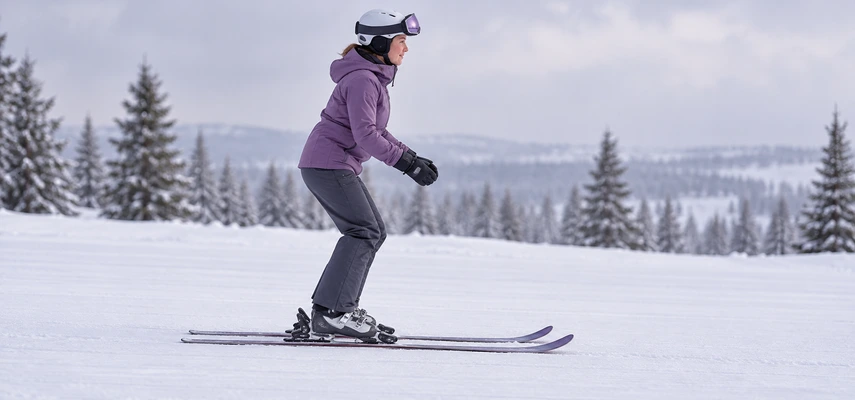

Standing still sounds like an undemanding introduction to a sport. Then you attach skis to your feet and discover that the ground has become rather less committed to staying underneath you.
The answer isn’t to freeze into a perfect pose. Ski balance is the ability to remain supported while the skis and your body move, with enough freedom left to make the next adjustment. A useful stance is a starting arrangement for movement, not a sculpture of a skier.
Begin on nearly level snow in a designated learning area with an instructor. Learn to handle the equipment and stop before attempting longer glides. The ideas below help explain the task; they don’t make a busy slope an appropriate place for a first balance experiment.
Start with the feet you actually have
Place the skis roughly parallel with a comfortable separation. For many beginners, a stance around hip to shoulder width is a useful starting range, but body proportions, equipment, and the task affect what works.
The aim is room for each leg to move without forcing an exaggerated spread. Skis pressed together can make independent adjustments difficult; an excessively wide stance can create other problems. Let the instructor help you find a manageable middle ground.
Feel support through the feet rather than trying to stand entirely on the toes or heels. Your contact with the boot gives useful information about where your body is supported. Don’t chase a sensation so aggressively that the rest of the stance becomes strained.
Check that both skis are secure and the equipment is correctly fitted. If something feels loose or painful, have the instructor or technician assess it before practicing. A balance task should not depend on compensating for a problem in the setup.
Flex several joints, not just the knees
Ankles, knees, and hips contribute together. A little comfortable flexion gives you room to adjust, while locking everything straight reduces your options. The target isn’t the deepest bend you can manage.
“Bend your knees” can be misleading if it sends the hips backward without useful ankle movement. A skier may look lower while feeling less supported over the feet. More visible effort doesn’t necessarily mean a better arrangement.
Try a small, coordinated softening through the lower joints while stationary, with the instructor checking the result. Notice whether you remain able to move slightly taller and lower without lurching or collapsing backward.
The REI beginner stance explanation introduces this athletic starting position. Treat the description as a practical beginning, then adapt it to your body and the feedback you receive rather than copying one photograph exactly.
Let the boots support movement without leaning on them blindly
Alpine ski boots limit ankle motion compared with shoes. They also transmit movement between you and the skis. That combination can make the first stance feel unfamiliar even before the skis slide.
Gentle contact with the boot cuff can be a useful cue for some learners. It doesn’t mean driving the shins forward as hard as possible or hanging against the front of the boots. Support through the feet and coordinated body position still matter.
Likewise, pressing the calves into the backs of the boots isn’t a dependable way to feel safe. It can leave your body behind the feet and make steering harder. An instructor can distinguish a movement habit from an equipment limitation.
If you can’t find a comfortable range, ask for a fitting assessment. Salomon’s boot guidance identifies fit and flex among the relevant factors. Don’t change bindings or attempt equipment modifications yourself to solve a stance question.
Put the hands somewhere useful
Keep the arms comfortable and the hands generally in front of and a little to the sides of the body. This leaves room for small adjustments without pulling the shoulders backward or creating a rigid reach.
The hands aren’t a steering wheel. Swinging them dramatically in the direction you want to go can move the upper body without producing the ski action you need. At the beginning, quiet and available is a more useful objective than theatrical.
An instructor may leave poles aside during early practice. That’s a teaching choice, not a missing piece of balance equipment. Poles have useful roles, but they don’t replace a stance supported through the feet.
Look toward the space you intend to move into rather than continuously staring at the ski tips. You need awareness of the environment, and lifting the gaze often helps reduce the urge to fold the body around the equipment.
Think of balance as a conversation with support
When you stand on firm ground, you make small adjustments without noticing them. On skis, the support can move more easily, so those adjustments become more apparent. The task is still to organize the body in relation to what supports it.
Imagine standing in a slowly moving train. A rigid pose makes a small change feel abrupt. Some flexibility lets your body respond without turning every movement into a crisis. The analogy explains adaptability, not a particular ski technique.
During actual skiing, gravity isn’t the only force affecting your balance. Direction changes and ski-snow contact matter too. Ron LeMaster’s discussion of alignment explains why a single vertical body position cannot describe every skiing situation.
For a beginner, the practical implication is reassuring: the stance will evolve as you move. You don’t need to preserve the same knee angle through an entire run. You need enough organization and freedom to respond.
Explore small movements before adding distance
On level snow selected by the instructor, gently move a little taller and a little lower. Keep the motion comfortable and notice whether the support remains under your feet. This is an observation task, not a competition to find the lowest crouch.
You may also explore small changes in support from one foot toward the other while keeping both skis on the snow. The instructor can help you recognize the difference between a deliberate adjustment and tipping the whole body beyond its manageable support.
Some lessons use one-ski activities, short steps, or other simple tasks. Follow the progression selected for you. An exercise seen online may assume skills or terrain you haven’t yet developed.
If a movement feels confusing, reduce it and ask for a demonstration. Small changes are often easier to understand than large ones because you can notice what changed without spending all your attention on recovering afterward.
Add a short glide only in a suitable setting
Once the instructor selects an appropriate progression, a very short glide can reveal how balance changes when the skis move. The setting should offer controlled beginner practice, clear space, and a suitable stopping arrangement.
Move with the skis rather than trying to hold the feet back while the body advances, or letting the feet run away ahead. That relationship is easier to explore over a short manageable distance than during a long descent.
Don’t add speed to make a balance exercise feel more authentic. If you’re unable to stop or remain within the selected practice area, the task is already too demanding. Return to the instructor’s simpler step.
The useful result is a repeatable glide with available movement, not a distance record. Notice whether you can remain reasonably relaxed and look ahead while keeping the body supported. Tell the instructor where the sensation changes.
Recognize the common defensive reactions
Leaning backward is understandable when downhill motion feels threatening. Unfortunately, it can make the skis harder to guide. The solution is not simply throwing the shoulders forward; it is restoring a more useful relationship between body, feet, and support.
A deep squat is another common attempt to feel secure. It may create muscular effort without providing the intended mobility. If your thighs are doing all the work while you feel stuck, ask the instructor to look at the whole arrangement.
Stiff arms, clenched hands, or staring at the tips can accompany the same defensive response. Change the task’s difficulty as well as the body cue. Easier terrain and a shorter movement may allow relaxation more effectively than repeated instructions to be calm.
Don’t treat these patterns as personal failures. They are information about how you’re responding to an unfamiliar situation. Useful feedback identifies a manageable change and gives you a place to practice it.
Keep practice within your ability and attention
Balance changes as you tire, become cold, or lose concentration. If your movements become rigid or uncontrolled, pause and reassess rather than demanding another run from the same struggling setup.
Choose open terrain appropriate to your current stopping and turning skills. A lesson exercise doesn’t suspend the NSAA responsibility code: remain in control, avoid people ahead, and stop where visible without blocking traffic.
Professional instruction is especially useful when you repeatedly feel stuck, cannot identify whether the problem is fit or movement, or are preparing to add slope and speed. An observer can see relationships you can’t reliably judge from inside the sensation.
The PSIA-AASI Eastern task descriptions show balance and support developing across different skiing activities. Your beginning is much simpler: find a comfortable starting stance, explore small adjustments, and learn to carry that freedom into a controlled glide.
Good balance often feels less dramatic than expected. There is less bracing, less argument with the boots, and more room to make a decision. Standing on skis becomes useful when it leaves you ready to move.












