










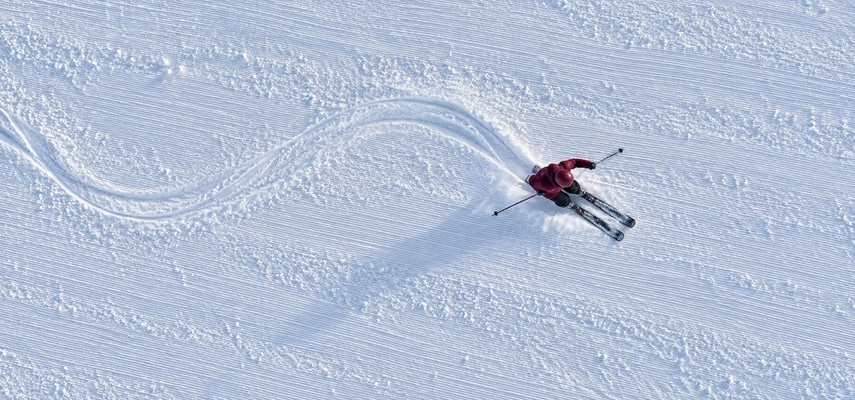

One turn goes well. You finish it, enjoy a small moment of triumph, and then remember that another turn is supposed to happen. By the time you’ve organized that thought, the skis have taken you somewhere less convenient.
Linking turns means making that connection part of the movement. Instead of treating each arc as a separate assignment, you let the finish of one prepare the beginning of the next. The goal is a series of chosen paths with manageable speed, not an uninterrupted performance that prevents you from stopping when you need to.
You can work on this in wedge turns, developing parallel turns, or established parallel skiing. The movements differ, but the organizing idea stays useful: look ahead, shape the current turn, and arrive ready to change direction again.
Start with turns you can already control
This isn’t a first lesson in stopping or steering. Before practicing linked turns independently, you need a reliable way to turn both directions and stop on the selected slope. If either side still feels like a hopeful experiment, work with a qualified instructor on that foundation first.
Choose open, appropriately gentle terrain with predictable snow and good visibility. A familiar run can become a different proposition when it’s crowded, scraped hard, or hidden in flat light. Pick conditions for the skill you’re practicing today, rather than the skill you hope to have by lunch.
REI’s parallel-turn progression begins from existing linked wedge turns and emphasizes a comfortable practice slope. That sequence matters: linking is useful before parallel skiing, and parallel skis alone don’t prove that the skier is managing the descent.
An instructor can help decide whether your next step is linking a few wedge turns, reducing a pause between parallel turns, or improving an already continuous sequence. Those are related tasks, but they don’t need the same cue.
Think of a connected path
Imagine drawing a gently winding line down a sheet of paper. Each bend has a beginning, a curved middle, and an exit that points toward the following bend. Now imagine drawing a series of disconnected hooks. The hooks may look respectable individually, yet connecting them requires a new decision every time.
On snow, a long sideways traverse between turns can feel like a reset button. Sometimes a traverse is exactly what the situation requires. But when it appears after every turn because you don’t know how to start the next one, it interrupts the sequence you are trying to learn.
The answer isn’t to delete the end of the current turn. Cutting each arc short can leave more of your route pointing downhill, which may increase speed beyond what you intended. Instead, practice completing useful round turns while preparing their connections earlier.
Choose a small section of the slope where you can see the space ahead. Plan a few manageable bends through that space, leaving room for traffic and a safe stopping place. You’re choosing a general corridor, not claiming a private lane or fixing a line that everyone else must accommodate.
Finish the present turn before chasing the next
There is an easy trap here: hearing “link” and assuming “hurry.” A rushed skier may twist the skis into a new direction before establishing control in the old one. The resulting sequence is continuous, certainly, but continuity by itself is a modest achievement if every turn becomes faster.
Let the current turn produce the direction and pace you need. As the skis come farther across the hill, consider where the next arc will begin. You should still be able to adjust or stop if somebody enters the space you expected to use.
Turn shape is one tool for managing speed; snow, slope angle, ski interaction, and the way you execute the turn also matter. There isn’t a universal rule that a particular shape guarantees a particular speed. Notice the actual response rather than assuming the drawing in your head controls the mountain.
For example, a sequence that feels calm on soft groomed snow may require different decisions on a firmer pitch. If speed keeps building, return to easier terrain and ask an instructor to assess the whole turn. A more frantic connection is unlikely to solve the underlying problem.
Make room for the change of direction
During a linked sequence, the skis need to move out of one turning relationship with the snow and into another. In parallel skiing, releasing the old edges is part of making that possible. In a developing wedge progression, steering, support, and the relationship between the skis evolve differently.
That is why “just throw your weight onto the other foot” is an incomplete lesson. Abruptly moving the upper body can create a lurch without producing the intended ski response. Likewise, clinging to the old turn until the last possible instant can make the next entrance feel blocked.
The PSIA-AASI Central wedge-christie assessment treats the activity as integrated skiing through the turn phases. It’s a useful reminder that a turn isn’t assembled from unrelated gestures. The transition belongs to the sequence, rather than being an awkward blank between two real turns.
Ask your instructor for one movement that suits your current skiing. It might concern releasing, steering both legs, or maintaining useful support as the direction changes. Practice that particular adjustment instead of collecting five competing instructions and attempting them simultaneously.
Look far enough ahead to make a choice
Looking directly at your ski tips is rather like navigating a hallway by watching your shoes. You get excellent information about the nearest few inches and surprisingly little help with the approaching doorway.
Keep your attention moving through the usable slope ahead. Check the next part of your intended route while retaining awareness of people and obstacles around you. The exact distance changes with speed, visibility, terrain, and traffic; there is no magic number of feet that works everywhere.
Looking ahead doesn’t mean staring at one fixed point and ignoring the rest of the hill. You need a changing picture. If the space closes, adjust the plan. If you cannot see beyond a rollover, approach in control rather than assuming the hidden section is empty.
The NSAA responsibility code requires control and avoidance of people ahead or downhill. A practice pattern never overrides that duty. Interrupting a sequence to accommodate another person is good judgment, even if it spoils your elegant imaginary line.
Practice a short sequence with a clear ending
On terrain selected with your instructor, try a small number of linked turns followed by a planned stop in an appropriate place. The point isn’t the number. It’s giving yourself a task short enough to notice what happened without turning the entire run into a test.
Before starting, look uphill and avoid others. Identify the general space available and a visible place to finish without blocking traffic. Then focus on one question: does the end of each turn leave you ready for the next?
After stopping, describe the result in ordinary language. Perhaps the first two turns felt connected, but the third needed a long traverse. Perhaps the sequence stayed continuous while the speed increased. Perhaps the left-to-right connection felt easy and the other direction did not.
Those observations give an instructor something useful to work with. “I need to be smoother” is an understandable wish, but “I pause after every right turn” is a much more helpful starting point for finding the cause.
Repeat only while the space and your attention remain suitable. If you find yourself staring at the exercise instead of seeing other skiers, simplify the task or stop practicing it for the moment.
Troubleshoot the connection, not just the appearance
A long pause may mean you’re holding the old edges, finishing in an awkward position, choosing terrain that feels too demanding, or simply making your next decision too late. Several different causes can create the same visible hesitation. That is where an observer earns their keep.
An abrupt upper-body swing can suggest you’re trying to manufacture the next turn with your shoulders. Rather than locking the torso rigid, ask how to organize the legs and balance so the skis can change direction without that rescue movement.
Uneven left and right turns are also worth noticing without treating them as a character flaw. Slope shape, visibility, habits, equipment fit, and movement differences may contribute. Practice on appropriate terrain with specific feedback instead of forcing the reluctant side harder.
If you become tired, cold, distracted, or anxious, a previously comfortable sequence may deteriorate. Take that information seriously. Continuing until every turn becomes a recovery move doesn’t make the exercise more productive.
Let smoothness follow useful control
Smooth skiing doesn’t require every turn to have identical size or timing. A changing slope may call for a different arc, and traffic may require an entirely different route. The valuable skill is connecting movements while preserving the ability to change your mind.
Keep the practice goal small: a controlled current turn, an available next turn, and enough awareness to adapt between them. Once that becomes repeatable on easy terrain, your instructor can help transfer it to a modest new challenge without changing everything at once.
The pleasing part is that the run begins to feel less like a stack of separate problems. You still make decisions, but you make them early enough for one turn to help the next. That’s where flow starts: with a connection you can choose, adjust, and comfortably interrupt.












