











The awkward part of a snowboard turn often happens between the turns. One edge feels reassuringly engaged. The other will probably feel fine once you reach it. In the middle is a brief moment when your feet seem to ask who, exactly, is in charge.
A smooth edge change makes that middle feel like part of the movement rather than a gap in the instructions. You release the support you’ve been using, move with the board and establish the next edge in a way that suits your direction of travel.
This is a skill to develop with an instructor on appropriate terrain. It isn’t a command to flip from heel to toe as quickly as possible. Good timing matters more than theatrical speed.
What changes when you change edges?
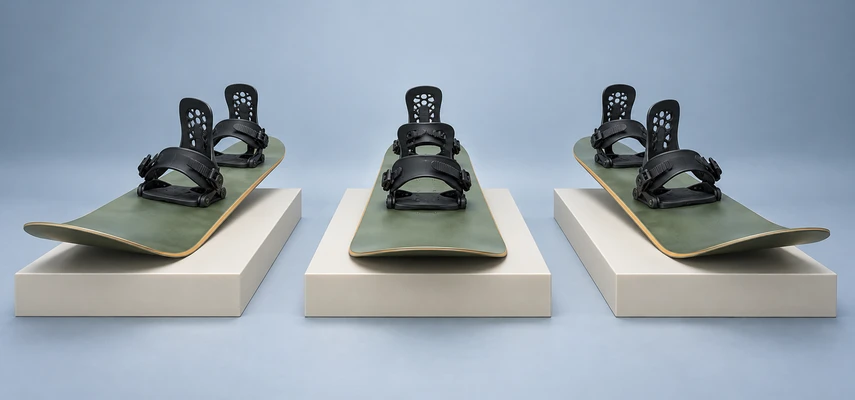
The heel-side edge runs beneath your heels; the toe-side edge runs beneath your toes. In a typical linked turn, the board moves from being tilted toward one long edge, through a flatter orientation, toward the other.
That’s a description of tilt, not a complete account of the turn. The board also changes direction, pressure changes along and across it, and your body moves relative to the support beneath you. Those events overlap.
The AASI technical performance guide distinguishes board tilt, pivot, twist and pressure management. Thinking in those separate terms helps identify why an edge change can feel abrupt even when you know which edge comes next.
Perhaps you’re trying to rotate a strongly engaged board. Perhaps you’re moving your upper body while the board stays behind. Or perhaps the next edge is engaging before the board’s motion supports it. The same feeling of hesitation can come from different causes.
Release the old edge before demanding the new one
An engaged edge provides support and resistance to sideways motion. If you try to force a new direction while maintaining a strong grip on the old edge, the movement can become a struggle between your intended route and the board’s existing contact with the snow.
Reducing the edge angle lets that old engagement diminish. That creates room for the board to redirect and for your relationship to it to change. The movement can be small; it doesn’t require standing completely upright or jumping.
Imagine releasing pressure on a door handle before trying to move the latch in another direction. You aren’t abandoning control. You’re making the next action possible. The snowboard analogy is imperfect, but it captures why simply adding more force can make a transition less cooperative.
An instructor can help you feel the difference between a purposeful release and unexpectedly losing the edge. One is part of the plan. The other suggests that the movements, terrain or snow need reassessment.
The board has a direction and a path
A snowboard can point one way while sliding partly another way. During a skidded turn, some of its movement is sideways across its length. That matters because changing tilt has to make sense for the actual motion, not just the direction the nose appears to face.
If the next edge engages strongly while the board is still sliding across it in an unfavorable direction, it may catch. That’s why a universal rule such as switch edges whenever the nose points downhill leaves out information you need.
Beginning progressions commonly organize the turn so that the board’s direction, its travel and the edge change develop together. The instructor selects a task that reduces the chance of rushing one part ahead of another. Your job is to learn that relationship, not memorize a single instant that applies to every turn on every slope.
If you’re unsure about the timing, return to easier tasks with the instructor. A faster run doesn’t make the missing information clearer.
A flatter board is a transition, not a waiting room
Moving between edges generally involves a flatter board. That doesn’t mean pausing on a flat base until you feel perfectly settled. On a slope, motion continues while you’re deciding.
Nor does it mean the flat phase must be eliminated. Trying to leap instantly from one strongly engaged edge to the other can introduce abrupt tilt or an unhelpful jump. Smoothness is about a connected, appropriate change, not winning a contest for the shortest transition.
The duration varies with the task, terrain, turn shape and riding style. In an early learning exercise, the flatter phase may be easy to notice. As coordination develops, the same overall change can become less conspicuous.
Burton’s beginner progression places edge work within a sequence of gliding and turning skills. That’s a useful reminder: the transition belongs to a moving turn, rather than being a disconnected foot exercise.
Let the body travel with the change
Your center of mass is the useful shorthand for the overall balance point of your body. Its relationship to the board changes through a turn. You can’t create a dependable transition by moving only your shoulders while your lower body continues to support the old edge.
Ankles, knees and hips contribute to moving and tilting the board while keeping you able to respond. Think about allowing a connected change through the body, with enough mobility to make small adjustments. Avoid throwing the upper body toward the next turn and hoping the feet will receive the message.
On heel side, a deep seated position can leave you behind the support you need to move away from. On toe side, folding at the waist can move your torso without producing the intended board response. These are observations an instructor can test, not diagnoses for every hesitant turn.
Your hands don’t need to perform the transition. Keeping them comfortably organized can make it easier to notice what the legs and board are actually doing.
Pressure doesn’t need to arrive as a surprise
Changing edges also changes where support is coming from. If you unload abruptly and then stamp the new edge into the snow, the turn may feel like two separate events connected by a jolt.
Aim for a progressive transfer that suits the task. As the old edge releases, allow the next edge to build useful engagement instead of demanding maximum grip immediately. The snow and the board’s response tell you whether that engagement is developing.
Flexion and extension can help manage the process, but there isn’t one mandatory up-and-down pattern for all riding. Different turn types use different timing. A movement that helps one learning task can become excessive when copied into another.
The PSIA-AASI Eastern workbook treats tilt, pivot, twist and pressure as adjustable elements in learning tasks. That approach is more useful than treating every transition as the same choreographed knee bend.
Give yourself a manageable experiment
Ask an instructor to choose a gentle, open learning area with consistent snow, room to turn and a suitable stopping place. You should already be able to control speed and stop on both edges in the selected terrain.
A task may begin with releasing an edge into a shallow glide and re-establishing control, rather than immediately making a long sequence of linked turns. Another task may isolate the beginning of one turn. The exact progression should reflect what you can currently do.
Work on a small number of turns with one observation in mind. Does the old edge release without a shoulder lunge? Does the new edge build support without a sudden scrape? Can you keep the route and speed manageable throughout?
The purpose isn’t to keep going until fatigue produces a lucky run. Short, clear attempts provide better information than a long descent in which every turn becomes an improvised rescue.
Read the hesitation before correcting it
If you hold the old edge too long, the turn may travel farther across the slope than intended. You may then rush the next movement to recover the route. The visible rush is real, but the earlier delay may be the part to address.
If you rotate the board aggressively, it may enter the transition with substantial sideways movement. Adding the next edge abruptly can make the outcome harsher. The answer may involve the amount of pivot as well as edge timing.
If you brace rigidly, small variations in the snow can disturb the whole movement. If you collapse suddenly, you may remove the support you were relying on. Neither problem is solved by the vague instruction to relax more.
Tell the instructor what you feel and when it happens. Observations such as my toe-side transition feels rushed after a long heel-side finish are specific enough to investigate. A general complaint that the board is unpredictable leaves more detective work to do.
Smoothness depends on the place
An edge change that feels organized on gentle groomed snow may require different timing on a steeper pitch or uneven surface. That isn’t proof that the first version was fake. The task has changed.
Return to manageable terrain when introducing a new movement. Don’t use crowded narrow trails, icy pitches or blind rollovers as testing grounds. Keep the ability to make familiar controlled turns and stop while you’re learning.
The NSAA Responsibility Code requires looking uphill before starting and avoiding people ahead. During a practice task, those responsibilities remain more important than completing your planned number of transitions.
Make the middle part of the turn
A smooth edge change doesn’t erase the moment between supports. It makes that moment understandable. The old edge releases, your body and board continue moving together, and the next edge engages in a way that fits the path.
With suitable instruction, you’ll begin to recognize the difference between a purposeful transition and a hurried correction. That recognition is valuable even before every turn feels polished.
The goal is to reach the next edge with time and options, rather than treating it as somewhere you must escape to. Once the middle belongs to the turn, the whole descent can feel less like a succession of negotiations with your feet.












