










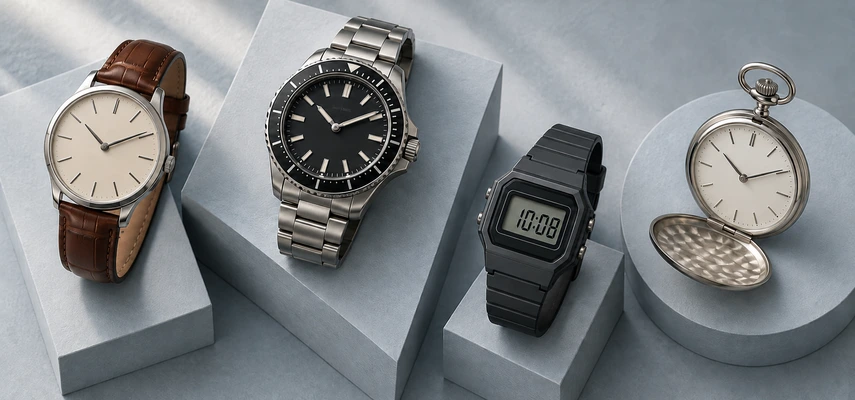

Put a mechanical watch in a drawer and, for a while, it keeps working in the dark. No charger, no battery, no signal from a satellite. A spring you wound earlier is paying the energy bill. What is a watch, then? At its simplest, it’s a portable timekeeper made to be carried or worn, with a mechanism that tracks passing time and a way to tell you the result.
That sounds modest until you consider the assignment: keep a steady rhythm while somebody walks, waves, catches a train or forgets you on a bedside table. A watch has to bring its own tiny reference for time along for the ride. The interesting part begins behind the display.
What makes a watch a watch?
A wall clock belongs to a room. A watch goes with a person. Today that usually means a wristwatch, but a pocket watch qualifies too. The defining idea is personal portability, rather than a round case, a leather strap or moving hands.
Other instruments answer different questions. A sundial uses the Sun’s position to indicate time. A stopwatch measures an elapsed interval: how long a lap took, for example. A watch ordinarily keeps a continuing account of the time of day. It can include a stopwatch, but that is an extra job rather than its basic identity.
A smartphone also tells the time. We usually call it a phone because timekeeping is one feature inside a broader computer. The boundary becomes less tidy with a smartwatch, which wears the familiar watch shape while adding computing, communications and sensors. These categories describe useful differences; they aren’t membership rules for an exclusive club.
The same distinction helps with appearance. An elegant watch and a rugged watch may perform the same basic task in very different clothes. Their size, controls, display and protection determine how comfortably that task fits into your day.
A watch needs a rhythm before it needs hands
Imagine counting your steps to estimate how far you’ve walked. The count is useful only if the steps are reasonably consistent. A timekeeper faces a similar problem: it needs a repeating event, then a means of counting those repetitions.
In a conventional mechanical wristwatch, a small wheel rocks back and forth with the help of a fine spring. This is the balance wheel and balance spring. In a quartz watch, the repeating event is the vibration of a specially prepared crystal. Neither object knows that you’re late. Each supplies a rhythm that the rest of the watch can turn into a reading.
From there, the display supplies the final translation. An analog watch uses hands moving against markers. A digital watch shows numbers. Those are ways of presenting information, rather than explanations of what powers the watch underneath. A quartz watch can have traditional hands; an electronic watch needn’t look like a miniature calculator.
Getting the rhythm right and showing it clearly are separate achievements. A beautiful dial cannot rescue an unstable timekeeper, while an accurate mechanism is frustrating if its hands disappear against the background. The practical watch needs both engineering and communication design.
How a wound spring becomes useful time
A mechanical watch stores energy in a coiled metal strip called the mainspring. Winding it puts energy into that spring. As it unwinds, it drives a series of gears, often called a gear train. Left uncontrolled, the stored energy would run out far too quickly to be useful.
The escapement is the mechanism that meters the gear train’s advance and gives the balance assembly small impulses to keep it oscillating. Think of a gate opening in repeated small steps, coordinated with a swinging rhythm. That analogy captures the job; inside the watch, the interactions happen through precisely shaped parts. Horopedia’s escapement explanation describes how this mechanism controls the release of energy and sustains the balance’s motion.
The hands advance through gearing connected to that controlled motion. Turning the crown, the small knob on the side of many watches, can wind the spring on a hand-wound model. An automatic mechanical watch instead uses a moving weight, or rotor, to help wind it as you move your wrist. Some automatics also support hand winding.
Automatic means the winding is assisted, not that energy appears from nowhere. Leave the watch unworn long enough and its stored energy eventually runs out. That running time is its power reserve. Citizen’s mechanical-watch introduction explains the distinction between the energy-storing mainspring and the balance that regulates the pace. They are different springs doing different jobs.
Quartz watches trade the swinging wheel for a crystal
By contrast, a conventional quartz watch uses electrical energy to sustain an electronic oscillator built around a quartz crystal. A circuit counts the oscillations and converts them into useful timing signals. Those signals can drive a tiny motor and hands, or control an electronic display.
Many quartz watch crystals operate at 32,768 vibrations per second. As NIST explains in its timekeeping FAQ, dividing that frequency down produces one-second timing signals. The number is convenient for binary electronics: halve it fifteen times and you reach one. The crystal isn’t supplying the power; it’s providing a stable rhythm.
An ordinary quartz watch generally keeps time more accurately than an ordinary mechanical watch. That’s a comparison of timekeeping performance, not a verdict on whether either is enjoyable to own. Seiko’s guide to mechanical accuracy explains why the watch’s position, temperature and winding state can affect its rate. A complicated movement isn’t automatically the better clock.
Electrical power doesn’t always mean a disposable battery. Light-powered watches convert light into electricity and store energy in a rechargeable cell, as Citizen’s Eco-Drive technical explanation describes. There are also hybrids: Seiko’s Spring Drive uses a mainspring for power and quartz-controlled electronic regulation. Mechanical and electronic are useful starting points, with some ingenious engineering between them.
Why taking time along was such a difficult invention
Making a clock smaller wasn’t enough. A portable timekeeper needed a power source and regulator suited to being carried, plus parts that could survive everyday movement. Friction, changing temperature and impacts all complicate the pursuit of a steady rate. Tiny tolerances matter because a small error repeats throughout the day.
Early European watches emerged around 1500 from portable spring-driven clocks. Their usefulness and decoration developed together: some were jewels that told the time, while others put timekeeping first. The Metropolitan Museum of Art’s historical account describes early examples whose limited precision made a minute hand unnecessary, and the major improvement associated with the spiral balance spring in the seventeenth century.
The wrist later offered a practical advantage over the pocket: a quicker glance. The Science Museum Group preserves an Ingersoll pocket watch converted for wrist use, explaining how soldiers during the First World War could consult wristwatches while keeping their hands free. That example illustrates a pressure toward convenience; it doesn’t mean wristwatches were invented in the trenches.
This history helps explain the modern object. Legibility, portability and durability are responses to real problems. Decoration belongs to the story too. Watches carried personal meaning long before anyone had the option of checking a phone.
Reading the object on your wrist
You don’t need a collector’s vocabulary to notice what a watch is doing. The case houses the mechanism. The crystal is the transparent cover over the display. The dial is the face beneath it on a conventional analog watch. A strap or bracelet holds the assembly in place.
Try looking at a simple watch as if you were designing it. Can you distinguish the hour and minute hands instantly? Are the markers readable at an angle? Does the crown dig into your wrist? Does the clasp stay comfortable while your hand rests on a desk? These questions turn an attractive photograph into an assessment of an object you’ll actually wear.
Extra information brings extra decisions. A date window may be useful; a crowded display may slow your reading. In watch language, added functions beyond basic timekeeping are called complications. A complication can be practical or delightful, but you don’t need a busy dial to own an interesting watch.
Also separate style from permission. A sporty case doesn’t establish that a watch is suitable for swimming. Water resistance has conditions, and the model’s instructions matter. Seiko’s basic operating instructions explicitly warn against operating the crown when the watch is wet or underwater. Appearance cannot replace a specification.
Why wear a watch when your phone already works?
The practical answer can be as small as a glance. Looking at your wrist tells you the time without taking out another object. A traditional watch can also offer a display devoted to one job, without presenting messages alongside the hour. Whether that feels liberating or limiting depends on what you want from it.
Craftsmanship offers a different pleasure. You might enjoy knowing that a spring, an oscillator and a carefully assembled mechanism are working under the dial. You might prefer the straightforward reliability of quartz. Or you might care most about a particular shape, a slim case or a strap that feels right. None requires pretending your preference wins every engineering contest.
Price answers a different set of questions again. Materials, manufacture, decoration, distribution and brand positioning can all contribute to what a watch costs. Price alone doesn’t tell you how accurately it runs or how well it suits you. A modest digital watch can be an excellent timekeeper; an elaborate mechanical watch can be rewarding for reasons other than precision.
Personal history can matter just as much. A graduation gift, a watch inherited from a relative or the one you wore through an important chapter can acquire meaning that isn’t printed in its specifications. That value belongs to the owner, not to a ranking of movements.
A useful way to begin is simply to ask what you want to experience each time you look down: information, convenience, a pleasing design, a little visible machinery, or some combination. You don’t need to become a collector to answer. The small achievement is already there on your wrist: a rhythm made portable, counted, and turned into something you can read.










