










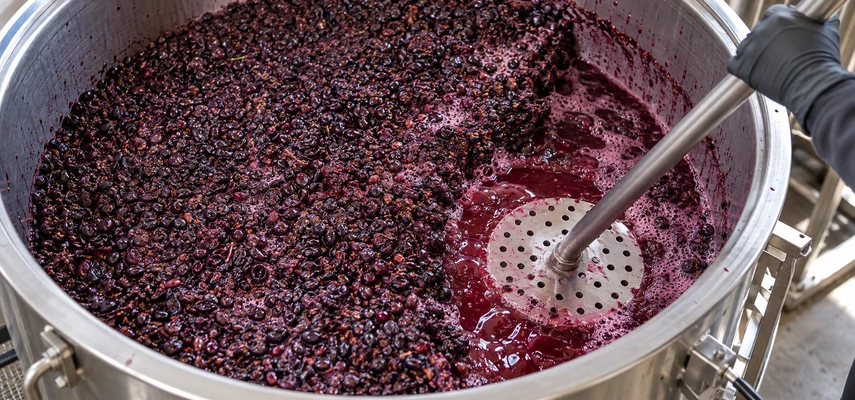

A red ferment contains both liquid and the grape solids that can change its character. The winemaker has to decide how much to extract, when to extract it and when to stop. Red winemaking is not simply white winemaking with darker grapes: keeping skins in the ferment creates another set of choices about colour, tannin, aroma and texture.
Article #6 · Part I: Wine Science, Viticulture, and Winemaking. This independent lesson follows Unit 1 LO1, criterion 3, in the 2022 Issue 2 WSET Level 3 specification. Explain fruit reception, destemming, crushing, pre- and post-fermentation extraction, cap management, whole-bunch methods, pressing and subsequent choices. Questions and indicative marking points are original TFE material, without WSET affiliation or endorsement.
Extraction starts with the fruit
Most black wine grapes carry much of their colour in the skins, while skins and seeds supply tannins. Stems can contribute tannin and other compounds if included. Extraction transfers compounds from solids into the liquid. Maceration is contact between juice or wine and grape solids; its result depends on the conditions, not just the number of days.
Variety, ripeness, berry condition and the proportion of skins to juice create different starting points. Pinot Noir, Cabernet Sauvignon and Gamay do not supply identical material. A technique that suits one lot can produce an unbalanced result in another. The intended style therefore guides extraction rather than an assumption that the darkest or most tannic wine must be the best.
Reception and sorting can remove unsuitable fruit or material, adding labour or equipment costs and reducing usable volume. Healthy, appropriately ripe grapes make some decisions easier, but neither a sorting table nor a prestigious origin guarantees quality. The useful mechanism is what enters the ferment and how its condition affects the available production choices.
Destemming and crushing are separate decisions
Destemming removes stalks. Crushing breaks berry skins and releases juice. The operations can be combined by equipment, yet remain distinct: destemmed berries may be left relatively intact, while whole bunches retain both berries and stems. Choosing among them changes the physical arrangement of the ferment as well as the compounds potentially extracted.
Removing stems can limit unwanted stem-derived characteristics in a particular lot. Keeping some bunches may alter aroma, texture and fermentation behaviour, but unsuitable stems can contribute unwanted green or astringent character. “Whole bunch” is not a guarantee of either delicacy or toughness. The proportion, fruit condition and management matter.
Crushed fruit exposes juice readily to yeast and makes conventional fermentation on skins possible. Gentle handling can avoid unnecessary damage to seeds, which could change extraction. Explain the intended result rather than asserting that every producer must crush every berry or remove every stem. Both decisions are adjustable parts of a wider method.
Cold soaking occurs before alcoholic fermentation
In pre-fermentation cold maceration, often called cold soaking, fruit and juice remain together at a temperature intended to delay fermentation. Some compounds can move into the aqueous juice before substantial alcohol is present. Cooling, hygiene and protection against unwanted microbial activity are therefore essential parts of the operation, not optional details.
The technique may be used to influence colour or aroma, but its effect is not identical across varieties and conditions. It also occupies tank capacity and requires cooling resources. Avoid the shorthand that cold soaking always extracts more stable colour or always creates softer wine. The producer must assess whether the chosen time and temperature achieve a useful result with that fruit.
The American Vineyard Foundation’s tannin-extraction research summary illustrates why cold soak and cap-management practices are investigated rather than assigned one universal sensory outcome. A technique’s name tells you what was attempted. Measurements and tasting establish what actually happened.
Fermentation changes the extraction environment
Yeast converts sugars into ethanol and carbon dioxide, releasing heat. In a conventional red ferment, this happens while juice remains with skins and seeds. The rising alcohol changes solvent conditions; temperature, contact and physical mixing also influence extraction. Colour and tannin do not necessarily accumulate at the same rate or remain unchanged once extracted.
Red fermentations are often warmer than those used for delicate aromatic whites, helping extraction and producing a different aroma profile. Excessive temperature can impair yeast and create uneven conditions in the tank. Cooling and monitoring help manage the ferment. Conversely, a temperature too low for the selected yeast and objective can slow progress rather than improve finesse.
As carbon dioxide rises, skins collect towards the surface in a floating cap. The cap can differ in temperature from the liquid below and needs management. A dry, neglected surface can create spoilage risks. Thus cap work is not only about extracting tannin: it can mix the ferment, distribute heat and manage the surface environment.
Pumping over and punching down
Pumping over, or remontage, draws liquid from lower in the tank and distributes it over the cap. Punching down, or pigeage, pushes cap material back into the liquid. Either can be performed with varying force, duration and frequency. Their effects depend on how they are used, so a method name alone cannot establish that extraction was gentle or aggressive.
AWRI’s cap-management explanation connects these operations with extraction, mixing, temperature and the stage of fermentation. Oxygen introduced during some operations can support yeast at suitable stages, while unwanted exposure at other times can be harmful. A thoughtful programme changes as the ferment develops instead of repeating a fixed schedule without observation.
| Decision | Main mechanism | Possible consequence |
|---|---|---|
| Pump liquid over the cap. | Renew contact and mix the ferment. | Changes extraction and heat distribution; intensity depends on operation. |
| Push cap into the liquid. | Submerge and break up floating solids. | Improves contact while requiring suitable handling and labour or equipment. |
| Increase extraction temperature within suitable limits. | Changes diffusion and extraction conditions. | Can increase phenolic extraction, with fermentation health still requiring control. |
| Reduce late-stage physical extraction. | Limit further interaction with solids when alcohol is higher. | May help avoid excessive extraction for a particular target style. |
In a written answer, specify the relevant operation and its purpose. “Pump-overs improve quality” is incomplete. Explain what is being mixed or extracted, then why that change could suit the fruit and intended wine. Additional work may add cost without improving quality if it extracts more than the wine can support.
Post-fermentation maceration is another choice
After most sugar has been consumed, wine may remain with skins and seeds for post-fermentation maceration. The extraction environment is now alcoholic, and tannin composition and perception can continue changing. The outcome depends on fruit, temperature, time and handling. Extended contact is not a reliable mathematical rule that each extra day makes a wine both better and more tannic.
The producer must manage temperature, microbial risks and exposure while tanks remain occupied. Extra tank time can limit capacity for other lots, adding an opportunity cost. Taste and analysis help determine when to separate the wine. Stopping earlier may suit an accessible, fruit-led style, while another lot may benefit from a longer considered programme.
Whole-bunch methods are not all the same
Carbonic maceration begins with intact grapes in an oxygen-excluding, carbon-dioxide-rich environment. Metabolism inside intact berries produces some alcohol and characteristic aroma changes without the ordinary initial action of yeast in free juice. This intracellular stage cannot be assumed to complete the whole fermentation. The fruit is subsequently processed and yeast fermentation completes the conversion of remaining sugars.
Semi-carbonic maceration combines processes. Some berries at the bottom break and release juice that ferments with yeast, generating carbon dioxide. Intact berries elsewhere experience intracellular changes. The Beaujolais wine board describes this arrangement in its regional method. That does not mean every Beaujolais producer uses an identical process or makes a short-lived wine.
Whole bunches with crushed fruit provide a further option. Ordinary yeast fermentation occurs in the liquid while intact berries may undergo some intracellular changes. Stems also interact with the ferment. AWRI distinguishes these whole-bunch approaches, which can influence fruit character and structure in different proportions.
Carbonic-related methods are associated with perfumed, fruit-led examples, including some Gamay wines, but they do not guarantee one aroma or a fixed quality level. Fruit character, tannin extraction, time before pressing and subsequent treatment still matter. Do not identify a method solely from one banana-like aroma, or confuse the initial intracellular process with a permanently yeast-free finished wine.
Pressing separates wine from the solids
At the chosen point, liquid can be drained as free-run wine, and the remaining solids are pressed. Press wine can differ in tannin and other composition. Keeping fractions separate creates options for blending: a suitable amount may add structure, while including too much could unbalance the target wine. Free-run is not automatically flawless, and press wine is not automatically waste.
In conventional red production, pressing usually follows alcoholic fermentation. In some whole-bunch programmes, pressing occurs while sugars remain, and the separated liquid finishes fermentation afterwards. This is why the answer must name the process rather than treat every red wine as having one rigid sequence. Fermentation and extraction can overlap in more than one arrangement.
Press selection also has a commercial consequence. Diverting a fraction can reduce the volume of the principal wine, while blending it back may increase that volume if it suits the target. The decision requires both sensory assessment and an understanding of the wine’s intended use. Maximising litres and maximising a particular quality objective are not always the same operation.
The red wine still needs finishing decisions
Most red wines undergo malolactic conversion, in which bacteria convert malic acid into lactic acid, reducing acidity and affecting style. The process is distinct from yeast’s alcoholic fermentation. Suitable management helps achieve the intended result; an acid change is not equivalent to adding oak flavour. The AWRI MLC fact sheet explains its wider sensory implications.
Maturation may occur in oak, inert vessels or a combination, with blending and later clarification and stabilisation decisions. New oak can contribute aromas and other effects, while older or larger vessels behave differently. Detailed maturation belongs to the next finishing lesson; here, remember that fermentation style is only one part of the finished wine’s character.
For comparison, imagine a producer seeking an early-drinking Gamay and another seeking a structured Cabernet Sauvignon blend. They may choose different extraction programmes because their fruit and aims differ. Explain those aims and mechanisms rather than assigning a universal “premium” technique. More heat, more oak, more tannin or more time cannot substitute for balance in the resulting wine.
Knowledge check: 10 original practice questions
1. What is maceration?
2. What is the floating cap in a red ferment mainly composed of?
3. What does pumping over do?
4. What distinguishes punching down?
5. Why is cold soak not a universal quality guarantee?
6. Which statement correctly describes the initial carbonic stage?
7. What supplies carbon dioxide in a typical semi-carbonic arrangement?
8. Why might a winemaker keep press wine separate?
9. What must be considered during post-fermentation maceration?
10. What is a sound way to assess a cap-management programme?
Answers and explanations
1. B — Contact. Maceration concerns liquid and solids remaining together. Extraction depends on the conditions of that contact rather than the word alone.
2. C — Floating solids. Carbon dioxide helps lift skins into the cap. Management can affect temperature, surface condition and extraction, not merely push liquid around.
3. A — Liquid over solids. The operation renews contact and mixes the ferment. Its precise intensity varies, so it does not guarantee one sensory outcome.
4. D — Solids into liquid. Punching down submerges cap material. It differs physically from taking liquid from below and distributing it over the surface.
5. B — Context and tradeoffs. Fruit, time and temperature influence the result. Cooling resources and microbial protection are needed, and a name alone does not prove quality.
6. C — Intracellular change. The initial phase differs from ordinary yeast fermentation in free juice. Subsequent yeast activity completes the wine’s fermentation.
7. A — Released juice ferments. Broken fruit provides juice for yeast, whose fermentation produces carbon dioxide around intact berries. Several processes can therefore coexist.
8. D — Composition and blending. Press wine may add useful structure or unbalance a blend. Keeping it separate preserves the option to assess proportions.
9. B — Managed contact. Alcoholic wine remains with solids, so extraction and condition continue to need assessment. Longer contact is not inherently an improvement.
10. C — Purpose and execution. The programme must suit the fruit and objective while maintaining a healthy ferment. More force or more repetitions alone cannot establish success.
Written exercise 1: manage the cap
Question: Explain how pumping over can influence a conventional red-wine fermentation. Give two distinct production objectives and explain why more frequent pump-overs are not automatically better. Suggested marks: 5. Learning outcome: Unit 1 LO1, criterion 3.
Indicative marking points: One point each for drawing liquid from below; distributing it over cap solids; explaining renewed contact and extraction; explaining mixing or heat distribution as a distinct objective; and explaining that excess or unsuitable extraction can unbalance the intended wine. Equivalent accurate points may be credited, capped at five.
Model answer: Pumping over takes liquid from lower in the tank and distributes it over the cap. This renews contact with skins and changes extraction of compounds such as colour and tannin. It also mixes the ferment and helps distribute heat. More frequent operations can increase handling and extraction beyond what a particular lot needs, so frequency should respond to fruit, fermentation stage and intended style.
Why it earns credit: The response describes the physical action before explaining two objectives and a limit. Common mistake: writing only that pump-overs improve quality, with no account of what they change.
Written exercise 2: distinguish whole-bunch processes
Question: Explain the initial difference between carbonic and semi-carbonic maceration. Explain why describing either as a process that never involves yeast is misleading. Suggested marks: 6. Learning outcome: Unit 1 LO1, criterion 3.
Indicative marking points: One point each for intact berries in carbonic maceration; an established oxygen-excluding carbon-dioxide environment; intracellular changes producing some alcohol; broken berries releasing juice in a semi-carbonic arrangement; yeast fermenting that juice and producing carbon dioxide; and subsequent yeast fermentation completing remaining sugar conversion rather than intracellular metabolism finishing everything.
Model answer: Carbonic maceration begins with intact berries in an established carbon-dioxide-rich, oxygen-excluding environment, allowing intracellular changes that produce some alcohol. In a semi-carbonic arrangement, some berries break and release juice that ferments with yeast, generating carbon dioxide around intact berries. Yeast therefore participates from the outset in that liquid, and ordinary yeast fermentation also completes remaining sugar conversion after the initial carbonic stage. Neither method means that the entire wine is made without yeast.
Why it earns credit: The answer separates the atmosphere, berry process and free-juice fermentation, then connects them to completion. Common mistake: calling every whole-bunch ferment pure carbonic maceration or assuming one process ends all fermentation inside an intact grape.
One-page revision summary
Extraction depends on fruit, liquid–solid contact, temperature, alcohol, time and physical handling. Pumping over moves liquid over cap solids; punching down moves solids into liquid. Cold soak, fermentation maceration and post-fermentation contact occur under different conditions. Distinguish carbonic, semi-carbonic and mixed whole-bunch approaches. Finally, assess press fractions, acid conversion and maturation as additional decisions rather than treating colour or tannin quantity as a quality verdict.












