










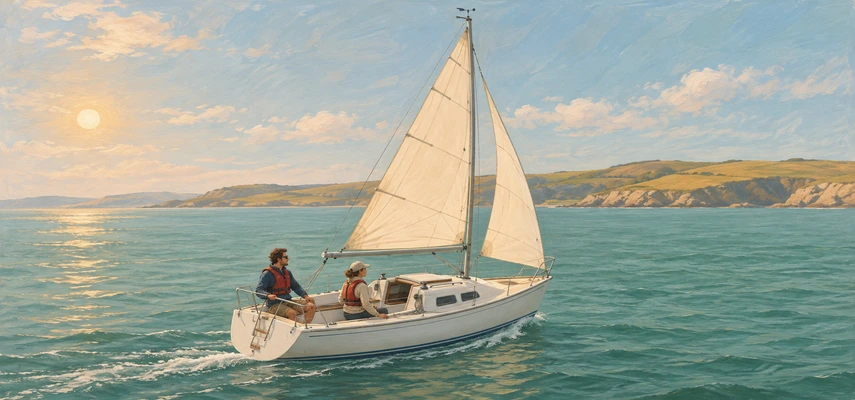

How can a sailboat travel toward a destination when the wind is blowing from that direction? Imagine your picnic spot is across a bay, directly upwind. A drifting beach ball won’t get there. A sailboat can, though its route will look more like a zigzag than a ruler line.
What is sailing? It’s the practical skill of using wind acting on sails to move and control a boat. The clever part happens above and below the water together: sails develop aerodynamic forces, while underwater surfaces help resist sideways motion. The result can be useful forward travel, even toward an upwind destination by an indirect route.
You don’t need equations to understand the central bargain. You do need to stop picturing the sail as nothing more than a bedsheet held out to catch a shove.
What is sailing doing differently from powered boating?
A motorboat usually obtains its driving force from an engine or electric motor turning a propeller. A sailing boat obtains its sailing drive from its sails interacting with moving air. Both still have to float, steer, avoid hazards and return their crew safely.
Many cruising sailboats also carry an auxiliary engine. That makes close harbor work and calm passages possible without pretending a breeze will appear on request. Having an engine aboard doesn’t make the sails decorative; the crew chooses the appropriate means of propulsion for the situation.
Under sail, your available routes depend on the wind’s direction and strength as well as the boat. Pointing the bow at a destination isn’t enough. You have to ask whether the sails can produce useful drive on that heading, whether there’s room to maneuver and what the water is doing underneath you.
That’s the appeal for some people: a journey becomes a conversation with the conditions. The wind gets a vote. It doesn’t get the entire ballot.
Sails make a force, not a promise to go straight
Hold a hand sideways in moving air and change its angle: the force changes. A sail is a much more effective, adjustable surface, but the useful starting idea is similar. Its shape and orientation change how air flows around it.
Airflow around a working sail produces a pressure distribution and an overall aerodynamic force. Lift is the component perpendicular to the approaching airflow; drag acts along it. Here, “lift” doesn’t mean the boat must rise out of the water. It describes a direction relative to the flow. NASA’s explanation of lift connects that force to airflow being turned, rather than a mysterious attraction.
The combined aerodynamic force can include both a forward component and a sideways component. Imagine an arrow drawn diagonally across the deck: part of its direction points toward the bow, and part points over the side. We can describe those effects separately even though the sail experiences one combined force.
Sailors adjust sails using control lines, including sheets. Changing a sail’s angle or shape is called trimming. Trim is about arranging the sail to work with the airflow, rather than simply pulling every rope as tight as possible. The detailed controls come later in this guide.
Sailing downwind can use substantial drag as well as lift. Across the wind and toward it at a workable angle, lift becomes central to the explanation. There isn’t one sail setting that works for every heading. Discover Boating’s sail overview provides a useful introduction to that distinction.
The underwater half of the bargain
If sails produce sideways force, why doesn’t the whole boat just slide away? It does slip sideways somewhat. Sailors call that leeway. The important point is that a suitable underwater shape limits this motion while allowing useful forward travel.
A keel is a structure extending beneath the hull. Many sailing keels are shaped to develop a sideways hydrodynamic force as the boat moves through water with a small amount of leeway. Some smaller boats instead use a centerboard, a retractable underwater foil. These surfaces help oppose the sideways sail force; they aren’t underground rails locking the boat onto a track.
As the boat settles into steady sailing, the sideways forces approximately balance. The forward component of the sail force works against resistance from air and water. Accelerating, turning and pitching through waves complicate the picture, but the steady case explains why the boat can make useful progress.
The keel doesn’t manufacture free forward energy. Its contribution is to the balance of forces that makes the sail’s drive useful. Physicist Bryon D. Anderson’s sailing analysis in Physics Today describes both the need for some leeway and the opposing forces from sails and keel.
A useful mental picture is a boat negotiating with two moving surroundings. The sail engages the air; the underwater surfaces engage the water. Leave either half out and the explanation starts drifting.
Meet the boat without learning a dictionary
The hull is the floating body. Its forward end is the bow; the rear is the stern. It supports the crew and equipment while its shape influences resistance, space and how the boat behaves in waves.
The mast supports the sails and their associated rigging. On a common modern sloop, the mainsail sits behind the mast and a headsail sits forward. A horizontal boom supports the mainsail’s foot on many such boats. Different rigs arrange sails differently, so this is a familiar example rather than the only valid sailboat.
The rudder is the movable underwater steering surface. A tiller or wheel lets the person steering change its angle. Water moving past the rudder produces a force that turns the boat; it isn’t a car’s front axle transplanted into a marina. Steering depends on conditions and water flow, which matters particularly at low speed.
These parts belong to a system. A large rudder movement can’t rescue every poor course choice, and a well-shaped sail can’t erase a shoal ahead. American Sailing’s introductory keelboat standards treat boat parts, terminology, sail handling, navigation responsibilities and demonstrated skills together for good reason.
How sailing toward the wind actually works
Return to the picnic spot. Suppose the wind comes from the north and your destination lies north of you. For an ordinary sailboat under sail, aiming directly north puts the sails into an unworkable position for sustained forward drive. Sailors describe the headings too close to the wind as a no-go zone.
Instead, the boat sails diagonally toward the destination: first on one side of the wind, then on the other. Tacking means turning the bow through the wind to change between those sides. Each useful diagonal leg gains some distance toward the upwind destination.
Think of crossing a steep hillside along switchbacks. You take a longer route because the direct route isn’t workable. The analogy describes the route, though a boat’s propulsion comes from fluid forces rather than shoe grip.
There isn’t a universal angle at which every sailboat can sail upwind. Boat design, sails, wind, waves and crew handling all matter. A diagram with two neat equal legs also leaves out current, leeway, obstacles and the space needed for the turn.
This is an explanation of why tacking works, not a maneuver checklist. On board, the turn involves lookout, communication, sail handling and moving people safely. An instructor will connect the idea to the actual boat before asking you to do it.
The wind you feel isn’t the whole weather report
Stand still on a quiet day, then cycle forward: you feel air coming toward you even without a fresh breeze. A moving boat similarly experiences apparent wind, the airflow relative to itself. That can differ from the wind measured relative to the water.
For now, the useful consequence is simple: as a boat changes speed or direction, the airflow its sails encounter changes too. Sail settings and steering decisions have to respond. The later apparent-wind lesson will unpack that relationship without asking this introduction to become a vector workshop.
Water moves too. A current can carry the boat sideways or help or hinder its progress over the ground. Pointing toward an object, moving through water toward it and actually approaching it over the seabed are related but different things. That’s why sailing eventually leads naturally to navigation.
Why people keep coming back
Sailing can mean an afternoon on a nearby lake, a friendly race around marks or a coastal trip with lunch aboard. The common thread is participation: noticing a change, making a choice and feeling the boat respond.
Imagine a supervised first lesson on sheltered water. You watch the sail flutter, feel it settle after an adjustment and notice the wake become more purposeful. That small connection between observation and response can be satisfying long before you know the names of every fitting.
Different boats offer different experiences. A small dinghy makes crew movement immediately noticeable; a cruising yacht offers another scale of space and responsibility. Neither experience has to become an ocean crossing to count. The best early objective is a suitable, enjoyable session with competent support.
Understanding comes ashore; skill develops afloat
A good explanation helps you recognize what’s happening. It doesn’t supply practiced judgment, a safe recovery maneuver or familiarity with an unfamiliar boat. Reading the word “tack” is considerably easier than coordinating one while watching traffic.
Choose qualified on-water instruction and supervised practice appropriate to the craft and conditions. The RYA’s Start Yachting course is one example of an introductory course taught afloat; its subjects include boat handling, safety and weather. It’s an example of a learning route, not a claim that one certificate grants permission everywhere.
For a first outing, wear a properly fitted lifejacket or buoyancy aid appropriate to the activity, and have the instructor check it. The RNLI’s beginner guidance stresses wearing suitable flotation and building skills before independent sailing. Equipment helps manage risk; it doesn’t make the water harmless.
Ask for a briefing on where to sit, the boom’s movement, loaded lines and what to do when instructions are unclear. The skipper must consider current forecasts, local requirements, equipment and everyone’s capability. Changing or canceling the plan is part of seamanship. A written guide cannot establish that you’re ready to skipper independently.
Where the next 99 articles take you
The rest of this guide builds outward from this partnership of wind, boat and water. First come sailing styles, getting started, useful language and the first trip aboard. Boat anatomy and sailing science then give the practical lessons a foundation.
You’ll meet sail trim and maneuvers, knots and deck hardware, docking and anchoring, safety and collision rules. Navigation, electronics, weather, tides and passage planning explain how a pleasant departure becomes a well-considered journey. Later chapters explore cruising life, boat systems, offshore preparation, racing, design, chartering, ownership and sailing culture.
For your next supervised outing, carry one question: what are the air and water asking the boat to do? Watch how a change in heading alters the sails, and how the boat responds. The upwind picnic spot is no longer a contradiction. It’s a destination that calls for a better route.










