










History of Ford
This article is a concise History of Ford Motor Company, tracing Henry Ford’s Model T, the moving assembly line and other major milestones through the company’s ongoing shift to electrification.
Key milestones
- 1899 — Henry Ford’s Detroit Automobile Company (unsuccessful early venture)
- 1901 — Henry Ford Company (early predecessor)
- June 16, 1903 — Ford Motor Company incorporated; first Model A sold in July 1903
- 1908 — Model T introduced
- 1913 — Continuously moving assembly line introduced at Highland Park
- 1914 — $5-per-day wage policy introduced
- 1922 — Lincoln Motor Company acquired
- 1937 — “Battle of the Overpass” with UAW organizers
- 1938 — Mercury brand launched
- 1941 — Ford recognizes the UAW after strikes and pressure
- 1945 — Henry Ford II assumes leadership and begins reorganization
- 1947 — Death of Henry Ford
- 1948 — F-Series introduced
- 1949 — “Shoebox” Ford modernizes the lineup
- 1964 — Mustang introduced
- 1967 — Ford of Europe formed (British and German subsidiaries consolidated)
- 1970s — Pinto controversy and rising emissions/safety regulations
- 1989 — Jaguar acquired
- 1999 — Volvo Cars acquired
- 2000 — Land Rover acquired from BMW
- 2006 — Alan Mulally hired and “One Ford” plan launched
- 2008 — Ford does not receive assistance under Treasury’s TARP Automotive Industry Financing Program; Jaguar and Land Rover sold to Tata Motors
- 2010 — Volvo Cars sold to Geely
- 2014 — Alan Mulally steps down; Mark Fields succeeds him
- 2017 — Leadership change: Mark Fields replaced by Jim Hackett; Ford commits $1 billion to Argo AI and becomes its majority stakeholder
- October 2020 — Jim Farley becomes CEO
- November 2019–December 2020 — 2021 Mustang Mach-E unveiled; production and first U.S. deliveries begin
- 2020–2021 — Global pandemic drives semiconductor shortages and supply-chain disruption
- April–May 2022 — F-150 Lightning full production begins at the Rouge Electric Vehicle Center and the first retail customer delivery is reported; Argo AI begins winding down later that year
- 2023 — Coordinated UAW strikes; tentative Ford agreement announced October 25 and ratified November 20
How a farm-boy’s insistence on an affordable car remade industry
Henry Ford set out with a deceptively simple idea: the automobile should not be an expensive toy for the rich but an affordable tool for ordinary people. That idea—lowering the cost of the car while improving its reliability—became the organizing principle of Ford Motor Company and reshaped manufacturing, labor relations and American life.
From a small Detroit workshop in 1903, Ford grew into a global automaker whose innovations—the Model T, the moving assembly line, and high-volume truck platforms—reverberated through twentieth-century industry and continue to shape the company’s transition to electrified transport in the twenty-first century.
Origins and founding: Detroit, partners, and the first Model A
Ford Motor Company was founded in Detroit in June 1903. Henry Ford had earlier experimented with automobiles and small manufacturing ventures: the unsuccessful Detroit Automobile Company (1899) and the Henry Ford Company (1901), ventures that taught him both engineering and the hazards of entwining capital with controlling partners.
In 1903 a group of local investors—including Alexander Y. Malcomson, John S. Gray and Horace Rackham—backed a new venture that bore Henry Ford’s name and engineering drive. The company’s first product, also called the Model A, reached customers in 1903. It was a modest, functional runabout but it established Ford’s combination of practical engineering, hands-on experimentation and close ties to Detroit-area suppliers. From the outset Ford’s backers expected profitability, but Henry Ford kept revising designs and processes until he found a formula that combined cost control with mass appeal.
Highland Park, the Model T and the assembly-line breakthrough
Ford’s defining early turning point came in 1908 with the Model T, and the process innovations that followed. The Model T, introduced that year, was explicitly engineered for simplicity, ruggedness and low cost. Sales were steady, but it was Ford’s rethinking of production that turned the car into a commodity.
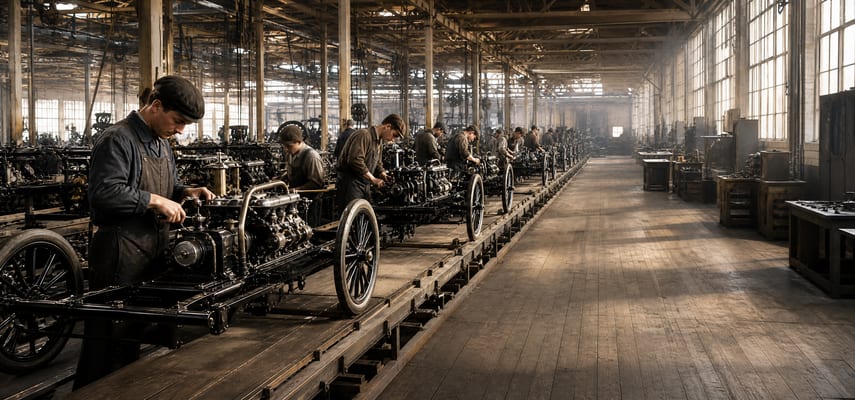
At the Highland Park plant, Ford and his engineers iteratively restructured tasks and workflows to cut time and cost. By October 1913 they had introduced the continuously moving chassis assembly line—moving the work to the car rather than the car to the work. The line sharply reduced assembly time and helped Ford lower the Model T’s price as production scaled. The Model T became the vehicle that put millions of Americans on the road.
Two decisions reinforced each other. First, the moving line reduced unit cost, making the car attainable for more buyers. Second, in 1914 Ford introduced a $5 eight-hour day for qualifying workers, more than double the previous daily rate; the policy sharply improved retention and stabilized the workforce. The company’s economic model—high volume, tight cost control, and steady demand—became a template for modern manufacturing.
Mass production, wartime output and labor struggles
Mass production made Ford a national institution, but it also created political and social friction. Henry Ford’s management style grew increasingly autocratic; he resisted unionization and centralized decision-making. The “Battle of the Overpass” in 1937—when Ford security clashed with United Auto Workers organizers—became a public symbol of that resistance. The company finally recognized the UAW in 1941 after strikes and political pressure; that recognition changed Ford’s industrial relations and introduced collective bargaining that would shape costs and productivity for decades.
Ford’s scale also made it a wartime industrial power. During World War II, the company shifted civilian production to military output. Designed by industrial architect Albert Kahn for Ford’s mass production of Consolidated Aircraft’s B-24 Liberator, the Willow Run plant in Michigan began producing parts in October 1941, and its first complete B-24s came off the line in September 1942. The plant reached a production rate of one bomber per hour in March 1944 and built 8,685 Liberators before manufacturing ended on June 28, 1945. Willow Run exemplified Ford’s ability to apply automobile-style throughput to aircraft manufacturing. That wartime mobilization deepened the company’s technical and managerial capacity, while also tying Ford firmly to national industrial policy.
Brand architecture: Lincoln, Mercury and the truck business
As Ford matured, it diversified its product portfolio to cover distinct customer segments. Ford acquired the Lincoln Motor Company in 1922 to gain an entry into the luxury market and later launched Mercury in 1938 as an intermediate brand between Ford and Lincoln. Those moves helped Ford compete across price points without diluting the core Ford-badged volume business.
Equally important was Ford’s sustained emphasis on trucks. The F-Series, introduced in 1948, evolved into a family of light- and heavy-duty pickups that would become the company’s most profitable and enduring product line. Trucks proved more resilient through economic cycles and provided Ford with a steady source of margin and market identity, especially in North America.
Post‑war disruption and the Henry Ford II turnaround
The postwar era tested Ford’s governance. Henry Ford’s elder generation remained deeply involved until his death in 1947. Henry Ford II, who returned from Navy service, took the helm in 1945 after a turbulent period marked by internal feuding and managerial sclerosis. The younger Ford carried out a sweeping management purge, removed or neutralized the old guard, and reorganized the company’s executive structure to modern standards.
Henry Ford II’s first major product success was the 1949 “shoebox” Ford, a cleanly styled, fully modern replacement for prewar designs that revived sales and modernized manufacturing. His leadership reversed Ford’s drift and set the company on a path of renewed competitiveness in the 1950s and 1960s.
The 1960s and 1970s: the Mustang, global consolidation and regulatory pressures
In 1964 Ford changed the market with the Mustang. Introduced as a sporty, affordable two-door coupe, the Mustang created the “pony car” segment and generated massive publicity and brisk sales. It demonstrated Ford’s ability to create demand through product image and tapped new buyers into the brand.
Internationally, Ford consolidated its European operations. In 1967 the company merged its British and German subsidiaries to form Ford of Europe, aligning product development and platform strategies across markets. That consolidation allowed Ford to rationalize costs and offer models tailored to local tastes while sharing engineering resources across borders.
At the same time, regulators and consumers forced automakers into new modes of engineering. Emissions standards, safety regulations and fuel-economy concerns reshaped vehicle design in the 1970s and 1980s. Ford responded with engineering changes, lighter materials, and modifications across its lineup, but these regulatory shifts also increased costs and compressed margins industry-wide.
Late‑twentieth-century reshaping: acquisitions and divestitures
From the 1980s onward, Ford pursued a strategy of expanding its footprint through acquisitions in search of global scale and luxury-market credibility. These moves placed a collection of European luxury marques under Ford’s Premier Automotive Group:
- In December 1989 Ford acquired Jaguar Cars plc following a successful offer to its shareholders.
- In 1999 it bought Volvo Cars from AB Volvo.
- In 2000 Ford expanded its portfolio with Land Rover, purchased from BMW.
The acquisitions brought design cachet and technology—but not steady profits. The integration challenges, brand positioning difficulties and cyclical downturns exposed the limits of acquiring prestige marques as a guaranteed route to profit. Ford ultimately reversed course: in 2008 it sold Jaguar and Land Rover to Tata Motors, and in 2010 it divested Volvo Cars to Geely. Those disposals marked a re-concentration on core Ford and Lincoln products and on global platform efficiency.
Pinto, Firestone, and the costs of design failures
Ford’s history also contains prominent safety controversies that tested its reputation. The Ford Pinto, produced in the 1970s, became a flashpoint after investigators and journalists highlighted the car’s vulnerability to fuel-tank fires in rear-end collisions. The controversy involved recalls, litigation and intense public scrutiny; it led automakers—including Ford—to change crashworthiness priorities and safer design standards.
Another major safety episode came in 2000, when a wave of tire failures on the Ford Explorer equipped with Firestone tires led to a large-scale recall and a prolonged public dispute between Ford and Bridgestone/Firestone. The episode damaged sales in key segments and underscored the reputational and financial risk of supplier defects. Both episodes forced Ford to tighten design review, supplier oversight and crisis communications.
The One Ford turnaround and Alan Mulally’s restructuring
By the early 2000s Ford faced sagging market share, fragmented global models and heavy pension and legacy costs. In 2006 Ford hired Alan Mulally, a former Boeing executive, as chief executive. Mulally launched the “One Ford” plan: global platform consolidation, fewer nameplates, sharper product discipline, and centralized decision-making.
He also secured significant liquidity by mortgaging assets and drawing a large credit line in 2006, a controversial but prescient move that improved Ford’s balance-sheet flexibility. When the global financial crisis struck in 2008, Ford’s liquidity and rapid product rationalization under Mulally proved decisive. Unlike General Motors and Chrysler, Ford did not receive assistance under Treasury’s TARP Automotive Industry Financing Program. This does not mean that Ford received no government-supported financing: Ford Credit used Federal Reserve liquidity programs during the crisis, and Ford obtained a $5.9 billion Department of Energy advanced-vehicle loan in September 2009. The privately arranged credit line and reorganization gave Ford time to refocus on product quality and global coordination.
Leadership transitions in the 2010s and a strategic pivot
Alan Mulally stepped down in 2014 and was succeeded by Mark Fields, who emphasized growth in China and expansion of mobility services. Fields was replaced in 2017 by Jim Hackett, who sought to accelerate Ford’s transformation into a mobility and technology company while stabilizing vehicle operations. In October 2020 Jim Farley became CEO. Farley inherited a company already repositioning for electrification but still dependent on profitable trucks and SUVs for near-term cash flow.
These leadership changes reflected a persistent tension inside Ford: how to allocate capital between durable, high-margin legacy products (trucks and SUVs) and long-term investments in electrification, connectivity and autonomy. Management changes often tracked a recalibration of those bets.
Electrification, connectivity, and the new product slate
In the 2010s and early 2020s Ford moved decisively to embrace electrification. The company unveiled the Mustang Mach-E on November 17, 2019, as a 2021-model-year electric crossover. Production began at Ford’s Cuautitlán plant in Mexico on November 4, 2020, and the first U.S. customer deliveries were recorded as sales in December 2020; European deliveries followed in early 2021. Ford began full production of the F-150 Lightning on April 26, 2022, at the Rouge Electric Vehicle Center in Dearborn, Michigan. The first retail customer delivery was reported on May 26, 2022, and Ford recorded its first customer sales at the end of May. These products signaled a major shift: Ford aimed to adapt its best-known nameplates to an electric future rather than cede them to new entrants.
At the same time, Ford invested in software, connected-vehicle services and mobility partnerships. On February 10, 2017, Ford announced a $1 billion, five-year investment commitment in Argo AI and became the autonomous-driving startup’s majority stakeholder. After a transaction with Volkswagen completed on June 1, 2020, Ford and Volkswagen each held 41% of Argo AI, with the remaining interests held by employees, founders and Lyft. On October 26, 2022, Ford announced that Argo AI planned to wind down; Ford and Volkswagen exited their joint development of Level 4 autonomous-driving technology through Argo, and Ford shifted its emphasis toward internally developed Level 2 and Level 3 driver-assistance systems.
Recent pressures: the UAW strike and supply-chain shocks
Ford’s recent era has been shaped as much by industrial and macroeconomic forces as by product strategy. The global pandemic produced supply‑chain bottlenecks—especially semiconductor shortages—that disrupted production in 2020–2021 and forced model-specific shortages. Labor relations resurfaced as a major factor in 2023, when the UAW launched coordinated strikes across Detroit automakers. On October 25, 2023, UAW negotiators announced a tentative agreement with Ford; the contract was ratified by union members on November 20. The four-and-a-half-year agreement runs through April 30, 2028. According to the UAW’s official Ford contract summary, its principal terms include 25% general wage increases, restored cost-of-living adjustments, a three-year progression to the top wage rate, a $5,000 ratification bonus, an enhanced profit-sharing formula and job-security provisions covering plant closures and parts of Ford’s EV transition. The settlement highlighted the continuing importance of organized labor to costs, scheduling and plant flexibility as the industry transitions to electric architectures.
How Ford finances and family control shaped its path
Since Ford became a publicly traded company in 1956, it has maintained two classes of voting stock. Publicly traded common stock carries one vote per share and collectively holds 60% of the general voting power. Class B Stock, held by members of the Ford family and related trusts, carries an annually adjusted number of votes per share and collectively holds the remaining 40%. For Ford’s 2026 annual meeting, each Class B share carried 37.075 votes, and 99.9% of the outstanding Class B shares were held in a family voting trust as of February 1, 2026. The structure gives the Ford family considerable influence over matters requiring shareholder approval.
Family influence has been both a stabilizer and a source of internal governance complexity.
Legacy: what Ford changed and what it left behind
Ford’s most enduring contribution is not a single car but a set of production and managerial practices. The moving assembly line and the discipline of mass production reshaped industrial capacity beyond automobiles—steel, chemicals, consumer goods—and made affordable personal transport a mass phenomenon. The $5 day and later labor agreements helped create an American middle class that could buy the products its own factories produced.
On the product side, the Model T established the economic idea that volume could substitute for margin; the F-Series proved that a reliable truck platform could anchor profitability for decades; and the Mustang showed how product image and segmentation could create new categories. Conversely, Ford’s missteps—the Pinto safety problems, supply‑chain vulnerabilities and misread luxury acquisitions in the 1990s—are reminders that scale and engineering excellence do not immunize a company against governance, design or integration failures.
Where Ford stands now: reconciling legacy with transformation
By the mid-2020s Ford is a company still defined by its past yet actively remaking itself for a different future. Its current commercial reality remains anchored in profitable trucks and SUVs in North America, a global manufacturing footprint, and a continuing stake in retail finance and after-sales services. Simultaneously, Ford has committed significant engineering and marketing resources to electric vehicles, to bringing its marquee nameplates into the EV era, and to software-driven services that could differentiate vehicles over their lifetimes.
That duality—preserving cash-generating legacy vehicles while investing in a risky, capital-intensive EV and software transition—captures the central tension in Ford’s modern history. Family control, manufacturing scale and brand strength give Ford important advantages. But the company must also navigate supply-chain volatility, rising labor expectations, regulatory shifts and fierce new competitors in EVs and software.
Conclusion: from cheap runabouts to electrified icon
Ford began as an experiment in making cars affordable and grew into an industrial system that remade production worldwide. The Model T and the moving assembly line created Ford’s early greatness; strategic decisions in the mid-twentieth century—acquiring Lincoln, building a dominant truck franchise, modernizing management—kept the company central to global auto markets. Late‑century experiments with luxury brands exposed the limits of scale without integration, while the One Ford era and Alan Mulally’s liquidity moves demonstrated the value of clear managerial focus.
Today, Ford’s story is once again one of practical reinvention. The company is adapting its most powerful assets—its icon nameplates, global production footprint and deep dealer and service network—to a world where electric powertrains, software and changing consumer expectations determine winners. That transition will test the same capabilities that made Ford an industrial exemplar: disciplined engineering, manufacturing scale, and the ability to align labor, capital and product strategy behind a clear idea of what a car should be for people.











