










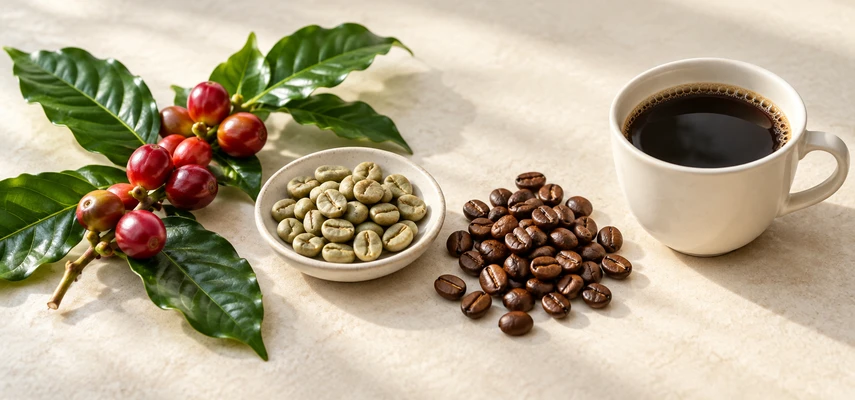
Open a bag of coffee and take a breath. That familiar roasted smell gives away very little about where the beans began: tucked inside a fruit on a tropical plant. Your morning cup has had quite a journey before you’ve even found a clean mug.
That journey explains a lot, including why one coffee reminds you of chocolate while another seems almost fruity. It also makes the drink more interesting than the caffeine delivery system we sometimes ask it to be. You don’t need an expensive machine or a vocabulary full of tasting notes to get started. A little curiosity will do.
What is coffee, exactly?
At its simplest, coffee is what happens when water draws flavor and other substances out of roasted, ground coffee seeds. Yes, seeds. We call them beans, but botanically they’re something else. The plants belong to the genus Coffea, in the Rubiaceae family. You can safely enjoy your next cup without memorizing either name.
The fruit is called a coffee cherry, thanks to its appearance. Open one and you’ll usually find two seeds nestled together, flat sides facing inward. Occasionally there’s just one rounded seed, called a peaberry. Once the fruit is removed and the seeds are prepared, you have green coffee: the unroasted starting material for a roaster.
So when someone talks about coffee, they might mean a plant, a bag of beans, or the drink you’re trying not to spill. All three belong to the same story.
Where coffee comes from
Coffee’s story begins in Africa, with Arabica rooted especially in Ethiopia’s forests. You may have heard about Kaldi, the goatherd whose animals supposedly became unusually energetic after eating coffee cherries. It’s a memorable origin story. It’s also a legend, so the goats shouldn’t get sole credit for your morning routine.
The firmer historical trail leads across the Red Sea to Yemen, where coffee was being grown by the fifteenth century. From there, coffee drinking spread through the Middle East and eventually into Europe. Coffeehouses offered somewhere to hear the news, meet friends, and talk business. The appeal of a good drink and somewhere to linger clearly travels well.
Coffee farming spread through trade and colonial networks, too, with consequences far beyond the cafe. Plantation labor, slavery, and unequal power are part of that history, as the Fire and Freedom exhibition explains. Appreciating coffee means making room for that harder history alongside the stories of hospitality and invention.
Arabica and Robusta: two names to recognize
Spend a few minutes reading coffee bags and you’ll meet Arabica and Robusta. These names tell you about the plant. Most commercial coffee comes from Coffea arabica or Coffea canephora, the species widely sold as Robusta. Neither name tells you how dark the beans were roasted or how you should brew them.
Arabica often brings aromatic complexity and noticeable acidity, the brightness you might associate with fruit. Robusta commonly has more caffeine and a firmer, more bitter flavor profile. But a species name can’t do all the work of describing a coffee. Farming, processing, roasting, and brewing have plenty to say about the result.
There are also different varieties within these species, which helps explain why two Arabica coffees can be quite different. For now, think of the species as a broad category and the variety as a more specific plant selection. The detailed family tree can wait.
When you’re choosing a bag, treat the species as a clue. An Arabica label isn’t a complete quality guarantee, and Robusta deserves more than an automatic dismissal.
How coffee grows
Picture a coffee farm. Perhaps you’re imagining a misty hillside, but coffee doesn’t grow in just one kind of landscape. It’s largely a tropical crop, with temperature, rainfall, elevation, soil, and plant type shaping where it thrives. A cool highland farm and a warm lowland farm present different jobs for the grower.
Those jobs include feeding plants, managing weeds, watching for pests and disease, and waiting for cherries to ripen. Coffee plants stay in the ground across multiple harvests, so growers are looking after years of production. There’s a lot more to the work than picking a few red fruits.
Harvesting varies, too. Some growers pick ripe cherries selectively by hand; others strip fruit from branches or use machines where the land and farm layout allow. Following coffee from planting through harvest is a useful reminder: by the time a roaster receives the seeds, someone else has already done a great deal of work.
From fruit to roasted beans
Processing removes the fruit
Before those seeds can travel, producers have to deal with the fruit around them. You’ll see names for this step on coffee bags. With natural processing, the cherries dry with the fruit still around the seeds. With washed processing, much of the fruit comes off before drying, often with fermentation and washing helping remove the sticky layer around the seeds.
Then there’s honey processing, which leaves some of that sticky layer, called mucilage, on during drying. No honey is added, despite the inviting name. These processing methods vary from farm to farm, so the labels give you a broad picture rather than an exact recipe.
Processing helps shape flavor, but it doesn’t make every natural coffee fruity or every washed coffee delicate. The quality of the cherries and care taken during drying still count.
Roasting develops familiar coffee aromas
Green coffee doesn’t have that familiar just-opened-the-bag aroma. Roasting is where much of it develops. Heat changes the seeds’ color, structure, and chemistry, and the roaster’s choices about time and heat help determine what you’ll smell and taste.
You’ve probably already met light, medium, and dark roasts. Darker roasting generally brings roasted and bitter flavors forward; lighter roasting can leave more room for fruit-like aromas and acidity. The boundaries vary between sellers, and your favorite roast is something you get to discover by drinking it.
One useful surprise: a darker-looking bean doesn’t tell you exactly how much caffeine your cup will contain. Your dose and brewing method matter, too.
How water turns grounds into a drink
Drop whole roasted beans into water and you’re giving it a harder job. Grinding exposes much more surface for water to work on. As you brew, soluble material moves from the grounds into the liquid, along with varying amounts of oils and fine particles. That transfer is extraction, a technical word for something your coffee maker handles every morning.
In drip brewing, water passes through a bed of grounds and a filter. A French press instead holds grounds in water before a mesh plunger separates much of the solid material. Paper-filtered coffee often feels cleaner in texture; mesh-filtered preparations commonly retain more oils and fine particles.
Espresso brings pressure into the picture, pushing water through a compact bed of finely ground coffee. It’s a brewing method, so there isn’t a separate espresso species growing somewhere. That little serving is concentrated, making it useful on its own or as the foundation for a drink with milk or added water. A larger drip coffee gets there by a different route.
You don’t have to choose a camp. Enjoying a gentle filter coffee at breakfast and a milk drink later gives you two good places to start exploring.
Why coffees taste different
If you’ve ever enjoyed a coffee in a cafe and struggled to recreate it at home, you’ve already encountered the puzzle. Flavor comes from the plant and growing conditions, then keeps changing through processing, roasting, storage, and brewing. The bag gives you the ingredients; preparation helps decide what happens next.
Even the same beans can make noticeably different cups. Use more grounds relative to water and you’ll usually get a stronger drink. Change the grind or contact time and you also change how much material the water extracts. Strength means concentration; extraction means how much you’ve taken from the grounds. Brewing research shows how these changes influence flavor, and how much people’s preferences differ. There’s room for your taste here.
And those mentions of citrus, chocolate, or flowers on a bag? They usually describe what the coffee reminds a taster of. Nobody necessarily put orange peel in the roaster. Explicitly flavored coffees are a separate case. Country names offer clues, too, but two coffees from the same country can taste surprisingly different.
Why coffee matters beyond the cup
Sometimes coffee is five quiet minutes before the day starts. Sometimes it’s the excuse for a conversation that runs an hour. Across different cultures, it can mean hospitality, a daily pause, or a place to gather. The drink is only part of what people come for.
For millions of farming families, coffee also means a livelihood. Its economic importance reaches through rural communities, employment, and export trade. By the time you pay for a cup, farming, milling, transport, roasting, distribution, and service have all contributed to its price.
That price alone won’t tell you what the grower earned. It’s worth being curious about the people behind the beans as well as the person pouring your drink. A farm or origin name on the bag can open the conversation, even if it can’t tell the whole story.
A sensible introduction to caffeine
Coffee naturally contains caffeine, a stimulant. The amount in a drink varies with the coffee, dose, preparation, and serving size. A small espresso is concentrated, but a larger brewed coffee can contain more caffeine in total.
The FDA’s caffeine guidance cites 400 milligrams per day as an amount generally not associated with negative effects for most adults. This is not a target or a guarantee for every person. Sensitivity, medications, and health conditions can change what is appropriate.
Caffeine can disturb sleep and cause effects such as jitters or a racing heart. People who are pregnant, trying to become pregnant, or breastfeeding should discuss limits with a healthcare professional. Decaf contains much less caffeine but is not necessarily caffeine-free. Count caffeine from other sources too, and let your own response guide a cautious approach.
Start with curiosity, one cup at a time
Begin with a coffee you already drink. Notice its aroma, how heavy or light it feels, and whether it seems pleasantly bright, distinctly bitter, or comfortably balanced. Let it cool enough to taste safely and observe whether your impression changes. Ordinary words are enough.
Next time, change one thing. Try the same coffee with a different amount of water, or compare two coffees prepared the same way. Jot down what you liked. You don’t need a tasting notebook worthy of a laboratory; “smoother than yesterday” is a perfectly useful observation.
You can follow this subject all the way into botany, chemistry, history, or the engineering of an espresso machine. For now, start with what’s in your cup. Knowing that it began as fruit, passed through many hands, and can taste different with a small change gives you plenty to explore tomorrow morning.










