










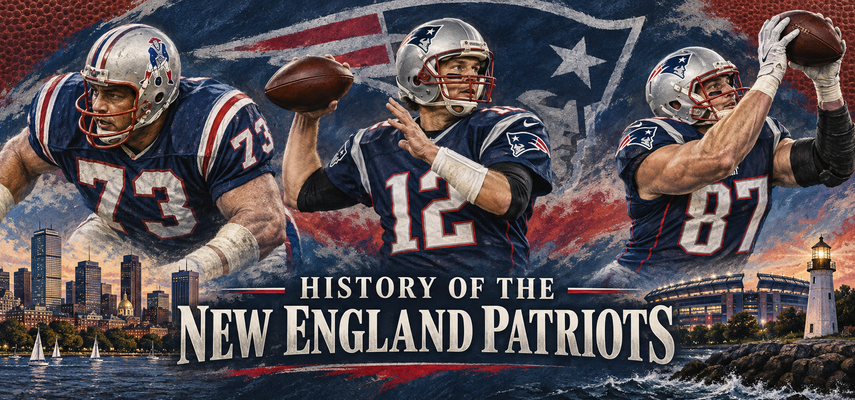

The New England Patriots grew from an unsettled Boston AFL franchise into one of professional football’s defining championship organizations. Their early history included changing venues, financial uncertainty and occasional contention before Robert Kraft’s ownership supplied a more durable foundation. Bill Belichick and Tom Brady then led six Super Bowl-winning teams across two decades, with different supporting casts sustaining the run. That success also brought intense scrutiny and consequential league sanctions. This history follows the franchise through its Boston beginnings, the move to Foxborough, the championship eras and the later return to the Super Bowl under Mike Vrabel and Drake Maye.
Franchise at a glance
| Field | Details |
|---|---|
| Founded | 1959; AFL franchise awarded to Billy Sullivan |
| First season | 1960, American Football League |
| Original city and name | Boston, Massachusetts — Boston Patriots |
| Current city and name | New England Patriots; home games in Foxborough, Massachusetts |
| Previous cities and names | Boston Patriots (1960–1970); New England Patriots (1971–present) |
| League and conference/division | NFL — American Football Conference East; AFL through 1969 |
| Home venue | Gillette Stadium, Foxborough; opened in 2002 |
| League championships | 6 Super Bowl championships through the completed 2025 season: 2001, 2003, 2004, 2014, 2016, 2018 |
| Other recognized championships | 12 AFC championships through 2025; no AFL championship |
| Historical coverage | 2025 NFL season, including playoffs completed in February 2026; later developments through October 16, 2026 |
Origins and early years
Billy Sullivan received an AFL franchise for Boston in November 1959, and the Patriots began play the following year. The name drew on New England’s Revolutionary-era identity, while the Pat Patriot figure gave the club an immediately recognizable visual connection with that history. Boston joined the new league without a permanent football stadium or the institutional security of the established NFL franchises.
The team used several venues during its Boston years, including Boston University’s field, Fenway Park and college stadiums. Butch Songin, Babe Parilli and Gino Cappelletti were among the early players who gave the young club recognizable faces. Attendance, ownership resources and the search for a suitable home remained important practical concerns. Those difficulties did not prevent occasional contention, but they limited the organization’s stability. The franchise entered the merged NFL in 1970 and moved its home games to Foxborough the following year. Its new regional name reflected that change in setting without creating a separate franchise or restarting the team’s historical record.
Defining eras
1960–1970: The Boston AFL years
The early Patriots developed a credible team despite their uncertain physical and financial foundations. Cappelletti combined receiving and kicking, while Parilli supplied experienced quarterback play. The 1963 team reached the AFL Championship Game after defeating Buffalo in a divisional playoff. San Diego then won the title game 51–10, leaving Boston without an AFL championship.
That remained the franchise’s only appearance in the AFL final. The following seasons brought changes in coaching and personnel without another comparable breakthrough. Professional football’s expanding television presence helped the league survive and eventually secure its merger with the NFL. Boston therefore entered the new combined structure as an existing organization with a decade of history, rather than as a new expansion club.
1971–1992: Foxborough and the first Super Bowl appearance
The move to Foxborough gave the Patriots a more permanent home in 1971, and the New England name broadened their regional identification. John Hannah became the central player of a powerful offensive line, while quarterback Steve Grogan helped define the next competitive generation. Strong late-1970s teams established that the franchise could contend beyond its early AFL high point.
The 1985 Patriots reached the playoffs as a wild card and won three road games to become AFC champions. Their run ended in a 46–10 Super Bowl XX defeat to Chicago. The conference title was a genuine milestone, but the one-sided final showed that it was not an overall championship. Ownership and financial problems subsequently returned to the foreground, and on-field performance declined. The franchise needed institutional stability and another rebuild.
1993–2000: Parcells, Kraft and the foundations of change
Bill Parcells became head coach in 1993, and the Patriots selected Drew Bledsoe first overall in that year’s draft. The new quarterback and a more demanding coaching approach helped restore credibility. Kraft bought the franchise in 1994, providing an ownership framework that would prove far more durable than the preceding sequence of changes.
The Patriots won the AFC championship after the 1996 season but lost Super Bowl XXXI to Green Bay. Parcells then departed, and Pete Carroll coached the next three seasons. Belichick arrived as head coach in 2000, inheriting a team that needed another reconstruction rather than a finished champion. New England went 5–11 in his first season. Brady, selected in the sixth round that spring, was still a reserve quarterback.
2001–2004: Three championships establish a new standard
Bledsoe’s injury early in 2001 put Brady into the starting lineup. A strong defense, adaptable game plans and important special-teams contributions helped the Patriots turn an uncertain beginning into an AFC championship. Adam Vinatieri’s kicking mattered throughout the postseason, including the final field goal in the 20–17 Super Bowl XXXVI victory over the St. Louis Rams.
Gillette Stadium opened the following season, giving the organization a lasting foundation. New England missed the 2002 playoffs, then returned with consecutive championships in 2003 and 2004. The Patriots defeated Carolina 32–29 in Super Bowl XXXVIII and Philadelphia 24–21 in Super Bowl XXXIX. Brady, Ty Law, Richard Seymour, Tedy Bruschi and other contributors supplied different parts of a balanced team. Three titles in four seasons established a championship period whose success depended on defense, roster depth and situational execution as well as the quarterback.
2005–2013: A record offense and painful near misses
The Patriots remained regular contenders as the roster evolved. Randy Moss and Wes Welker transformed the passing offense in 2007, and New England completed a 16–0 regular season. The Giants then won Super Bowl XLII 17–14, ending the attempt to finish the entire season unbeaten. A second Super Bowl loss to New York followed the 2011 season.
The 2007 videotaping controversy brought sanctions. The NFL penalized Belichick and the team for filming an opponent’s signals from an unauthorized location, imposing fines and the loss of a first-round draft choice. Those sanctions are part of the historical record alongside the wins. Brady’s 2008 knee injury and subsequent return presented a different challenge, while later conference-final defeats showed how sustained contention could continue without another title.
2014–2019: Three more titles with a changing roster
New England defeated Seattle 28–24 in Super Bowl XLIX after the 2014 season, with Malcolm Butler’s interception protecting the late lead. The ensuing Deflategate dispute brought league penalties to the club and a four-game suspension that Brady ultimately served in 2016. The disciplinary outcome should be distinguished from both the contested allegations and the football results.
The 2016 team then completed a historic Super Bowl comeback, recovering from a 28–3 deficit to defeat Atlanta 34–28 in overtime. Philadelphia beat the Patriots in the following season’s Super Bowl, but New England returned again and defeated the Los Angeles Rams 13–3 after the 2018 season. Julian Edelman received that game’s MVP. Brady’s final Patriots season ended with a wild-card loss after 2019, closing a twenty-season association with the franchise.
2020–2025: Rebuilding and a new return to the final game
Brady left for Tampa Bay, and New England attempted to establish a new offensive direction. Cam Newton and then Mac Jones supplied different quarterback approaches. The 2021 team reached the playoffs but lost heavily at Buffalo, and the broader results declined. Belichick’s tenure ended after the 2023 season. Former Patriots linebacker Jerod Mayo coached in 2024, when the club again finished 4–13.
Vrabel took over for 2025, working with second-year quarterback Maye. The transformation was immediate: New England finished 14–3, won the AFC East and advanced through the Chargers, Texans and Broncos to another Super Bowl. Seattle won Super Bowl LX 29–13 in February 2026. The season restored the Patriots to the AFC championship level under new leadership, while the defeat kept the franchise’s Super Bowl victory total at six.
Recent history
The latest completed season is 2025, including Super Bowl LX on February 8, 2026. Under Vrabel, New England improved from consecutive 4–13 seasons to a 14–3 regular season and its twelfth AFC championship. The 29–13 loss to Seattle was the franchise’s sixth Super Bowl defeat, balancing its six victories. Maye’s development and the new coaching leadership established a different competitive chapter from the Brady–Belichick years. They did not retroactively extend the same roster or coaching partnership. As of October 16, 2026, the following NFL season was still underway, so its final record and postseason outcome remain unassigned here. Gillette Stadium continued as the team’s home, and Vrabel remained head coach at the research cutoff.
Greatest players and influential figures
Tom Brady
Brady led all six Patriots Super Bowl-winning teams and became the central offensive figure across two decades of contention. His four Super Bowl MVP awards with New England belong to that franchise contribution. A later Tampa Bay title and fifth game MVP are separate achievements within his wider professional career.
John Hannah
Hannah spent his entire NFL playing career with the Patriots and became one of the sport’s leading offensive guards. His run blocking helped define strong teams before the dynasty years, including the 1985 AFC champions. His retired No. 73 recognizes a foundational contribution that preceded the franchise’s Super Bowl victories.
Andre Tippett
Tippett supplied exceptional pass rushing and defensive leadership during New England’s 1980s rise. His work helped the 1985 team reach the franchise’s first Super Bowl, and his entire NFL playing career remained with the Patriots. That period’s conference championship is distinct from the overall titles earned by later teams.
Ty Law
Law became a leading defensive player of the first three-title generation, combining coverage ability with important postseason plays. His interception return for a touchdown helped New England defeat the Rams in Super Bowl XXXVI. Later service elsewhere belongs to a broader career, while the Patriots years established his central historical association.
Rob Gronkowski
Gronkowski changed the Patriots’ offense through an exceptional combination of receiving, blocking and size at tight end. He contributed to the later championship generation, although injury kept him out of the postseason following the 2016 season. His subsequent Tampa Bay championship belongs to a separate team chapter.
Adam Vinatieri
Vinatieri supplied decisive kicks during New England’s first championship run and the winning field goal in Super Bowl XXXVIII. His pressure performances helped turn close games into completed titles. The Patriots portion of his career must remain distinct from his long later Indianapolis tenure and another championship earned there.
Bill Belichick
Belichick coached all six Patriots Super Bowl victories and built a system capable of adapting to different opponents and rosters. His twenty-four-season tenure also included league sanctions and a difficult final decline. The full New England record contains both the championship achievements and the consequential controversies attached to his leadership.
Robert Kraft
Kraft’s 1994 purchase supplied ownership continuity after years of institutional instability. He helped secure the franchise’s long-term New England home and the development of Gillette Stadium. His contribution spans the Parcells, Belichick and later coaching periods rather than being confined to one quarterback, roster or championship season.
Championships and postseason milestones
The table lists six Super Bowl victories by NFL season, rather than the calendar year in which the game was played. For example, the 2001 title was decided in February 2002. New England’s twelve AFC championships include the six seasons that ended with Super Bowl defeats; they are not twelve additional overall titles. The 1963 AFL final was also a defeat, so the franchise has no AFL championship to add to its Super Bowl total.
On smaller screens, scroll horizontally to see all columns.
| Season/year | Competition | Opponent | Result | Defining figure(s) |
|---|---|---|---|---|
| 2001 | Super Bowl XXXVI | St. Louis Rams | Won 20–17 | Tom Brady; Adam Vinatieri; Bill Belichick |
| 2003 | Super Bowl XXXVIII | Carolina Panthers | Won 32–29 | Tom Brady; Adam Vinatieri; Bill Belichick |
| 2004 | Super Bowl XXXIX | Philadelphia Eagles | Won 24–21 | Tom Brady; Deion Branch; Bill Belichick |
| 2014 | Super Bowl XLIX | Seattle Seahawks | Won 28–24 | Tom Brady; Malcolm Butler; Bill Belichick |
| 2016 | Super Bowl LI | Atlanta Falcons | Won 34–28 (OT) | Tom Brady; James White; Bill Belichick |
| 2018 | Super Bowl LIII | Los Angeles Rams | Won 13–3 | Julian Edelman; Tom Brady; Bill Belichick |
Rivalries, venues and team identity
Rivalries
The Jets supplied a long divisional rivalry with additional coaching connections involving Parcells and Belichick. Indianapolis became a major postseason opponent during the Brady–Peyton Manning years. Repeated Super Bowl and regular-season meetings with the Giants and Seattle created other consequential relationships, while Buffalo increasingly challenged New England’s divisional position.
Home venues and traditions
The franchise’s early Boston venues gave way to Foxborough in 1971. Gillette Stadium opened in 2002 and became part of a wider Patriot Place development. Pat Patriot and the later flying-head logo connect different visual eras, while the stadium lighthouse and regional name reinforce a New England identity beyond Boston itself.
Retired numbers and team honors
The Patriots retired Brady’s No. 12 during his 2024 club Hall of Fame induction. Earlier retired numbers include Hannah’s 73 and Tippett’s 56. The Patriots Hall of Fame recognizes a wider selection of players and contributors; it is separate from number retirement and from election to the Pro Football Hall of Fame in Canton.
Legacy
The Patriots’ significance rests on both the scale and duration of their championship success. Six titles across changing rosters made the organization more than a brief dominant team, while the earlier Boston and Foxborough years explain how far its institutional position changed. The sanctions and controversies remain part of that same record rather than a separate history. The later return to the Super Bowl under Vrabel and Maye demonstrated another possible direction without erasing the previous era’s distinctiveness. New England’s completed story combines organizational stability, exceptional football partnerships and the difficulty of sustaining a standard after its defining figures depart.
Where to eat in Boston
Planning a visit? Explore our best restaurants in Boston guide.











