










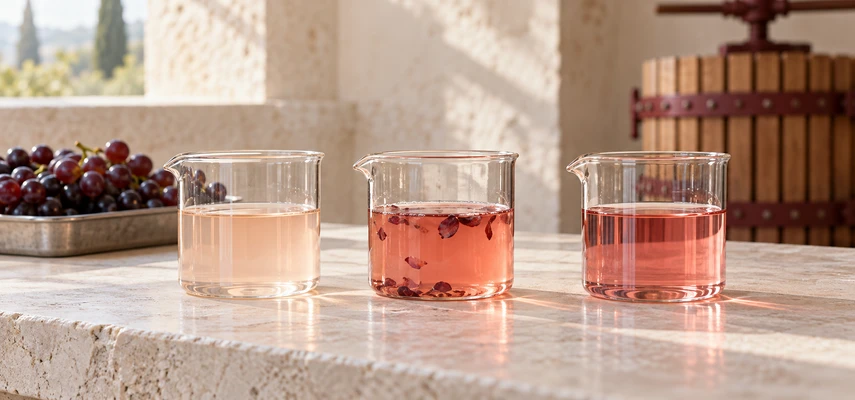

A pale pink wine can be dry, sweet, delicate, firm, inexpensive or ambitious. Its colour does not settle any of those questions. Rosé winemaking controls how grape constituents enter the juice, then uses fermentation and finishing choices to build the intended balance. The pink is an outcome of that process, not a complete description of the wine.
Direct pressing, short maceration and blending provide different routes. Saignée adds another important commercial context because its rosé can be linked to a red-wine production decision. To compare them properly, ask what fruit each route uses, when liquid separates from skins and what happens to the material afterwards.
The official Diploma specification includes these rosé routes within wine production. A useful answer follows the physical changes through to colour, flavour, texture, style and cost. Simply identifying a pink shade and guessing a method leaves most of the reasoning undone.
Rosé winemaking begins with an intended style
Choose the desired balance before choosing the colour target. A fresh dry rosé may need suitable acidity and direct fruit character, while another wine may aim for greater texture or a different flavour profile. Grapes selected for those purposes can require different maturity from fruit intended for a full-bodied red.
Black-skinned grapes commonly supply the pigments, with much of the juice initially pale. There are exceptions to the general rule of pale pulp, so grape anatomy should not be turned into an absolute statement about every variety. Variety and fruit condition influence both what can be extracted and how quickly the colour develops.
Skin contact changes more than appearance. It can bring aroma-related constituents and phenolics affecting texture, bitterness or astringency. A colour target therefore needs to be considered with the wine’s other components. Extracting until the juice looks right can still produce an unsuitable sensory balance.
The Provence wine council’s production account links method choice with variety, maturity and intended profile. Its local examples are useful mechanisms, not universal timetables. A prescribed number of hours cannot guarantee the same colour from different grapes in different conditions.
Direct pressing limits deliberate pre-press contact
Direct pressing takes the grapes to the press without a separate planned maceration stage. Whole bunches or suitably handled berries can be pressed, depending on the route. Some extraction still occurs during loading and pressing. Direct does not mean that juice has never touched a skin.
The press programme, duration, fruit temperature and handling influence the result. Gentle treatment can help obtain a pale juice with a restrained phenolic profile, provided the fruit offers the intended characteristics. A vigorous or prolonged press cycle may produce different fractions even though both operations are called direct pressing.
Keep track of fractions rather than assuming the entire press delivers an identical product. Early liquid and later pressings can differ in character and suitability. Separate collection allows trials and blending decisions, while using extra vessels and attention. The value of that flexibility depends on the scale and quality objective.
Direct pressing can suit a purpose-grown pale rosé because the harvest and processing are organised around that wine from the start. It still needs appropriate crop health and maturity. The method cannot replace the flavour missing from unsuitable grapes, and pale colour alone cannot demonstrate that the producer handled them well.
Short maceration adds a controlled contact stage
Short maceration holds juice with grape skins before the main separation. Fruit may be destemmed and crushed to release juice and provide contact. The producer monitors extraction, then drains and presses when the proposed balance is reached. The duration is short relative to many red-wine routes, rather than a fixed global number.
Temperature influences extraction and microbial activity. Cooler conditions can help manage the contact period, but cooling does not sterilise the material. Hygiene, fruit condition and protection remain relevant. Account for contact already experienced during harvesting and transport before adding a further hold at the winery.
AWRI’s skin-contact discussion explains why extraction and handling need to be evaluated together. Although much of that resource concerns white wine, the distinction between controlled contact and unintended exposure is also useful for rosé. The desired extracted material, rather than contact time alone, is the target.
Compared with a restrained direct-press route from similar fruit, maceration can provide greater colour and phenolic extraction. It does not follow that every macerated rosé is dark or every direct-pressed example is pale. Variety, temperature, pressure, blending and subsequent changes prevent the method from being read reliably from colour alone.
Saignée links the rosé to a red ferment
Saignée means bleeding off a portion of juice from a red-grape mass. The remaining material has more skins relative to liquid, which can support a concentration objective for the red wine. The separated juice can be fermented as rosé. AWRI’s saignée resource describes that relationship between the two products.
This is a different production objective from planning the entire crop specifically for rosé. Grapes chosen for the red wine may carry sugar, acidity or flavour characteristics that require a different rosé strategy. That does not make the resulting pink wine necessarily inferior; it means its raw material and constraints need to be understood.
The producer must evaluate both streams. More juice removed reduces the red lot’s liquid volume while creating a separate product that needs tanks, fermentation and a market. A successful concentration effect in the red wine is not proof that the rosé will be commercially useful, or vice versa.
Short maceration and saignée can look similar at the moment pink juice drains from skins. The important distinction is the intended role of the remaining fruit and the production plan. Explain what happens to both fractions rather than relying on the drainage action alone to name the process.
Blending has more than one meaning
Blending can combine rosé lots made from different varieties, parcels, harvest dates or processing routes. The aims may include balance, consistency and style. It is part of production even where every component was made as rosé; the word does not necessarily mean mixing a finished red with a finished white.
Blending red and white wine is another route where the applicable product rules permit it. A small coloured component can change not only appearance but aroma, tannin and balance. Bench trials should assess the whole wine rather than calculate a colour correction in isolation. Permission must be checked for the region and product category concerned.
Check the applicable product specification before using a familiar blending example as a precedent. Still rosé and sparkling rosé can fall under different requirements. A method permitted for one product is not automatically authorised for another.
Co-fermenting varieties or fruit colours is a further distinction: the components ferment together rather than being combined only as finished wines. Their constituents interact earlier, and their maturity must suit the common schedule. Separate vinification retains more later blending choice, but uses more individual lots and handling.
Fermentation determines sweetness as well as aroma
Once separated, much rosé juice follows a fermentation route comparable to white-wine production. Yeast choice, temperature, nutrients and juice solids influence performance and sensory outcome. A cool, controlled fermentation can support a fresh style, provided the selected yeast works reliably in those conditions.
AWRI’s yeast-choice guidance is useful here because microbial control and style are connected. Selected cultures and spontaneous fermentation create different starting strategies, while both need monitoring. The most expressive plan is unhelpful if the ferment develops unwanted characters or fails to reach its intended endpoint.
Colour does not determine residual sugar. A pale wine can retain sugar, and a deeper pink wine can ferment dry. Sweetness depends on the production route and what remains at the end, with appropriate stabilisation if fermentable sugar is retained. Do not use a visual impression as a sugar analysis.
Acidity and alcohol also affect the perceived balance. The same residual sugar can seem different in wines with different structure and flavours. A producer should therefore assess composition and sensory results together rather than trying to describe the finished wine from one laboratory value.
Oxygen, lees and maturation add further choices
Rosé colour and aroma can change during handling and storage. Appropriate protection involves the actual wine, transfers, vessel conditions and monitoring. Sulfur dioxide has useful antioxidant and antimicrobial roles, with pH and binding affecting performance. A fixed addition cannot guarantee identical protection for every lot.
Some rosés remain in neutral vessels for an early-release style. Others use suitable lees contact or wood to build different texture and complexity. The Provence council’s style discussion illustrates that cellar choices continue after pressing. Its specific regional descriptions should not become a definition of all rosé.
Lees contact can influence texture without requiring prominent oak flavour. Barrel use can add its own contribution depending on size, age and treatment. Evaluate freshness, aroma and balance as the wine develops. A longer or more expensive process needs a useful sensory result rather than a claim of seriousness based on time alone.
Malolactic conversion may be avoided where retaining malic acidity fits the style, while other wines can use it intentionally. It is another separate choice, not a consequence of making the wine pink. Any avoidance strategy must consider unwanted later microbial activity rather than relying only on a decision not to inoculate.
Evaluate quality and cost beyond the shade
A colour specification can be commercially important, but it should sit within a broader sensory target. Removing desirable flavour or texture merely to reach a paler appearance may weaken the wine. Conversely, unwanted astringency should not be defended simply because the colour looks impressive.
Compare marketable recovery, press capacity, cooling, separate fractions, laboratory work and storage. A short contact route uses different time and space from immediate pressing; blending requires suitable components and trials. The cost per bottle reflects the whole process and market context, not just the duration of skin contact.
The strongest Diploma comparison begins with similar fruit and a stated objective. Explain how each route changes contact, composition and flexibility, then consider fermentation and finishing. A useful conclusion can favour one approach for that case while recognising why another producer might rationally choose differently.
Connect this explanation with sweet wine production and red winemaking as linked parts of the same explanation. Trace the relevant growing or cellar decision through to its consequences, and identify the condition that could change the result rather than treating the relationship as automatic.
Original Diploma practice
These original exercises are not official WSET questions and have no official mark allocations.
Question 1: compare direct pressing and maceration
A producer wants a pale, fresh rosé but also finds the first press trial lacks flavour. Compare direct pressing with a controlled short maceration trial.
Indicative answer points: fruit potential; existing contact; temperature; colour and phenolic extraction; fractions; fermentation; sensory trials; no automatic more-flavour guarantee.
Outline answer: Direct pressing can limit deliberate pre-press contact, while a monitored hold may obtain additional skin-derived constituents. The extra extraction could improve the target profile or introduce unwanted phenolics and colour. Check fruit suitability and the full handling history before changing the route. Compare matched trials and useful press fractions through fermentation, rather than deciding from the juice’s appearance alone. If the grapes lack the needed flavour potential, a longer contact period may not solve the problem.
Question 2: evaluate a saignée business plan
A red-wine producer expects saignée to improve the red wine and create a profitable rosé with no extra cost. Evaluate the claim.
Indicative answer points: changed solids-to-liquid ratio; lower red volume; rosé raw material; separate processing; capacity; market and specifications; whole-operation return.
Outline answer: Bleeding juice changes the red ferment and produces a second stream, but neither resulting wine is guaranteed to improve or sell profitably. Evaluate the red wine’s balance and lost volume. Assess whether fruit maturity suits the rosé and allow for fermentation, stabilisation, packaging and sales costs. Extra product is not free merely because its grapes were already purchased. Compare the value of both streams with the original production plan.
Question 3: interpret a colour-based recommendation
A buyer assumes the palest sample is the driest and recommends adding red wine to correct another lot’s shade. What must be checked?
Indicative answer points: colour versus residual sugar; whole sensory balance; component identity; blending trials; regional and category permission; stability and consistency.
Outline answer: Measure or verify residual sugar rather than infer it from colour. Establish the intended aroma, acidity and texture as well as the shade. A red component may add tannin and flavour, so trial the blend across the full sensory profile. Confirm that the particular product permits the proposed red-white blend; another region’s example is insufficient. Assess stability and repeatability before scaling an apparently simple visual correction.











