










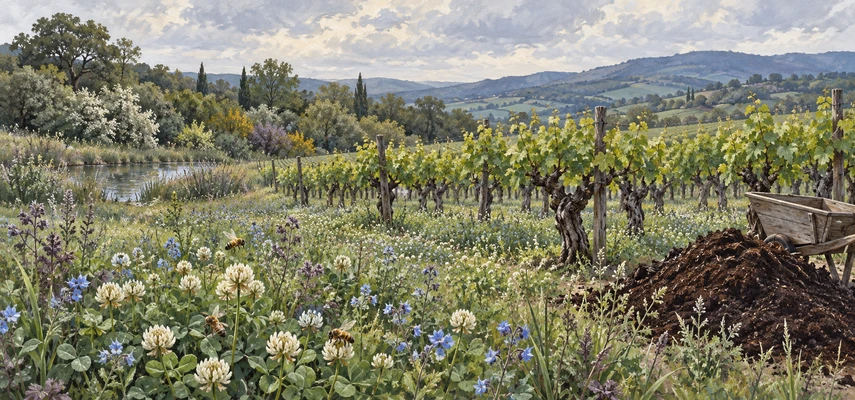

A vineyard can grow cover crops, encourage beneficial insects and use precision irrigation without being certified organic. Another can meet an organic standard while still needing to investigate fuel use, erosion or working conditions. Sustainable, organic, biodynamic and regenerative viticulture overlap, but the terms do not answer the same question.
Some describe broad goals. Others describe a particular production system, with requirements that can be checked against a standard. None is a reliable shortcut to deciding whether the wine tastes better. The useful approach is to ask what the grower actually does, what has been verified and what results follow.
The official D1 specification includes conventional, sustainable, organic, biodynamic, regenerative and precision viticulture. These approaches belong within the same production argument as pruning or irrigation: explain the mechanism, assess the outcome and recognise the conditions that limit a claim.
Conventional viticulture is a broad starting category
Conventional viticulture generally describes production outside a more specifically defined alternative system. It can use legally permitted synthetic inputs and a wide range of modern equipment. The term does not establish how often a grower sprays, whether inputs follow monitoring or how carefully soil and water are managed.
A conventional grower may use integrated pest management, groundcover, selective applications and beneficial habitats. Another may rely more heavily on routine interventions. Treating both as identical conceals the management decisions that determine impacts. Assess actual practices rather than assigning a single environmental score to the category.
This matters when comparing alternatives. A trial against poorly managed conventional production may answer a different question from a trial against a well-monitored integrated system. Specify the comparator before drawing conclusions about the value of a new approach. Otherwise the name of the treatment carries more weight than the evidence.
Sustainable viticulture asks about the continuing system
Sustainability considers environmental performance alongside social and economic viability. A vineyard must conserve resources and manage impacts while remaining a workable business with appropriate treatment of people. Strong performance in one area does not automatically compensate for failure in another.
Examples include water-use management, erosion control, biodiversity, energy, waste, chemical stewardship, worker training and business planning. These concerns can interact. Replacing one operation may reduce a particular input while adding fuel, labour or soil disturbance elsewhere. Compare the whole change rather than counting a single avoided product.
Sustainable Winegrowing Australia’s membership information illustrates a structured programme spanning vineyard and business practices. Membership and independently audited certification are distinct stages. A producer’s participation should not be described as certification without checking what status the producer actually holds.
Different schemes have different scopes and requirements. A certificate is evidence of compliance with its stated standard and audit process, not proof of zero environmental impact. Ask which operations, sites, dates and products it covers. That makes the claim useful to a buyer without asking the logo to answer questions beyond its remit.
Organic viticulture follows specified production rules
Organic viticulture emphasises management through approved methods and restrictions on inputs. Crop protection still involves prevention, monitoring and, where permitted, treatments. Organic does not mean that a vineyard receives no pesticides or that every naturally occurring material is harmless or allowed.
The USDA National List provides a clear example: under US organic crop rules, natural substances are generally allowed unless prohibited, while synthetic substances are prohibited unless specifically allowed. Conditions and certifier approval matter. This example should not be treated as the complete rulebook for every country.
Organic soil and crop management may include cover crops, compost, mechanical weed control and suitable biological approaches. The USDA crop standards overview explains the relationship between preventative management and permitted substances. Replacing a prohibited input still requires a workable way to manage the underlying problem.
Consider weeds under the vine. Mechanical cultivation may provide an alternative to a restricted herbicide, but repeated passes can affect labour, fuel use, soil disturbance and erosion risk. Those tradeoffs do not make organic production pointless; they show why the replacement strategy needs evaluation rather than an assumption that a removed input removes every impact.
Conversion, records and traceability also matter. A grower using some organic practices is not necessarily selling certified organic grapes. Distinguish the farm’s practices, formal certification and the eventual wine’s processing and labelling requirements. The word organic on a finished bottle involves more than what happened between the vineyard rows.
Biodynamic viticulture adds a particular farm philosophy
Biodynamic viticulture builds on organic management with an approach that treats the farm as an interconnected living system. It includes attention to soil, biodiversity and farm relationships, together with specified biodynamic preparations. The historical philosophy is associated with Rudolf Steiner’s agricultural ideas.
Demeter is an important certification organisation in this field. Its standard information explains that compliance is inspected in addition to organic inspection, with national requirements potentially supplementing the international standard. Claims about a particular certified vineyard should therefore refer to the applicable scheme rather than an imagined universal checklist.
The Demeter preparation resources identify preparations as a required element of its system. Their role within certification is a verifiable fact. Whether a particular claimed effect is demonstrated experimentally is a separate question. Explaining the system does not require presenting all of its philosophical claims as established plant science.
Some practitioners also use astronomical or lunar calendars to organise work. Separate such beliefs from effects with more readily identified physical pathways, such as maintaining groundcover or adding organic material. If a vineyard improves after adopting a package of practices, that observation alone cannot identify which part caused the improvement.
For example, comparing a biodynamic block with another block requires accounting for soil, crop level, canopy work, disease management and other differences. Good results can be real while their attribution remains uncertain. A careful evaluation respects the observed result and the limits of the comparison at the same time.
Regenerative viticulture focuses attention on recovery
Regenerative viticulture commonly aims to rebuild soil function, biodiversity and the resilience of the production system. Practices can include maintaining cover, reducing unnecessary soil disturbance, increasing plant diversity, using organic materials and integrating livestock where appropriate. The label alone does not specify the exact programme or prove a measured improvement.
An AWRI discussion of regenerative agriculture in vineyards connects these practices with soil function and the need to assess changes. Its practical message is useful: choose methods for the site and examine their consequences. Soil health is more informative when assessed through relevant physical, chemical and biological indicators than through a broad adjective.
Groundcover can protect soil and provide habitat, but it also uses water. In a moist, vigorous site that competition may be manageable or useful; in a dry site it may constrain the vines. Species, timing, mowing and termination influence the result. Leaving every plant growing indefinitely is not a universal regenerative prescription.
Livestock can manage vegetation and return nutrients, but require suitable timing, fencing and husbandry. They can also damage vines or compact wet soil. Evaluate the operation as a managed practice rather than treating the presence of sheep as an environmental conclusion. The benefits depend on how the system works.
Carbon claims require particular care. Increasing soil organic carbon is not the same measurement as the vineyard’s entire greenhouse-gas balance. A meaningful claim needs a baseline, consistent sampling, appropriate boundaries and time. Imported materials and other operations also belong in the accounting relevant to the claim being made.
Precision viticulture changes the scale of management
Precision viticulture uses spatial information to recognise and manage variation within vineyards. Tools can include soil surveys, positioning systems, yield maps and remotely sensed imagery. The purpose is better-targeted decisions; it is not a separate organic or biodynamic certification category.
Wine Australia’s vineyard-variability resources explain how mapping can support targeted inputs or selective harvesting. A vigorous zone and a weak zone may warrant different investigation and management. Their difference does not automatically mean one makes better wine.
A map identifies a pattern rather than its complete cause. Ground checks, sampling and records are needed to distinguish water supply, soil, missing vines, disease and other explanations. Precision management can support conventional or alternative systems, provided the proposed action is permitted within any certification being claimed.
Compare outcomes for the intended wine
Yield per vine and yield per unit area should both be considered when comparing systems. A lower crop might reflect deliberate management, poor set, disease losses or a transitional problem. Those causes have different implications. Record marketable yield and the resources used to obtain it, rather than judging a system by tonnage alone.
Vine and grape health remain essential under every approach. Grape component balance and aroma and flavour ripeness depend on site, season, variety and management. A certification does not supply missing warmth or guarantee freedom from rot. The grower still needs a practical response to biological constraints.
Red wine styles, white wine styles and rosé wine styles can all be produced under these approaches. Their requirements for maturity, healthy fruit and composition remain distinct. Residual sugar styles and no- and low-alcohol styles likewise need an appropriate raw material; a farming label does not resolve the production choices involved.
Quality levels from poor through acceptable, good and very good to outstanding concern the resulting wine. Price bands from inexpensive and mid-priced to premium and super-premium reflect commercial positioning and other influences. Certification can matter to particular buyers, but it does not guarantee a price premium sufficient to cover extra costs.
Make claims specific enough to test
Compare costs over a useful period, including transition, training, records, audits, equipment and additional operations. Benefits may include improved resource management, access to a market or reduced exposure to particular risks. Their value depends on the vineyard and its route to market rather than a universal profitability ranking.
Describe a proposed change in concrete terms: establish a specified groundcover, monitor soil condition, reduce an unnecessary operation or target inputs by zone. Then state the expected mechanism and what will be measured. A clear claim about a particular outcome is more informative than saying the vineyard is becoming greener.
For Diploma evaluation, separate four things: the philosophy, the required practice, the verified compliance and the measured result. They can reinforce one another, but they are not interchangeable. Keeping them distinct allows a fair comparison without either dismissing alternative systems or granting every claim attached to them.
Connect this explanation with harvest decisions and irrigation and vine nutrition as linked parts of the same explanation. Trace the relevant growing or cellar decision through to its consequences, and identify the condition that could change the result rather than treating the relationship as automatic.
Original Diploma practice
These original exercises are not official WSET questions and have no official mark allocations.
Question 1: evaluate an organic conversion
A humid vineyard plans organic certification and expects to eliminate crop-protection costs while charging more for its grapes. Evaluate these expectations.
Indicative answer points: distinguish allowed from absent treatments; assess local disease pressure; consider prevention and replacement operations; include conversion, records and audits; verify buyer demand; measure usable crop and costs.
Outline answer: Organic rules restrict methods and materials rather than abolish crop protection. A humid site still needs a workable disease-management programme using permitted approaches. Replacement operations, monitoring and certification can add costs even if some inputs disappear. Establish the applicable requirements and buyers’ actual specifications before projecting a premium. Compare marketable yield, fruit condition and full costs during and after conversion. Neither lower expenditure nor a higher selling price follows automatically from certification.
Question 2: assess a regenerative claim
A grower introduces mixed groundcover and describes the vineyard as carbon neutral after one season. Explain the evidence needed and the practical risks to assess.
Indicative answer points: distinguish practice from outcome; establish baseline and boundaries; use consistent carbon measurement; account for other emissions and materials; evaluate water competition; assess multiple seasons.
Outline answer: Groundcover may support soil protection and biodiversity, but adopting it does not establish the whole greenhouse-gas balance. Identify the claim’s boundary and measure relevant changes consistently against a baseline. Include other operations and material flows where required by that accounting. Assess whether the chosen plants compete excessively for water, particularly in dry periods. Evidence of an agronomic benefit should be reported on its own terms rather than inflated into an unsupported climate claim.
Question 3: interpret a biodynamic trial
A biodynamic block produces healthier grapes than a neighbouring conventional block. It also has different groundcover and canopy management. Can the result establish that preparations caused the improvement?
Indicative answer points: recognise the observation; identify multiple changed variables; assess site and season differences; distinguish certification from causation; design comparisons; include wine and commercial outcomes.
Outline answer: Healthier fruit is a useful observation but does not isolate the preparations’ contribution. Groundcover, canopy work, site and other management differences offer alternative explanations. A more informative trial would control or explicitly compare relevant factors, use replication where practical and continue across seasons. Certification verifies specified compliance rather than proving the causal explanation for every observed result. Evaluate fruit, resulting wine and costs separately, preserving the distinction between a successful system and proof of a particular mechanism.











