











Why heat a drink after putting so much care into fermenting it cool? Sake pasteurisation answers a different question from fermentation temperature control. Fermentation builds the product; heat treatment helps control what can happen afterward. Surviving microorganisms and active enzymes can continue to change the liquid, and the brewer decides which changes fit the intended style.
The Japanese term hi-ire refers to this controlled heating. Nama-zake omits pasteurisation, while nama-chozo and nama-zume describe different single-treatment histories. Those names are easiest to understand by drawing a line from pressing through storage to bottling. The location of the heat treatment matters as much as the number of times it occurs.
Sake pasteurisation has two main targets
The NRIB explanation of hi-ire identifies microorganisms and enzymes as distinct targets. Heat controls remaining yeast that could cause renewed fermentation and spoilage lactic-acid bacteria associated with souring. It also inactivates enzymes left from koji and yeast. Calling the operation simply a way to make sake look clear misses its principal functions.
Microbial stability concerns organisms capable of activity under the product’s conditions. Enzymatic stability concerns catalysts that can keep changing components even without a fresh population of growing yeast. An enzyme isn’t a tiny organism waiting to reproduce. This distinction explains why removing cells and stopping enzyme activity aren’t automatically the same achievement.
For a written answer, connect the target with the consequence. Control of yeast reduces the risk of unwanted refermentation; control of spoilage bacteria reduces a route to souring; enzyme inactivation limits further enzyme-driven compositional changes. Three linked explanations are more useful than repeating that heat makes the product stable three times.
Controlled heating is not boiling
NRIB describes heating to around 65°C. That gives the scale of the operation: gentle compared with boiling, but purposeful enough to affect microbes and enzymes. The exact effective treatment depends on temperature, exposure time, product conditions and the equipment. A study article shouldn’t turn a representative temperature into a universal operating instruction.
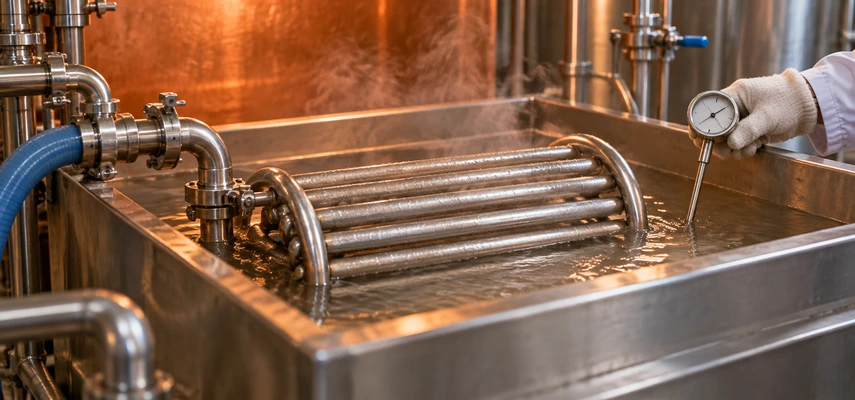
The JSS production account describes practical approaches to heating sake, including heat exchange and bottle treatment. In a heat-exchange arrangement, heat passes across a surface while the sake moves through equipment. With bottle treatment, the liquid is heated in its container. These approaches create different handling and control questions even when their general purpose is similar.
Uniformity matters. A reading from one convenient point doesn’t necessarily establish the temperature history of all the product. Breweries therefore need a controlled process rather than a brief encounter between one thermometer and something warm. Cooling and subsequent handling also belong to the production plan, because the desired heat exposure isn’t an invitation to leave the sake warm indefinitely.
Why the conventional sequence can include two treatments
A familiar sequence heats sake before storage and again around bottling or shipment. The first treatment helps stabilize the liquid while it rests. The later treatment addresses the product at a subsequent handling stage. The NRIB production diagram shows this common two-treatment route alongside the alternatives.
Two is a useful reference pattern, not a rule that every quality producer must follow. Equipment, packaging, hygiene and the intended style can support different arrangements. A modern account of a carefully managed single heat treatment doesn’t automatically contradict the traditional teaching sequence; it describes a different process plan.
Timing also affects what happens during the interval. If active enzymes remain during storage, they have an opportunity to alter components before a later heat treatment stops their activity. Heating afterward cannot rewind every change already produced. This is the central reasoning behind distinguishing the two single-pasteurization terms rather than memorizing both as vaguely fresh sake.
Nama-zake has no pasteurisation
Nama-zake, also encountered as nama-shu, means unpasteurized sake. The NRIB label glossary distinguishes it from the two once-heated forms. Omitting heat can preserve a particular fresh expression, but it also leaves a different stability challenge for the brewery, distributor, retailer and drinker.
Active enzymes can continue to alter the liquid, and microbial control requires attention. Cold handling slows many changes; it doesn’t make the product immune to time or poor storage. Follow the producer’s storage instructions and maintain the required cold chain rather than assuming a sealed bottle has the same practical resilience as any pasteurized bottle beside it.
Nama isn’t a promise that every sample will smell identical. Rice, yeast, fermentation, clarification and storage still influence aroma and palate. Nor is it a synonym for cloudy: an unpasteurized sake can be clear. Treat the word as information about heat history, then taste the actual product before describing its intensity, texture or quality.
Nama-chozo is stored without pasteurisation
Chozo relates to storage. Nama-chozo passes through its storage period unpasteurized and receives a heat treatment later, around bottling. The liquid therefore retains active enzymes during the unheated storage interval. The brewery manages that interval, commonly with low-temperature storage, to achieve the intended expression.
The later heat treatment can provide greater stability for subsequent distribution, but it doesn’t mean the preceding storage was irrelevant. Any changes during that time are part of the product’s history. This is why identifying merely one treatment doesn’t fully answer a question about style development or handling.
Don’t reverse the sequence because the English phrase sounds like fresh storage. Use a simple event order: pressing, unheated storage, heat around bottling. If you can reconstruct those events, you can explain both the name and the practical consequence without depending on a fragile memory trick.
Nama-zume is bottled without another heat treatment
Nama-zume receives heat before storage, then is bottled without the later pasteurization in the reference sequence. Enzymes have therefore been inactivated earlier than in nama-chozo. The word doesn’t mean the liquid has never been heated; it identifies omission of the later treatment.
Again, the distinction is chronological. Nama-chozo leaves storage unheated until the later step; nama-zume has already undergone heating when storage begins. Both can involve one treatment, but the period available for enzyme activity differs. That is an explanation of process, not a claim that one must always taste better or fresher than the other.
Careful filling and handling remain necessary after any treatment. Earlier heating doesn’t protect sake from every possible later handling problem. Equally, the omission of a second treatment isn’t evidence that a producer abandoned control. Assess the complete system and the producer’s instructions rather than awarding or removing quality points from the treatment count alone.
Heat history answers only one label question
Nama terms don’t establish whether alcohol was added, whether water was added after pressing or whether charcoal treatment occurred. Junmai, genshu and muroka address other production questions. A sake can carry several of these descriptions at once, provided the actual production supports them.
Consider two hypothetical clear genshu samples. One is nama and the other pasteurized. Their undiluted status is shared, while heat history differs. It would be an error to explain their different handling instructions by claiming the nama must contain more alcohol solely because it is nama. Keep each causal explanation attached to the variable it actually changes.
This discipline helps with blind tasting as well. Fresh aromas may support a possible production interpretation when combined with other evidence, but they aren’t documentary proof of an unobserved heat treatment. Distinguish a reasoned inference from a confirmed label fact, especially when samples have different storage histories.
Choose storage advice from the actual product
When recommending or serving nama, check the producer’s required storage temperature and the retailer’s handling information. Protect the bottle from heat and light, and plan use after opening according to the product and producer guidance. Avoid inventing a universal expiry period that treats every unpasteurized sake as identical.
Pasteurized sake also benefits from suitable storage. Heat treatment doesn’t stop every physical or chemical reaction, prevent light damage or reverse earlier mishandling. Its contribution is specific and valuable, but it sits alongside packaging, distribution temperature and time. A stable production plan is a collection of controls rather than one dramatic moment of heating.
For revision, take any proposed advice and ask which risk it addresses. Refrigeration relates to slowing change, light protection addresses a different exposure, and pasteurization changes microbial and enzymatic activity. Explaining these separately makes your recommendation more precise and prevents the vague instruction to keep everything fresh from doing all the work.
Compare the intervals, not just the totals
For a short revision exercise, draw three empty timelines and mark storage as a band rather than a single point. Put no heat marker on the nama line, a marker after that band on the nama-chozo line, and one before it on the nama-zume line. Now ask which liquid spends storage with enzymes still active. This turns a label-recall task into a causal explanation. Add a second question about distribution: which treatment has already happened by shipment, and what handling does the producer require afterward? The answers should refer to the actual sequence, not to an assumed ranking of freshness.
For the syllabus terminology, hi-ochi-kin refers to spoilage lactic-acid bacteria whose control is one microbial purpose of heating. Bulk heat treatment and bottle heat treatment describe different physical arrangements; double pasteurization describes a sequence, not a different organism. Keep the target, equipment and timing separate when explaining the operation.
For a practical heat-treatment comparison, use pasteurized and unpasteurized nama-zake from the same producer and grade where possible. Verify both histories, preserve the required storage conditions and taste at comparable temperatures before the reveal. Record any other differences. Freshness may support an interpretation, but it cannot independently prove the heat history.
Heat-treatment history explains part of the meaning of nama and related terms and informs storage and condition assessment. Compare appropriate examples in blind production-technique practice without treating freshness as documentary proof.
One-page revision summary
Hi-ire uses controlled heat to control relevant microorganisms and inactivate enzymes. Nama-zake receives no pasteurisation. Nama-chozo is stored unheated and heated later around bottling. Nama-zume is heated before storage and bottled without another heat treatment. Explain the interval available for activity, qualify sensory expectations and give storage advice from actual product requirements.
Written practice: original TFE exercises
These suggested marks and indicative points are independent teaching guidance, not official WSET marking schemes.
Exercise 1: 5 suggested marks
Explain two distinct stability purposes of sake pasteurisation and why filtration is not automatically equivalent. Mapping: Unit 1 LO1.
Indicative marking points:
- Heat controls relevant remaining microorganisms.
- Controlling yeast reduces unwanted refermentation or spoilage bacteria control reduces souring.
- Heat also inactivates enzymes.
- This limits further enzyme-driven changes in composition.
- Filtration specifications differ and cell removal does not necessarily remove or inactivate dissolved enzymes.
Model answer: Pasteurization controls relevant microorganisms, reducing risks such as yeast refermentation or bacterial souring. It also inactivates enzymes, limiting further enzyme-driven compositional changes. A filter can separate material according to its specification, but removing cells does not automatically inactivate dissolved enzymes, so it is not an interchangeable claim of treatment.
Why it works: The response separates organisms from catalysts and connects both targets with practical consequences before comparing mechanisms.
Common mistake: Calling enzymes bacteria, or saying any clear filtered sake has necessarily been pasteurized.
Exercise 2: 5 suggested marks
Compare the timing of heat treatment for nama-zake, nama-chozo and nama-zume, explaining a consequence for storage. Mapping: Unit 1 LO1; LO2.
Indicative marking points:
- Nama-zake receives no pasteurization.
- Nama-chozo is stored unheated and heated around bottling.
- Nama-zume is heated before storage without a further bottling treatment.
- Enzymes can remain active during unheated storage in nama and nama-chozo.
- Appropriate low-temperature handling and producer-specific instructions are therefore important.
Model answer: Nama-zake is unpasteurized throughout. Nama-chozo is stored unheated, then heated around bottling; nama-zume is heated before storage and not again at bottling. The unheated storage period permits continued enzyme activity, making appropriate low-temperature handling and producer instructions important. Equal treatment counts do not mean equal histories.
Why it works: It identifies all three sequences and explains why the timing matters beyond memorizing a label translation.
Common mistake: Reversing nama-chozo and nama-zume, or describing either once-heated form as never heated.
Knowledge check: 10 original practice questions
Independent TFE questions, not official WSET examination items. Choose one answer per question; explanations follow separately.
1. Why is filtering yeast not automatically the same as pasteurization?
2. Which advice for nama is most appropriate?
3. What distinguishes nama-zake?
4. Which sequence describes nama-zume?
5. What is hi-ire?
6. Why does the timing of a single heat treatment matter?
7. What does a typical temperature around 65°C establish?
8. Which statement about pasteurized sake is most defensible?
9. Which pair correctly identifies two targets of heat treatment?
10. Which sequence describes nama-chozo?
Answers and explanations
1. B — Dissolved enzymes may remain active even if cells are removed.. Cell separation and enzyme inactivation are different effects and require different evidence. Mapping: Unit 1 LO1 Range 4; LO2 Range 4.
2. A — Follow the producer cold-storage requirements and protect the cold chain.. Unpasteurized products require product-specific handling rather than a universal shelf-life assumption. Mapping: Unit 1 LO1 Range 4; LO2 Range 4.
3. A — It has not been pasteurized.. Nama describes heat-treatment history rather than clarity, dilution or rice identity. Mapping: Unit 1 LO1 Range 4; LO2 Range 4.
4. B — Heat before storage, then bottling without another treatment.. Nama-zume omits the later heat treatment but has already received one before storage. Mapping: Unit 1 LO1 Range 4; LO2 Range 4.
5. B — Controlled heat treatment of sake.. Hi-ire is pasteurization, with microbial and enzyme-related stability purposes. Mapping: Unit 1 LO1 Range 4; LO2 Range 4.
6. C — It changes the interval during which enzymes may remain active.. Changes during unheated storage are not necessarily reversed by later heating. Mapping: Unit 1 LO1 Range 4; LO2 Range 4.
7. D — The approximate scale of controlled heating, with effective treatment also depending on process conditions.. A representative temperature is not a complete validated operating schedule. Mapping: Unit 1 LO1 Range 4; LO2 Range 4.
8. C — It still needs suitable protection from heat, light and time.. Heat treatment addresses specific targets rather than eliminating every route to later change. Mapping: Unit 1 LO1 Range 4; LO2 Range 4.
9. C — Relevant microorganisms and active enzymes.. The targets are distinct: enzymes can act without themselves being living organisms. Mapping: Unit 1 LO1 Range 4; LO2 Range 4.
10. D — Unheated storage, then heat around bottling.. The storage interval is unpasteurized; a later heat treatment follows it. Mapping: Unit 1 LO1 Range 4; LO2 Range 4.












