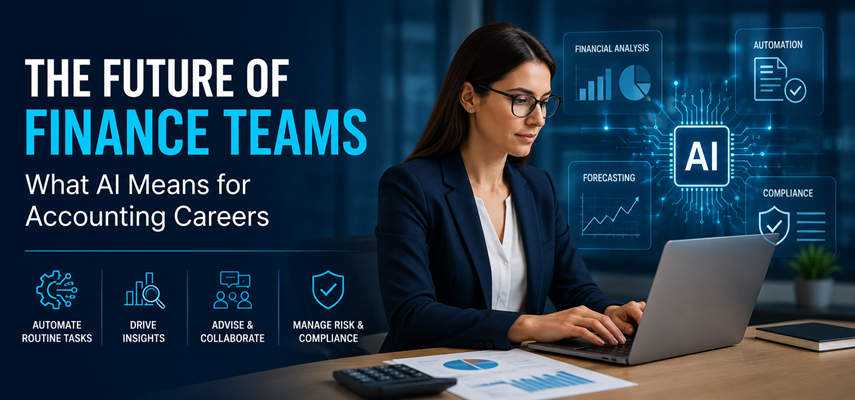
Artificial intelligence has moved well beyond the experimental stage. Across finance departments, AI-powered tools are helping professionals process invoices, reconcile accounts, analyze transactions, and generate reports faster than ever before. For accountants, finance leaders, and students preparing to enter the profession, this raises an important question: what does AI mean for accounting careers in the years ahead?
Some worry that automation will replace accounting jobs altogether. Others see AI as an opportunity to remove repetitive work and create more meaningful roles focused on strategy, analysis, and business guidance. The reality lies somewhere in between. AI is changing how finance teams operate, but it’s also creating demand for new skills and responsibilities.
As organizations invest more heavily in automation, accountants who combine technical knowledge with analytical thinking and business insight will be positioned to thrive. Understanding these changes is becoming a priority for anyone building a long-term career in finance.
How AI Is Affecting Accounting Today
AI is already reshaping daily accounting work. Tasks that once required hours of manual effort can now be completed in minutes through machine learning algorithms, automation platforms, and generative AI applications.
Many finance departments use AI for activities such as:
- Accounts payable processing
- Invoice data extraction
- Expense management
- Bank reconciliations
- Fraud detection
- Financial forecasting
- Audit support
- Compliance monitoring
The appeal is clear. According to research from the McKinsey Global Institute, finance functions contain substantial opportunities for automation, and productivity improvements in knowledge-based work frequently exceed 20% when generative AI tools are implemented effectively.
At the same time, adoption remains uneven. Despite widespread discussion surrounding AI, a recent industry report found that only 16% have implemented AI within their accounting operations. This gap suggests that many organizations are still evaluating how best to deploy these technologies.
For finance professionals, this creates an interesting period of transition. Companies are experimenting with AI capabilities while simultaneously seeking employees who can help bridge traditional accounting practices with emerging technologies.
Automation Is Changing Responsibilities, Not Eliminating Them
One of the biggest misconceptions about AI is that automation automatically leads to large-scale job elimination. While some tasks may disappear, most accounting roles consist of dozens of responsibilities rather than a single activity.
AI excels at handling structured, repetitive processes. It can categorize transactions, identify anomalies, prepare draft reports, and process large datasets at remarkable speed. However, accounting professionals still provide judgment, context, and decision-making that technology cannot fully replicate.
Consider a financial close process. AI can assist with reconciliations and identify unusual entries. Yet someone must still evaluate those findings, understand business implications, communicate results to stakeholders, and determine appropriate actions.
This shift means accountants are spending less time gathering information and more time interpreting it.
According to Goldman Sachs Research, generative AI could automate tasks equivalent to 300 million full-time jobs globally, with roughly two-thirds of occupations exposed to some level of automation. Exposure, however, does not necessarily mean replacement. In many cases, AI changes portions of jobs rather than eliminating entire professions.
Accounting is a strong example of this distinction.
The Rise of Strategic Finance Roles
As automation reduces manual workloads, finance teams are gaining capacity to contribute in new ways.
Executives increasingly expect finance professionals to provide insights that support growth, profitability, risk management, and long-term planning. Rather than functioning solely as scorekeepers, accountants are becoming strategic advisors.
Several responsibilities are growing in importance:
Financial Analysis
Organizations generate enormous volumes of data. AI can organize and summarize information, but professionals must still determine what the numbers mean.
Finance teams are expected to:
- Identify trends
- Evaluate business performance
- Assess risks
- Recommend actions
- Explain financial outcomes
Strong analytical skills help accountants convert raw data into useful business intelligence.
Business Partnering
Finance professionals now work more closely with operations, sales, marketing, and leadership teams.
Instead of simply producing reports, they help answer questions such as:
- Which products generate the highest margins?
- Where can costs be reduced?
- What investments offer the strongest return?
- How should resources be allocated?
This advisory role requires communication skills alongside financial expertise.
Scenario Planning
Economic uncertainty, market volatility, and changing regulations make forecasting more complex.
AI can generate projections quickly, but finance leaders still need to evaluate assumptions and prepare strategic responses. Accountants who can model different business scenarios and communicate potential outcomes provide significant value.
Compliance Technology Is Reshaping Risk Management
Regulatory compliance remains a major responsibility for finance teams. AI is changing how organizations approach this area as well.
Advanced compliance tools can monitor transactions continuously, flag unusual activities, and help identify potential violations before they become larger issues. Automated monitoring reduces the burden of manual reviews while improving consistency.
This shift doesn’t eliminate compliance professionals. Instead, it changes their focus.
Rather than spending most of their time searching for issues, finance specialists can concentrate on:
- Investigating exceptions
- Evaluating risks
- Improving internal controls
- Advising leadership
- Supporting governance initiatives
As regulations continue evolving, organizations will need professionals who understand both compliance requirements and the technology used to manage them.
Data Analytics Is Becoming a Core Accounting Skill
The accounting profession has always been data-driven, but AI is accelerating the importance of analytics.
Modern finance teams have access to more information than ever before. The challenge is no longer obtaining data. The challenge is understanding it.
Accountants who can work effectively with analytics tools gain several advantages:
- Faster decision-making
- Better forecasting accuracy
- Improved risk assessment
- Stronger performance measurement
- More effective communication with leadership
The ability to interpret dashboards, evaluate trends, and explain findings is becoming a highly valued capability.
This trend aligns with broader workforce changes. The Future of Jobs Report 2025 from the World Economic Forum projects that employers expect 39% of worker skills to change by 2030, with technology-related capabilities among the fastest-growing skill categories.
For accounting professionals, analytics knowledge is moving from a desirable qualification to a standard expectation.
Skills Accountants Need to Stay Competitive
Technical accounting expertise remains important. However, future success will depend on combining traditional knowledge with new competencies.
AI Literacy
Every accountant does not need to become a data scientist.
However, professionals should understand:
- How AI tools function
- Common use cases
- Potential limitations
- Data quality considerations
- Ethical concerns
A working knowledge of AI helps accountants collaborate effectively with technology teams and evaluate AI-generated outputs.
Data Interpretation
AI can generate reports quickly, but interpreting findings requires human judgment.
Accountants should strengthen their ability to:
- Analyze trends
- Identify anomalies
- Draw conclusions
- Support recommendations with evidence
These skills help bridge the gap between information and action.
Communication Skills
The ability to explain financial insights clearly is becoming more valuable.
Whether presenting to executives, clients, or operational teams, accountants must communicate complex information in understandable ways. Strong communication often differentiates high-performing professionals from their peers.
Adaptability
Technology evolves rapidly. New platforms, workflows, and regulations will continue emerging.
Professionals who embrace continuous learning are more likely to succeed than those who resist change.
According to the PwC 2025 Global AI Jobs Barometer, skills required in AI-exposed occupations are changing approximately 66% faster than in other occupations. This highlights the growing importance of ongoing professional development.
Business Acumen
Understanding broader business objectives allows accountants to contribute beyond compliance and reporting.
Professionals who understand strategy, operations, customer behavior, and market conditions can provide deeper insights that support organizational goals.
What Finance Leaders Should Expect
Finance leaders face a dual challenge. They must adopt new technologies while also preparing their teams for evolving responsibilities.
Successful organizations are investing in:
- AI-enabled finance platforms
- Employee training programs
- Data governance frameworks
- Cross-functional collaboration
- Analytics capabilities
The goal is not simply to automate work. It is to create finance functions capable of delivering stronger insights and better decision support.
Research from the Stanford Human-Centered AI Institute’s AI Index Report 2025 shows that enterprise AI adoption continues to rise across industries, while organizations increasingly report measurable benefits from AI initiatives.
Companies that pair technology investments with workforce development efforts are likely to gain the greatest value.
What Students and Early-Career Accountants Should Know
Students entering the profession may encounter a very different environment than accountants experienced a decade ago.
That should be viewed as an opportunity rather than a threat.
Foundational accounting knowledge remains important. Financial reporting, auditing, taxation, and compliance are not disappearing. However, future professionals will also benefit from developing complementary skills in analytics, technology, communication, and business strategy.
The profession is evolving toward higher-value activities that require critical thinking and judgment.
AI may handle repetitive tasks, but organizations still need professionals who can interpret information, solve problems, and guide decisions.
In many ways, accounting careers are becoming more diverse rather than more limited.
Looking Ahead: The Next Decade of Finance Teams
The next ten years will likely bring continued automation across finance functions. Generative AI, predictive analytics, and intelligent workflow systems will become more common in organizations of all sizes.
The economic impact could be substantial. According to McKinsey Global Institute, generative AI could contribute between $2.6 trillion and $4.4 trillion in annual economic value. Meanwhile, Goldman Sachs Research estimates AI adoption could increase global GDP by roughly 7% over a decade.
For finance teams, these developments point toward a future where technology handles more routine execution while humans focus on analysis, oversight, collaboration, and strategic guidance.
The accountants who thrive will not be those who compete against AI. They will be those who learn how to work alongside it.
Conclusion
AI is changing accounting, but the profession is far from disappearing. Automation is reducing time spent on repetitive tasks while creating opportunities for more strategic, analytical, and advisory work. Finance professionals are being asked to interpret data, support business decisions, manage risk, and communicate insights more effectively than ever before.
As organizations continue investing in AI, demand will grow for accountants who combine technical expertise with analytical thinking, adaptability, and business understanding. Compliance technology, data analytics, and AI-powered tools will continue shaping how finance teams operate, but human judgment remains indispensable.
For accountants, finance leaders, and students, the path forward is clear: embrace continuous learning, develop technology awareness, strengthen analytical skills, and focus on delivering value beyond routine processes. Those who do will be well positioned for the future of finance.