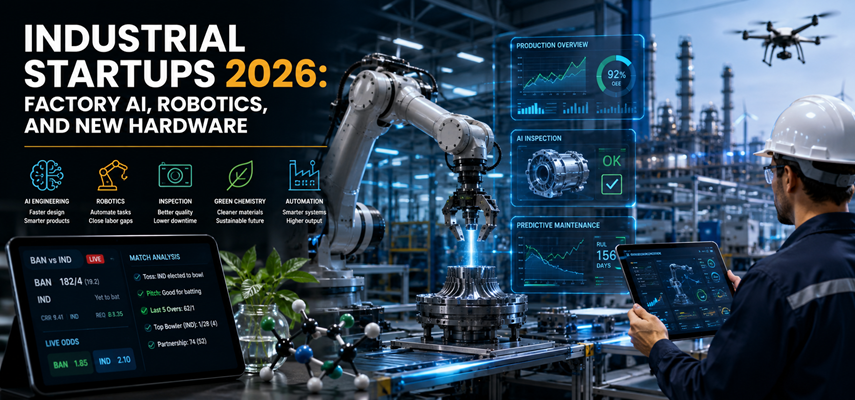

The most promising industrial startups of the year are not selling dashboards with factory stock photos. They are attacking harder problems: engineering cycles, aerospace parts, robotics, factory inspection, green chemistry, warehouse automation, and AI systems that touch physical production. Software ate the office first. Now it is chewing through the shop floor, the lab, the warehouse, and the supply chain. This shift is slower than consumer tech, but the stakes are higher because real machines do not forgive bad demos.
Industrial AI Is the New Boardroom Obsession
Prometheus became the loudest example in June 2026. Axios reported that Jeff Bezos and Vik Bajaj’s industrial AI startup raised $12 billion in Series B funding and reached a $41 billion valuation. Its pitch focuses on AI-assisted design and manufacturing for physical products, from jet engines to medical devices.
That size of funding changes the mood. Investors are no longer treating factory AI as a niche. They are betting that engineering itself can be compressed.
Manufacturing Innovation Is Moving Into Hardware Again
For years, startups preferred software because it scaled cleanly. Hardware was slower, expensive, and full of supply-chain pain. Now the pendulum is moving.
Hadrian, Bright Machines, Gecko Robotics, Agility Robotics, and similar companies show why. The opportunity is not one robot replacing one worker. It is a stack: sensors, machine vision, robotic control, factory software, quality inspection, and data feedback loops.
Cricket Markets and Industrial Thinking
Industrial founders and serious bettors share one habit: they hate weak signals. Factory data only matters when it improves output, and sports data only matters when it changes the price of a decision. That is why cricket betting in Bangladesh should be approached through structured match analysis rather than instinct. Useful variables include toss result, pitch condition, bowling economy, batting depth, recent workload, and live market movement after wickets. A fixed bankroll and clear unit size keep the decision process steady when a match starts swinging too fast.
Robotics Is Leaving the Demo Stage
Robotics funding is rising because the use cases are clearer. Warehouses need picking, scanning, packing, and inventory movement. Manufacturers need inspection and repetitive assembly. Energy companies need safer checks in dangerous sites.
Business Insider reported in June 2026 that robotics and “physical AI” investment grew from $4 billion in 2019 to $26 billion in 2025. That kind of movement attracts hype, but it also reflects labor shortages, supply-chain pressure, and demand for local production.
Green Chemistry Is an Industrial Startup Lane
Not every industrial winner will look robotic. Reuters argued in June 2026 that greener chemistry is becoming a serious part of the next industrial shift. The logic is practical: cleaner materials can reduce regulatory pressure, improve performance, and open new markets.
Startups working on PFAS alternatives, compostable materials, lower-carbon inputs, and AI-designed molecules may not look as flashy as humanoid robots. They may matter more. Materials decide what factories can build.
Betting Platforms and Data-Led Decision Habits
The factory floor is becoming more instrumented, and modern sports wagering has rapidly moved in the same direction. Today, users expect live data feeds, fast settlement times, clear market options, and seamless mobile access without dealing with slow menus. Looking closely at digital context and shifting fan behavior, cricket enthusiasts increasingly favor data-heavy hubs, which is why utilizing MelBet allows these analytical users to monitor live odds, review pre-match markets, and evaluate statistics simultaneously. This supportive environment reinforces a smarter routine in which fans carefully track team news, compare odds, and separate emotion from their overall stake size. While the activity remains fundamentally about entertainment, having access to superior information ultimately makes the entire tracking experience much sharper.
Which Industrial Startups Look Strongest
| Startup Type | What It Solves | Why Investors Care |
| Industrial AI design | Faster product engineering | Shorter R&D cycles |
| Factory robotics | Labor gaps and repeat tasks | Measurable productivity |
| Inspection robotics | Safer infrastructure checks | Lower downtime |
| Green chemistry | Cleaner materials | Regulatory and cost pressure |
| Automation platforms | Factory coordination | Better output data |
The common thread is measurable value. Industrial buyers do not pay for novelty for long. They pay for uptime, yield, safety, speed, and lower unit cost.
The Hard Part Comes After the Pilot
Industrial startups often win applause during pilots but struggle during deployment. Factories have old machines, mixed data formats, strict safety rules, union concerns, and production schedules that cannot pause for experiments. A tool that works in one plant may fail in another.
That is why the best startups will not be the flashiest. They will be the ones that integrate with messy systems, prove ROI, and survive procurement cycles. Real industrial technology wins slowly, then suddenly.