
Image credit
One scenario that you see play out constantly in real estate investment is this: you close on a 600,000-dollar rental property, you hand the paperwork to your CPA, and they depreciate the entire building over 27.5 years. It’s standard practice, but it also costs you tens of thousands of dollars in tax savings you are legally allowed to claim.
Cost segregation has existed as a tax strategy for decades. But for many investors, it remains underused. Either due to their generalist CPA not being across the details, or because they’ve never been shown the numbers in plain terms. R.E. Cost Seg is a firm built around fixing exactly that.
Who Are R.E. Cost Seg?
R.E. Cost Seg is a dedicated cost segregation firm, they service real estate investors, CPAs, and financial advisors across all 50 states. And unlike a generalist accounting firm that just offers cost seg as one of many services, this is the only thing they do. This specialization shows in the depth of their analysis, the speed of their turnaround, and the volume of recoverable depreciation they are able to identify.
Their client base spans individual rental property owners through to experienced portfolio investors. They’ve also built a parallel offering for CPAs and financial advisors who want a white-glove seg partner to handle the technical engineering work and client communication on their behalf.
What Is a Cost Segregation Study and Why Does It Matter?
Every investment property contains components that depreciate at different rates under the IRS rules. A fairly standard CPA approach assigns the entire building to one depreciation schedule. This is 27.5 years for residential rental property and 39 years for commercial. This is the default, and it’s expensive.
However, a cost segregation study changes this. You get a qualified engineer who reviews the property and reclassifies individual components. These components include cabinetry, flooring, speciality electrical, dedicated plumbing, appliances, driveways, landscaping, fencing, etc. These are divided into shorter asset categories of 5, 7, or 15 years. The result is significantly larger deductions much earlier.
With 100% bonus depreciation restored under the One Big Beautiful Bill Act, all 5,-7,-15-year qualifying property can now be deducted in full in Year 1. That front-loads years of depreciation into a single tax return.
The Numbers: What This Looks Like in Practice
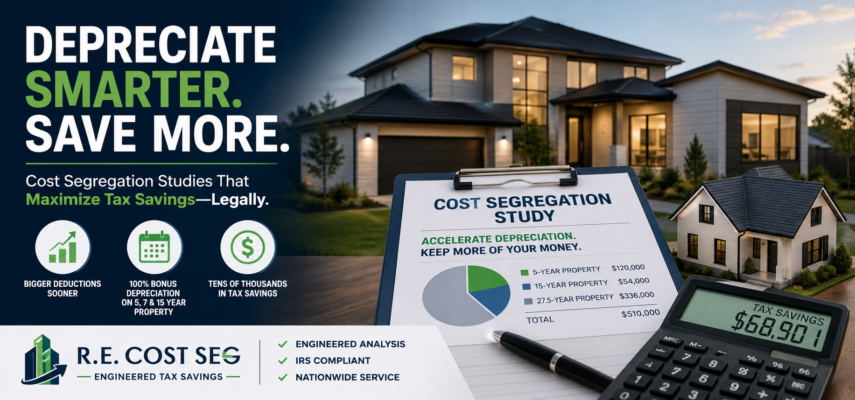
R.E. Cost Seg has examples on its site using a $600,000 residential rental property purchased in 2026 with 15% of the purchase price allocated to non-depreciable land.
Without cost segregation
A CPA will depreciate the full $510,000 depreciable basis straight line over 27.5 years. This produces a Year 1 deduction of roughly $18,545 or around $6,862 in tax savings at the 37% bracket.
With cost segregation
The study reclassifies $120,000 into 5-year personal property (cabinetry, flooring, appliances) and $54,000 into 15-year land improvements (driveways, landscaping, fencing). Under 100% bonus depreciation, both buckets are deducted in full in Year 1. Add the standard 27.5-year deduction on the remaining structure and the Year 1 deduction rise to approximately $186,218. This delivers around $68,901 in tax savings.
The difference: over $62,000 more in Year 1 tax savings versus standard depreciation from the same property with the same CPA filing the return.
How the Process Works
R.E. Cost Seg runs a three-step engagement from document submission to final report delivery that is typically completed within 2 to 4 weeks.
Step 1: Property Information
The investor will provide basic property details: closing statement, purchase price, property type, and photos. A pre-study checklist covers exactly what’s needed.
Step 2: Engineering Analysis
The firm’s engineer reviews the property through a site visit. This is done either in person or virtually. They then classify every component by its recovery period. Virtual inspection using photos, video walkthroughs, and satellite imagery produces IRS-compliant results identical to traditional onsite studies.
Step 3: Compliant Report
The investor will then receive a detailed cost segregation report. The report will be around 30 to 100 pages that the CPA uses to file depreciation deductions. It will include an asset-by-asset breakdown, depreciation schedules, and full IRS compliance documentation.
What Does It Cost and Is It Worth It?
There are two study options. The Rapid Report starts at $950 and is designed for smaller residential properties. The Fully Engineered Study is available for all property types and comes with a higher level of service. Prices for this rate start from $2,320 for residential properties and $2,730 for commercial properties.
Let’s use this against the $600,000 example above. A $5,000 study fee against $62,039 in additional Year 1 tax savings represents a 12:1 return; most studies deliver between 5:1 and 20:1, depending on the property value type and tax bracket.
The firm is straightforward about when a study doesn’t make sense: properties under $150,000 to $200,000 where reclassification potential is limited, investors in the 12% to 22% tax bracket where savings may not justify the fee, as well as properties held for fewer than one to two years where accelerated depreciation triggers recapture on sale.
Any Drawbacks?
The truth is that cost segregation isn’t right for every investor at every stage. If you have lower-value properties or you’re an investor in lower tax brackets, the study fee can reduce or even eliminate the net benefit.
R.E. Cost Seg addresses this directly on their website, so you can understand how it will benefit you before you sign up for the service. They offer a free calculator and a free proposal so investors can assess whether the numbers work before committing.
The Bottom Line
For real estate investors in higher tax brackets who own properties worth $200,000 or more, cost segregation is one of the most powerful and most underused tax tools available.
The difference between a generalist CPA assigning your entire building to a 27.5-year schedule and a specialist firm reclassifying its components correctly and can run into tens of thousands of dollars in a single tax year.
R.E. Cost Seg’s specialist-only focus, engineering-based methodology and nationwide coverage make it worth serious consideration for any investor who hasn’t yet had this conversation. You can get a free savings estimate in 60 seconds on the website today to see if you’re eligible.