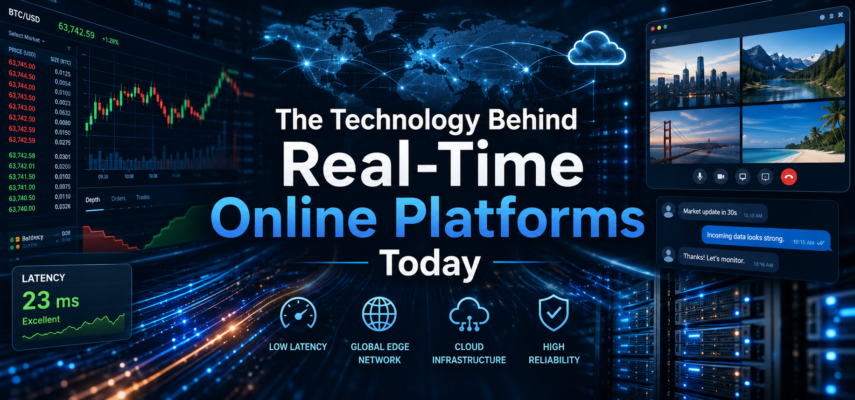
Anyone who watches a price ladder update through the trading day understands what real time really means. Quotes move in fractions of a second, and a delay of even a few hundred milliseconds can change a decision. The same engineering pressure now shapes a much wider set of consumer products, from live video and messaging to collaborative documents and remote work tools.
For a reader who already studies how data flows through markets, the systems behind everyday real-time apps are easier to appreciate than they first appear. The vocabulary overlaps, the bottlenecks rhyme, and the trade-offs between speed, cost, and reliability look familiar. Understanding that plumbing helps explain why some services feel instant while others lag.

Photo by panumas nikhomkhai on Pexels
What Real Time Actually Means
Real time is less a fixed number than a promise about responsiveness. A market data feed aims to deliver updates fast enough that a trader reacts to current conditions rather than stale ones. A video call aims to keep audio and motion close enough together that conversation feels natural. Both depend on shrinking the gap between an event happening and a user perceiving it.
Consumer video chat shows how far ordinary browser technology has come. A service such as CrushRoulette pairs users for one to one video sessions directly in the browser, using web standards that negotiate a connection, route around firewalls, and adapt video quality to the bandwidth available. Achieving that on this platform without a separate download reflects the kind of low latency delivery that was once reserved for specialized software. The takeaway for any builder is that the network, not the interface, usually sets the ceiling on how responsive an experience can feel.
Latency is the headline metric, but it is rarely a single value. Engineers track the median delay, the worst cases at the tail of the distribution, and the variation known as jitter. A platform with a low average that occasionally stalls for a full second can feel worse than one that is slightly slower but steady. Consistency, not just raw speed, is what users actually notice, and it is often the harder property to guarantee.
Connecting People Without the Wait
Live communication products face a problem that order books do not. They have to introduce two strangers and open a media stream between them in the moment, often without any prior relationship between the devices. Matching logic decides who connects to whom, signaling servers exchange the technical details, and the media itself frequently travels peer to peer to avoid an extra hop through a central server.
The same constraints appear across categories. The shift toward streaming in broadcasting, covered in this look at the evolution of sports broadcasting in Canada, leaned on adaptive delivery so a feed could degrade gracefully instead of freezing when a connection weakened. Whether the payload is a goal, a candle on a chart, or a face on a call, the engineering question is the same: how do you keep the stream coherent when conditions change? The answer usually involves buffering decisions, codec choices, and a willingness to trade a little quality for steady continuity.
Scaling Without Losing Speed
Building something fast for a handful of users is one challenge. Keeping it fast for millions is another. Real-time platforms lean on geographically distributed servers so that a user in Frankfurt is not routed through a data center in California for every action. Edge infrastructure places computation closer to people, trimming the physical distance that light and electrons have to travel and shaving precious milliseconds off every round trip.
Capacity planning matters just as much. Trading systems are sized for the open and the close, when volume spikes hardest. Communication apps brace for evenings and weekends. The discipline is identical: provision for the peak you can predict, then build elastic headroom for the surge you cannot. Cloud autoscaling helps, but it is not instant, so teams keep warm capacity ready for the moments when demand climbs faster than new servers can spin up. Monitoring closes the loop, surfacing the early signals that let operators intervene before a slowdown turns into an outage that users feel.
Reaching people is part of the same equation. Audiences gather on the channels where companies already have a presence, which is part of the argument in this case for why brands should use Twitter to meet customers in real time rather than waiting for them to arrive. A responsive backend means little if no one knows the service exists, so distribution and infrastructure tend to be planned together rather than as separate projects.
The Case for Digital Downtime
There is a quieter side to all this responsiveness. The very systems engineered to keep us connected every second can make it hard to step away. Traders know the temptation to refresh a position long after the session has closed, and the same pull applies to feeds, chats, and notifications that never stop arriving. The technology is designed to hold attention, which is exactly why deliberate breaks matter more now than they used to.
Digital downtime is not a rejection of these tools. It is a recognition that judgment improves with distance. Setting hours when alerts are silenced, closing the platform when the analysis is done, and protecting time that has nothing to do with a screen all tend to sharpen the work that happens when you return. The most disciplined users of real-time systems are often the ones who know exactly when to log off.
Looking under the hood of fast online platforms rewards the same curiosity that markets reward. The metrics that define a good trading feed, low and steady latency, sensible scaling, and graceful behavior under stress, are the metrics that define a good live application of any kind. Knowing how that responsiveness is built makes it easier to evaluate the tools you rely on, and easier to decide, on your own terms, when to put them down.