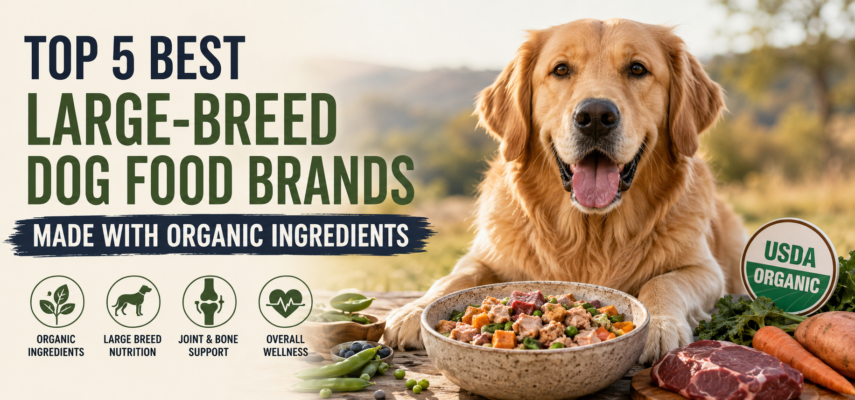

Large breed dogs face nutritional demands that smaller dogs simply don’t. Their joints, hearts, and digestive systems carry more weight and strain over a longer lifespan, which means the quality of what goes into their bowl matters even more.
Add organic ingredients to the equation, and the search for the right food gets even more specific. Owners want assurance that their 70-pound (or 100-pound) companion is getting whole, clean nutrition without pesticide residues, synthetic additives, or low-grade fillers.
This guide breaks down what large-breed owners should look for in organic dog food, then walks through five brands currently leading in this space.
What “Organic” and “Large Breed” Actually Mean on a Label
Not every “natural” or “premium” dog food is organic, and not every food marketed for large breeds is formulated any differently than a standard adult recipe. True organic pet food must meet USDA organic certification standards.
This means ingredients are grown without synthetic pesticides, artificial fertilizers, or GMOs, and the finished product is processed without artificial preservatives or colors. Look for the USDA organic seal or a specific certifying body named on the packaging rather than vague marketing language like “made with natural ingredients.”
Large breed formulations should also account for calcium-to-phosphorus ratios and controlled calorie density, both of which affect skeletal development and joint health over a dog’s lifetime. The Association of American Feed Control Officials (AAFCO) sets nutrient profiles specifically for large-size growth, and any large breed food worth considering should state compliance with that profile, not just a generic “all life stages” claim.
Our Top Picks for Large Breed Organic Dog Food
1. California Dog Kitchen
California Dog Kitchen makes gently cooked, human-grade dog food available at californiadogkitchen.com. The meals contain proteins, such as wild-hunted venison, wild-caught fish, Australian lamb, and GAP-certified organic chicken, and are cooked in the brand’s own commercial kitchen in San Diego. The food is formulated to meet AAFCO nutrient profiles for all life stages, including large-breed growth, which means it’s built with the specific needs of larger dogs in mind rather than scaled up from a standard adult recipe.
Key Features:
- Human-grade protein, gently cooked rather than extruded
- GAP-certified organic, USDA-certified ingredients
- Grain-free and chicken-free options for dogs with food sensitivities
- Frozen cube portioning system for precise, consistent feeding
Best For:
Large breed owners managing food allergies or sensitivities who want precise portion control without guesswork
Standout Quality:
California Dog Kitchen is one of a small number of pet food companies accepted into the Good Food Guild, a group that vets producers for transparent sourcing, high-quality and local ingredients, and a no-GMO standard. Combined with compostable packaging that breaks down within 180 days, it’s a brand built around sourcing accountability as much as it is about nutrition, which is increasingly rare in a category where “organic” can otherwise be used loosely.
2. The Farmer’s Dog
The Farmer’s Dog delivers fresh, gently cooked meals formulated by veterinary nutritionists and shipped frozen on a subscription basis. Portions are customized to each dog’s weight, age, and activity level through an online profile rather than a fixed bag size.
Key Features:
- Recipes developed with board-certified veterinary nutritionists
- Personalized portioning based on a detailed dog profile
- Pre-portioned packs that simplify daily feeding
- Subscription delivery with adjustable frequency
Best For:
Owners who want a fully customized feeding plan without manually portioning meals themselves
3. Open Farm
Open Farm built its reputation on ingredient traceability, offering lot codes that let owners trace each protein back to its source farm or fishery. Its Gently Cooked line uses a sous vide cooking method intended to retain more nutrients than higher-heat preparation.
Key Features:
- Certified Humane animal welfare standards for sourced proteins
- Ocean-friendly seafood sourcing
- Non-GMO ingredients across recipes
- B Corporation certified since 2018
Best For:
Owners who prioritize supply chain transparency and ethical sourcing as much as nutrition
4. Ollie
Ollie offers fresh, vet-formulated meals delivered on a subscription basis, with recipes built around named proteins like beef, chicken, and turkey. The brand emphasizes palatability testing alongside nutritional formulation.
Key Features:
- Vet-developed recipes with named, whole-food ingredients
- Customized portions based on a dog’s profile
- Recipes free of corn, wheat, and soy
- Frozen delivery with flexible subscription scheduling
Best For:
Owners feeding picky large breed dogs who need a food that’s both nutritionally complete and reliably appealing
5. JustFoodForDogs
JustFoodForDogs is known for its human-grade, vet-developed meals and is notable for publishing feeding-trial data on select recipes rather than relying solely on formulation analysis. The brand also offers a prescription diet line for dogs with diagnosed medical conditions.
Key Features:
- Published feeding-trial certificates on select recipes
- Human-grade sourcing standards
- Both fresh-frozen and shelf-stable “JustFresh” formats
- Veterinary-supervised therapeutic diet options
Best For:
Owners managing a diagnosed health condition who want a fresh option with veterinary backing
Tips for Transitioning a Large Breed Dog to Fresh Food
Switching a large breed dog to any new food, organic or otherwise, works best as a gradual process. This matters more for large breeds, whose digestive systems can be more sensitive to abrupt dietary changes given the sheer volume of food they process daily.
- Mix a small amount of the new food with the current diet, increasing the ratio over seven to ten days, as most veterinarians recommend.
- Watch stool quality and appetite throughout the transition.
- Weigh the diets, both fresh and cooked, using different methods and to different nutrient targets.
- Consider starting with a single-protein option, like organic chicken or lamb, before introducing variety, especially for dogs with existing allergies or sensitivities.
Final Thoughts
Choosing organic food for a large-breed dog comes down to a few consistent factors: verified certification rather than vague labeling, AAFCO compliance specific to large-breed needs, and ingredient sourcing you can actually trace.
Gently cooked options have gained ground for good reason, offering a middle path between the convenience of kibble and the nutrient retention associated with minimally processed meals.