The Bureau of Justice Statistics (BJS) reports that more than 90% of criminal convictions in both federal and state courts are obtained through guilty pleas. This means that only a small percentage of criminal cases proceed to jury trials where mistrials can occur.
Studies of U.S. criminal jury trials estimate that hung juries account for approximately 2% to 6% of jury trials, making them one of the most common reasons judges declare mistrials. But what is a mistrial in a criminal case?
Let’s learn why mistrials occur and what legal options you have to protect your rights throughout the criminal justice process.
Common Causes of Mistrials
Mistrials can occur for several different reasons, and the specific reason determines the double jeopardy analysis that follows.
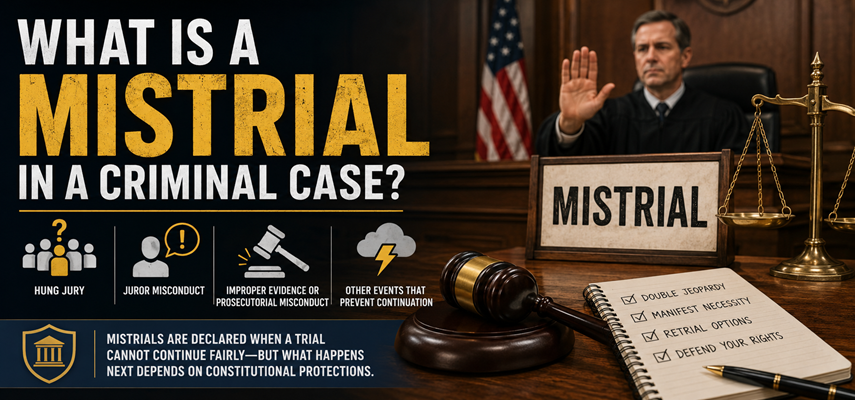
Hung Jury
A hung jury, where jurors can’t land on a unanimous verdict after long deliberations, is the usual reason for a mistrial. The judge often tells the jury to keep working and may give an Allen charge, also called a dynamite charge, which encourages jurors to make a genuine effort to reach an agreement. If more time is obviously not going to help, then the judge declares a mistrial, and the situation is done.
Juror Misconduct or Disqualification
Jurors can also cause a mistrial when they do their own research of the case. This includes contacting someone outside of the jury, discussing the case with other jurors before deliberation, or hiding bias during jury selection.
Courts usually would rather swap out a single troubling juror and move on with a substitute juror, if there is one. They usually declare a mistrial only when the misconduct might have infected the rest of the panel or when no alternate is available.
Improper Evidence or Prosecutorial Misconduct
If the jury gets to hear inadmissible evidence, or a witness drops some prejudicial comment, or the prosecutor makes an improper argument, then the judge has to judge it, like whether a curative instruction will do enough or if the whole exposure is so damaging that a warning can’t fix it. In really bad situations, a mistrial may be ordered even if the prosecution objects.
Other Events That Prevent Continuation
Things like a medical emergency that impacts a juror, a vital witness, or one of the parties; the death of a juror; a natural disaster; or any other situation that makes it impossible in practice for the trial to go forward in line with the law can support a mistrial under the idea of manifest necessity.
Manifest Necessity: The Constitutional Standard
When a mistrial is declared over the defendant’s objection, there’s a legal bar that has to be met; it’s called manifest necessity. This comes from the 1824 Supreme Court decision, United States v. Perez.
There, Justice Joseph Story essentially laid out that a court can excuse a jury if there’s a manifest necessity for the thing happening or the ends of public justice would otherwise be undercut or basically defeated. And this standard isn’t satisfied by mere inconvenience.
Courts also give real weight to what the trial judge decides. The Supreme Court said this clearly in Arizona v. Washington, 434 U.S. 497 (1978). As long as there’s support in the trial record for the mistrial decision, the trial judge doesn’t have to recite some special, exact phrase about manifest necessity.
Double Jeopardy and the Retrial Question
The Fifth Amendment’s Double Jeopardy Clause stops the government from trying somebody twice for the same offense once jeopardy has already been attached. In a jury trial, it attaches when the jury is sworn in, and in a bench trial, it attaches when the first witness is sworn.
The choice to take a case to a trial is one that should be made with careful consideration after a complete review of your entire case. The decision to choose between a bench trial or a jury trial can affect the outcome of your case, according to Georgetown theft lawyer Lytza Rojas.
For example, if someone is on trial for shoplifting or felony theft and the jury returns a not guilty verdict, that decision is final. Even if prosecutors later discover stronger evidence or believe the jury made the wrong decision, they generally cannot retry the defendant for the same theft offense.
In contrast to the other examples, however, a mistrial is a different situation when there is no decision at all. In case an individual faces the charges for burglary and theft, but the jury fails to reach consensus in terms of whether the individual is guilty or not guilty, the hung jury emerges.
The judge may decide to declare a mistrial, which means that the trial will be terminated without determining the issue in the case. In this case, the Double Jeopardy Clause is not applicable.
- Hung jury: Courts basically always treat a deadlocked jury as satisfying the manifest necessity requirement, so retrial is allowed and double jeopardy doesn’t really get triggered.
- Defense-requested mistrial: If the defendant asks for the mistrial, the law generally treats that as waiving double jeopardy protection. So the prosecution can retry. The important carve-out occurs when prosecutorial behavior deliberately aims to provoke the defendant into requesting a mistrial, which courts describe under the goading standard.
- Prosecution-requested mistrial, even though the defendant objects: Here, the government has to show manifest necessity. If it can not, a retrial may be barred. And the bar is tougher for the prosecution than it is in situations beyond either side’s control.
- Prosecutorial misconduct: When the government’s own intentional misconduct was what caused the mistrial, retrial can be barred too, even without a formal acquittal, based on the idea that the defendant shouldn’t face repeated prosecutions for the same charge.
Strategic Considerations After a Mistrial
From the prosecution’s perspective, a mistrial after a hung jury means the government has seen the entire defense case, sat through the cross-examination playbook, and somehow spotted the weak seam in its own evidence.
From the defense’s perspective, a hung jury is not really a defeat. It basically says at least one juror, and often several, wasn’t persuaded past a reasonable doubt by the government’s presentation.
And whether the prosecution decides to retry depends on what’s left that’s persuasive, the expense of a second attempt, and if the witness situation has shifted. High-profile matters are almost always retried. Lower-profile matters are more often handled through a plea arrangement that gets negotiated during the stretch between the mistrial and the retrial date.
The Transcript as the Constitutional Map
The mistrial record matters a lot. The reasons laid out by the judge, the objections that defense counsel preserved, and the conduct that got documented in the transcript all become the evidentiary backbone for any later double jeopardy claim.
A defendant who doesn’t object to a mistrial declaration on double jeopardy grounds might end up waiving the argument completely.
The Cornell Law School annotated Fifth Amendment resource gives a detailed breakdown of the Supreme Court double jeopardy case law, especially as it relates to mistrials. The push-pull between manifest necessity, prosecutorial behavior, and constitutional protection makes this area technically demanding more than most people expect in criminal procedure.