










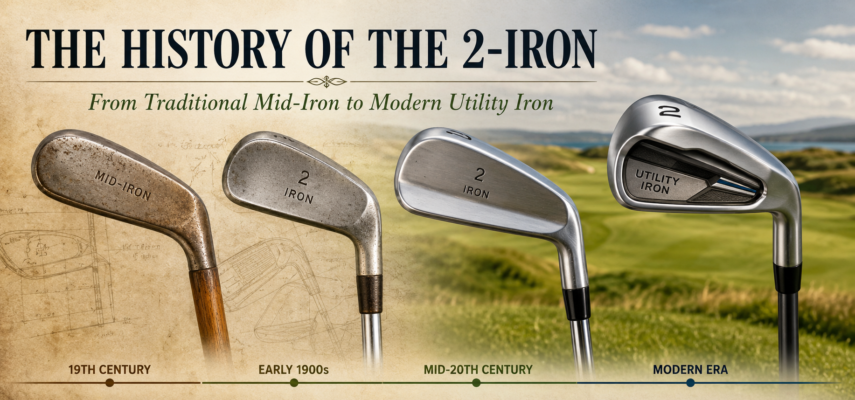
Few golf clubs have experienced a transformation quite like the 2-iron.
For much of the 20th century, the 2-iron was a standard component of a serious golfer’s set. It was used from tees, fairways and occasionally difficult lies, offering a penetrating flight that could run for considerable distance after landing. In the hands of a skilled player, it was one of the most precise long-distance clubs in the bag.
In the hands of almost everyone else, it was intimidating.
With its long shaft, small clubface and low loft, the traditional 2-iron demanded speed, precision and confidence. A well-struck shot could be spectacular. A poorly struck shot often traveled low, short and painfully through the golfer’s hands.
The conventional 2-iron has now largely disappeared from recreational golf. Hybrids, high-lofted fairway woods and hollow-bodied utility irons have taken its place. Yet the club’s essential purpose has survived. The modern driving iron is, in many respects, the 2-iron reinvented for a new generation.
Before the 2-Iron Had a Number
Golf clubs were not originally organized into the numbered sets familiar to modern players. Early golfers selected clubs with descriptive names based on their construction or intended use.
Among the long irons were clubs known as cleeks, driving cleeks, driving irons and mid-irons. These clubs generally featured narrow iron heads, wooden shafts and relatively little loft. They were designed to produce long, low shots from firm turf.
The club most closely associated with the later 2-iron was the mid-iron. It carried more loft than the driving iron but less than the mid-mashie. As manufacturers gradually adopted numbered sets, the mid-iron became broadly associated with the No. 2 iron.
These comparisons are approximate rather than exact. Early clubs were handmade, and lofts, shaft lengths and head shapes varied considerably. A 19th-century mid-iron did not necessarily perform like a modern 2-iron. Nevertheless, the two clubs occupied a similar position: each was a long, low-lofted iron intended to advance the ball significant distances.
The Arrival of Numbered Iron Sets
During the early decades of the 20th century, golf equipment became increasingly standardized. Mass production allowed manufacturers to offer coordinated sets rather than collections of individually named clubs.
The older language of cleeks, mashies and niblicks gradually gave way to the simpler numbered system. By the late 1920s, contemporary observers were already noting the disappearance of many traditional club names as golfers increasingly referred to irons by number.
This change was more than a matter of terminology. Numbered sets helped establish predictable distance gaps. A golfer could expect the 2-iron to fly farther and lower than the 3-iron, while the 3-iron would travel farther than the 4-iron.
The 2-iron settled near the top of the iron set, usually behind the even more demanding 1-iron. It became the longest iron many golfers could realistically consider using from the fairway.
Steel Shafts Change the Long Iron
The introduction of steel shafts accelerated the standardization of golf clubs.
Hickory shafts differed naturally in weight, stiffness and flexibility. Steel could be manufactured more consistently, allowing companies to produce iron sets with more uniform performance from one club to the next.
The United States Golf Association permitted steel shafts in 1924, while the R&A followed in 1929. By the 1930s, steel-shafted clubs were entering mass production and beginning to replace hickory throughout the game.
For the 2-iron, this consistency was especially valuable. Long irons magnify small errors in timing and contact. A more predictable shaft gave accomplished players greater confidence when attempting long shots or using the club from the tee.
Steel did not make the 2-iron easy, however. The club still required a fast swing and accurate strike to launch the ball properly.
What Made the Traditional 2-Iron So Difficult?
A traditional 2-iron combined several demanding characteristics.
Its shaft was longer than those of the middle and short irons. Its face had relatively little loft. Its blade was compact, and its center of gravity was not designed to provide much assistance on shots struck away from the center.
Low loft reduces the vertical component of launch. Unless the golfer generates enough clubhead speed and strikes the ball solidly, the shot may fail to climb into the air.
The long shaft also makes it harder to return the clubface squarely to the ball. Meanwhile, the small head and limited perimeter weighting provide little protection when contact occurs toward the heel or toe.
This combination produced one of golf’s clearest equipment divisions. Skilled players valued the 2-iron for control and predictability. Average golfers often found that it produced little more distance than a better-struck 3- or 4-iron.
The 2-Iron’s Golden Age
From the middle of the 20th century through the 1980s and 1990s, the 2-iron remained common in complete iron sets and professional golf bags.
Its primary attraction was control.
A wooden driver or fairway wood could produce more distance, but those clubs also generated a higher flight and more curvature. The 2-iron offered a narrower profile and a flatter trajectory. On tight holes, firm fairways or windy courses, it could function as a reliable alternative to a wood.
The club was particularly valuable in links golf. A low shot launched beneath the wind could land short of the target and use the ground to gain additional distance. On dry turf, a 2-iron could produce substantial rollout.
It could also be used as an escape club. Players sometimes selected it to hit low shots beneath tree branches or to advance the ball from firm, relatively clean lies.
The 2-iron therefore became associated with accomplished ball-striking. Carrying one suggested that a golfer possessed both the speed and confidence required to use it.
Cavity-Back Irons Offer Some Help
The development of perimeter-weighted and cavity-back irons made the iron category more forgiving.
Instead of concentrating most of the clubhead’s mass directly behind a small central impact area, designers moved weight toward the perimeter. This increased the head’s resistance to twisting when the ball was struck away from the center.
Ping helped popularize cavity-back construction during the second half of the 20th century, and the concept eventually spread throughout the industry.
The technology improved the 2-iron, but it could not eliminate the fundamental challenge created by low loft. A more stable head could preserve ball speed on imperfect contact, yet the golfer still needed sufficient speed to launch the shot.
For many players, the club remained difficult despite the added forgiveness.
The Hybrid Begins the 2-Iron’s Decline
The most serious threat to the 2-iron came from an entirely different style of club.
Hybrids combined characteristics of irons and fairway woods. Their wider soles, deeper centers of gravity and larger heads helped golfers launch the ball more easily. They also performed better from rough and imperfect lies.
A hybrid could occupy approximately the same distance slot as a 2-iron while demanding less precise contact. For recreational golfers, the tradeoff was compelling.
Fairway woods also became more forgiving. Improvements in metal construction, weighting and graphite shafts made higher-lofted woods easier to launch from the fairway. Golfers who once carried a 2-iron could instead choose a 5-wood or 7-wood.
As these alternatives improved, manufacturers began removing 2-irons from standard retail sets. Iron packages that had once started with the 2- or 3-iron increasingly began with the 4-, 5- or even 6-iron.
The 2-iron became a specialty purchase rather than an automatic part of the set.
Stronger Lofts Complicate the Story
Modern iron lofts make historical comparisons difficult.
Over time, many manufacturers reduced the lofts of numbered irons to produce greater distance. A contemporary game-improvement 4-iron may have a loft similar to that of a more traditionally designed 2- or 3-iron.
The number stamped on the sole therefore no longer provides a universal measure of loft. Modern iron designs use lower centers of gravity, flexible faces and internal weighting to help stronger-lofted clubs launch effectively.
This means the traditional 2-iron has not disappeared entirely in a functional sense. Some of its loft and distance characteristics have migrated into clubs carrying higher numbers.
Even so, a modern strong-lofted 4-iron is generally designed to be more forgiving than the thin-bladed 2-irons of previous eras.
The 2-Iron Returns as a Utility Iron
Although conventional 2-irons became rare, the club’s role remained useful—especially for strong players seeking an accurate option from the tee.
Manufacturers responded by developing the modern utility iron, also commonly called a driving iron.
These clubs often carry lofts associated with traditional 2-irons, but their construction is considerably more sophisticated. Many feature hollow bodies, thin faces, internal tungsten weights and graphite or lightweight steel shafts. The head may resemble an iron at address while containing technology more commonly associated with metal woods.
The objective is to preserve the traditional 2-iron’s strengths while reducing its weaknesses.
A modern utility iron can produce a penetrating flight and relatively low spin, making it attractive in windy conditions or on holes where accuracy matters more than maximum distance. Compared with a hybrid, it may offer a flatter trajectory and less tendency to curve dramatically. Compared with a traditional blade 2-iron, it provides substantially more help with launch and off-center strikes.
In effect, manufacturers did not eliminate the 2-iron. They rebuilt it.
Why Skilled Players Still Use One
The modern 2-iron remains a specialized club rather than a universal recommendation.
Players with high swing speeds may use it as a tee club on narrow par fours. The lower flight can provide control in wind, while the iron-like face may allow an accomplished golfer to shape the ball more deliberately than with a hybrid.
Some players also prefer the visual appearance of an iron. A compact head positioned behind the ball can inspire more confidence than a rounded hybrid.
Course conditions matter as well. A utility 2-iron can be especially effective on firm ground, where a low shot can land and run. On soft courses, however, the same trajectory may be less useful because the ball receives little assistance after landing.
The club is therefore best understood as a strategic tool. It is not automatically better than a hybrid or fairway wood. It simply creates a different flight.
Why Most Golfers Should Choose Something Else
For the majority of recreational players, a hybrid or fairway wood remains the more practical option.
Golfers with moderate swing speeds may struggle to generate enough launch and carry with a 2-iron. A hybrid’s deeper center of gravity can help elevate the ball, while its wider sole generally performs better from rough.
A fairway wood may launch even higher and provide more stopping power on long approach shots.
The correct choice depends on the shot a golfer needs. Someone seeking a low-running tee club may benefit from a utility iron. Someone trying to carry hazards or hold distant greens will often perform better with a hybrid or wood.
That distinction explains both the disappearance and survival of the 2-iron. It vanished from standard sets because it was not the easiest solution for most golfers. It survived as a specialty club because, under the right conditions, it still produces a valuable shot.
The Legacy of the 2-Iron
The history of the 2-iron reflects the broader history of golf equipment.
It began as the successor to the old mid-iron, became standardized as numbered sets replaced traditional club names and reached prominence during the era of steel-shafted blades. It later benefited from cavity-back construction but eventually lost its place to hybrids and increasingly forgiving fairway woods.
Today, the traditional 2-iron is rarely seen in an average golfer’s bag. Its modern descendant, however, remains very much alive.
The utility iron carries forward the same fundamental idea: provide long distance with the accuracy, appearance and penetrating flight of an iron. Modern materials have made that idea more accessible, but they have not changed its essential character.
The 2-iron was never designed to make golf easy. It was designed to produce a particular shot—and to reward the golfer capable of executing it.
That demanding identity is precisely why the club became nearly obsolete.
It is also why it never disappeared completely.












