










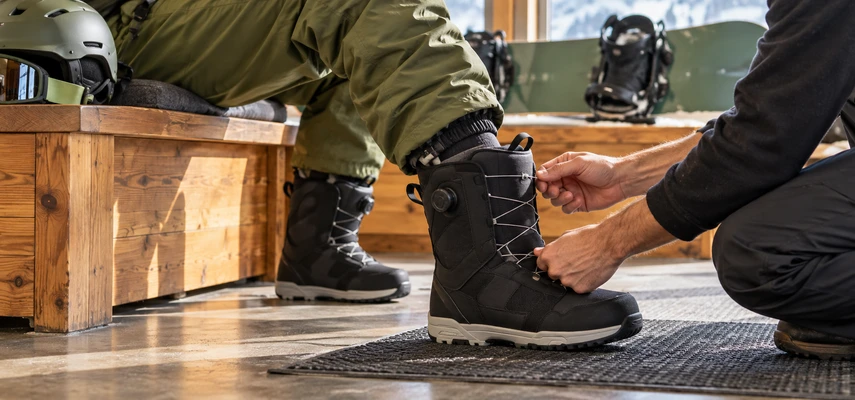

The snowboard gets the glamorous job in the shop window. The boots do the quiet work of determining whether you can feel your feet and communicate with the board. For a beginner, that’s a useful clue about where to put your attention.
You need equipment that fits, works together and suits the conditions. You don’t need to arrive with a specialist’s collection or buy your way past the learning stage. A sensible first setup can be rented, and some clothing may already be in your cupboard.
The gear falls into three practical groups: the board-and-boot system that lets you ride, clothing that manages moisture and temperature, and protective equipment that helps reduce consequences without eliminating risk. Think about the connections between those groups. Excellent goggles won’t rescue a painful boot fit, and a premium board won’t waterproof ordinary trousers.
Boots come before board graphics
Snowboard boots connect your body’s movements to the bindings. In a typical recreational setup, they flex differently from rigid alpine ski boots and support the foot and lower leg through an outer shell and liner. They need to hold you securely while allowing the intended movement.
A fit that feels spacious like a loose slipper can allow unwanted movement inside the boot. A fit that produces painful pressure or persistent numbness isn’t a badge of commitment. Tell the fitter exactly what you feel and when it happens. Fit problems are easier to address before you reach the lesson area.
REI’s snowboard boot guide discusses fit, flex and closure systems. Different laces, quick-pull systems and dials are ways of securing the boot, not substitutes for the right shape and size. More tightening can’t make every unsuitable boot appropriate.
Wear a suitable pair of socks while fitting. Avoid stacking thick socks to fill space, and keep fabric folds out of pressure areas. If you use a footbed or have a known fitting issue, discuss it with qualified staff. Guessing based only on street-shoe size leaves too much unexplored.
The snowboard should suit your body and current task
Board length, width, flex, shape and profile interact. For a beginner, the goal is a setup that allows appropriate learning movements, not one chosen for the terrain you hope to ride several seasons from now. A demanding specialist board may add resistance to an already unfamiliar task.
Manufacturer rider-weight guidance is useful when choosing sizes. Boot size and the board’s width also matter: excessive boot overhang can lead to contact with the snow when the board tilts. Height alone doesn’t settle the question, and a chin-level rule isn’t a complete fitting process.
Tell rental staff you’re a first-timer or describe your actual skills. Give accurate information and let them explain their choice. If buying later, use what you learned from rentals and lessons to ask better questions. Your first equipment experience is research, not an obligation to purchase its most expensive version.
A suitable board needs a serviceable base and edges. Obvious damage, loose parts or uncertainty about its condition deserve professional attention. A friend’s spare board may be perfectly useful, but free equipment still needs to fit you and function correctly.
Ask the rental shop how to report a problem during the day and whether equipment adjustments require returning to that location. Knowing where help is available matters when a boot begins to rub or a binding seems unfamiliar. Keep the rental agreement accessible and understand the return arrangements; a manageable equipment problem shouldn’t become an afternoon spent searching for the right counter.
Bindings have to match the rest of the system
Bindings secure boots to the board and transmit movements. On common strap models, the straps and highback support the boot in particular ways. Other systems use different attachment mechanisms. The required boot compatibility can be specific, especially with step-in-style systems.
Board mounting patterns and binding interfaces must also be compatible. REI’s binding guide explains the main fitting and mounting considerations. The fact that two products are both called snowboard equipment doesn’t prove they connect correctly.
For a rental, ask staff to set up the bindings and demonstrate securing and releasing them. Make sure you can repeat the operation. If something doesn’t latch, seems loose or requires unexplained force, stop and ask. Cold fingers are a poor environment for improvising a mechanical solution.
Follow manufacturer instructions and the venue’s equipment-retention requirements. Keep the board controlled when it’s unattached. Compatibility and proper operation are safety questions, not simply shopping preferences.
Dress for moisture moving in both directions
Snow can wet clothing from outside. Exercise creates moisture from inside. Useful clothing has to manage both, which is why a large warm coat isn’t the entire solution.
A base layer next to your skin helps manage perspiration. An insulating layer adds warmth, and an outer layer helps protect against wind and precipitation. The exact combination depends on weather, activity and your needs. Adjustable layers let you respond when practice heats you up and waiting cools you down.
REI’s snow-sports clothing guide explains the roles of these layers. Suitable general outdoor clothing can work for an initial outing, provided it offers the necessary protection. You don’t need every pocket or decorative zipper associated with snowboard-specific clothing.
Pants or bibs deserve particular attention because beginners spend time sitting or kneeling. Check whether the garment resists snow and moisture and allows comfortable movement. Ordinary jeans absorb moisture and can become an unpleasant companion to repeated snow contact.
Hands, eyes and the spaces between layers
Gloves or mittens should protect against the conditions while allowing you to operate equipment. Mittens often prioritize warmth; gloves offer separate fingers for handling tasks. Actual performance depends on construction, fit and weather rather than the category name alone.
Goggles help protect your eyes from wind, snow and bright light. Choose an appropriate lens for expected visibility and make sure the frame works with your helmet. A combination that pinches, creates an awkward gap or obstructs vision deserves another fitting attempt.
Pay attention to cuffs and overlaps. Snow entering between a glove and sleeve can make good individual garments perform badly as a system. A comfortable neck covering can help in cold weather, but avoid anything that interferes with breathing, visibility or equipment.
Protective equipment helps, with limits
Wear a properly fitted helmet intended for skiing or snowboarding and follow its manufacturer’s instructions. Check its condition and compatibility with goggles. A helmet isn’t useful merely because it can be balanced somewhere on top of your head.
The CDC’s snowboard helmet guidance explains that helmets can help protect against serious head injury but aren’t concussion-proof. The guide is written for children and teens; adults also need appropriate sport-specific fit and use, following relevant manufacturer guidance.
Ask a qualified fitter or instructor about snowboard-appropriate wrist guards and other protection that may suit you. Guards need to fit with gloves and should be used as directed. They don’t make all falls harmless or remove the need to learn suitable movement and falling practices with an instructor.
Impact shorts and other padding may appeal to some learners. Treat comfort, compatibility and intended use as real considerations rather than assuming more equipment always means more protection. You still need to choose terrain and speed that you can manage.
Rent, borrow or buy?
Renting is useful when you don’t yet know your preferences or how often you’ll ride. Ask precisely what is included: board, boots and bindings may come together, while a helmet or clothing may be separate. Confirm sizes and availability when arranging the lesson rather than assuming the package covers every item.
Borrowing can reduce the initial outlay, but check the same fit and compatibility questions. A board sized for a much larger friend doesn’t become beginner-friendly because the loan is generous. Have a qualified technician inspect and adjust unfamiliar equipment where needed.
Buying makes more sense when you can describe what problem the purchase solves. Boots might address fit; outerwear might address repeated wetness; a board might suit the riding you’ve learned to enjoy. These are stronger reasons than wanting to look finished before you’ve begun.
For used gear, condition and history matter. Ask about damage and modifications, verify compatibility and be especially careful with protective equipment whose impact history isn’t known. If you can’t establish whether an item is suitable, saving money isn’t the same as solving the need.
The small items that keep the day working
Bring sunscreen, a way to stay hydrated and access to suitable food. Keep necessary medication accessible according to your needs. Carry a charged phone and know how to contact mountain assistance, while recognizing that reception and battery performance aren’t guaranteed.
Secure loose items and follow the venue’s ticket or pass instructions. A pocket arrangement that seemed clever at home may put a hard object somewhere uncomfortable during a fall. Think about what you’re carrying and where it sits against your body.
Before leaving the fitting area, check that boots are comfortable, bindings work, the helmet fits and clothing allows you to bend and move. Ask about anything you don’t understand. The most useful beginner gear is a connected system that lets you pay attention to the lesson instead of spending the morning negotiating with your belongings.











